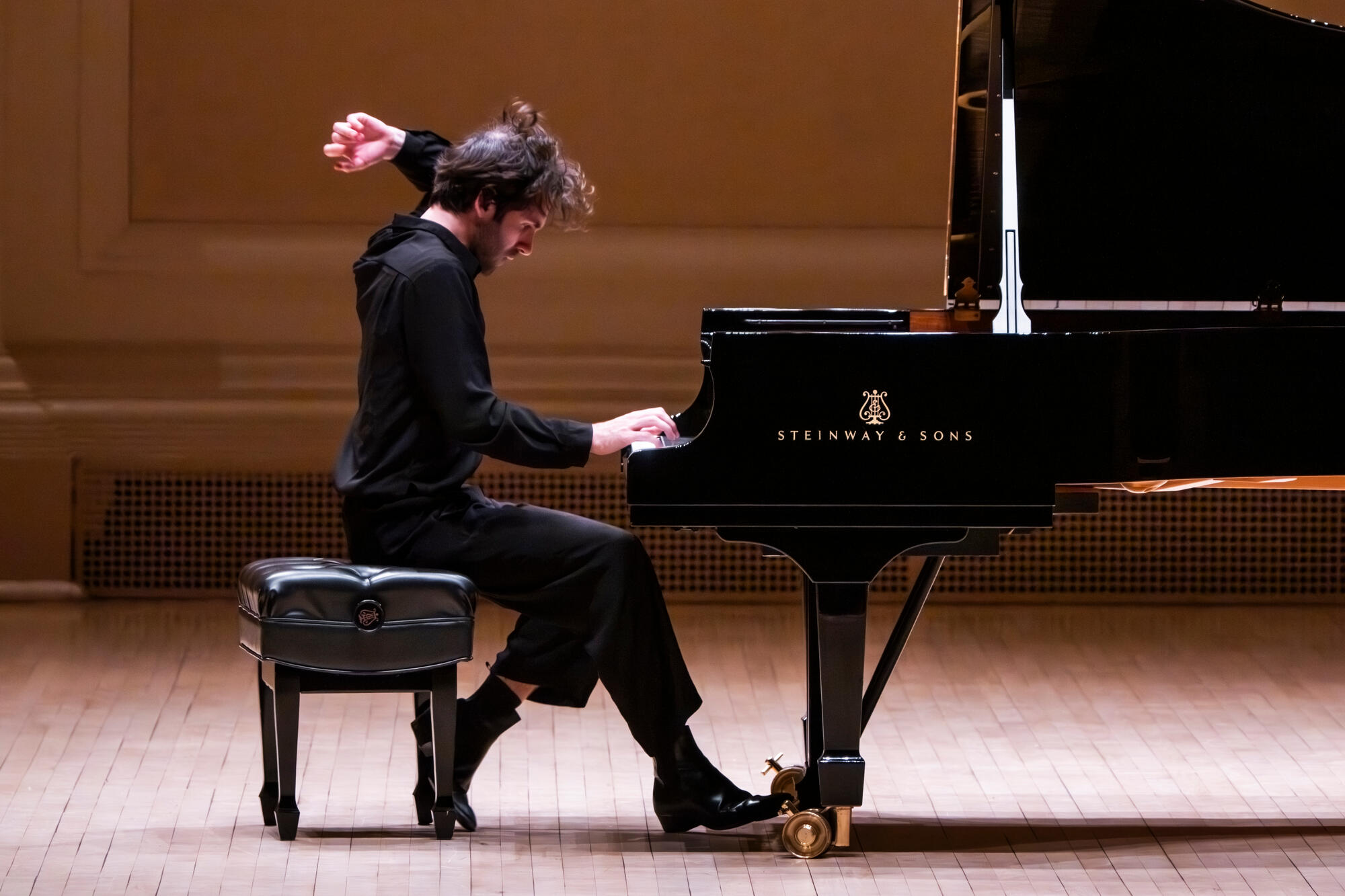
Prokofiev wrote a set of piano miniatures called Visions fugitives. On Tuesday night, Alexandre Kantorow played a program of “visions,” or visionary music, whether it was fugitive or not. Kantorow is a pianist, and his program was at Carnegie Hall.
In the summer of 2024, he played at the Salzburg Festival, and I noted the following, in my review:
He was born in France, in 1997. He won the Tchaikovsky Competition, in Moscow, in 2019. It would be hard to imagine the competition he would not win.
At Carnegie Hall, Kantorow opened with Liszt—some awkwardly titled Liszt: Variations on the Theme “Weinen, Klagen, Sorgen, Zagen” (after J. S. Bach), S. 180. Those German words mean “weeping, wailing, mourning, trembling.”
Liszt wrote this piece upon the death of his daughter Blandine. It is an outpouring of grief, among other things. It is a mystical combination of the Baroque and the Romantic—the furiously Romantic.
Kantorow began the piece with authority. He had total authority, of mind and fingers. This quality was present throughout the evening: authority. Liszt’s music had power, electricity, and grandeur. It also had the right “poetic” elements.
At intermission, a pianist friend would tell me, “You felt you were in the presence of Liszt himself.” I fully agreed.
Speaking of piano wizards: Vladimir Horowitz once said, in his special English, “Why nobody plays Medtner? He is wonderful composer. Piano composer—in some ways deeper than Rachmaninoff.”
Several pianists play Medtner today. These include Marc-André Hamelin, Daniil Trifonov—and Alexandre Kantorow, who on Tuesday night played Medtner’s Sonata in F minor, Op. 5.
Kantorow showed himself an excellent pedaler and colorist. He was attentive to all voices in the music. There is yearning in this sonata, and Kantorow caught that. I believe Nikolai Medtner himself would have been pleased.
The second half of the recital began with three fairly short pieces—the first of them by Chopin, his Prelude in C-sharp minor, Op. 45. Kantorow obeyed the musical line. He gave a demonstration of “horizontality” in piano playing. You could not really see, or hear, hammers going up and down.
He then played a piece by Charles-Valentin Alkan—best known for big pieces, not short ones: the Symphony for Solo Piano and the Concerto for Solo Piano. Both of these have been championed by Hamelin.
Kantorow played a piece that had never been played in Carnegie Hall before: “La chanson de la folle au bord de la mer” (“The Song of the Madwoman on the Shore”). From these hands, it was hypnotic.
If you’re going to play “visions,” or the visionary, you should probably play Scriabin—and Kantorow did, in the form of Vers la flamme (“Toward the Flame”). This piece is invariably described as “apocalyptic.” It was played by Horowitz, throughout his career.
Kantorow, let’s say, knows what to do with it.
He ended his program with a Beethoven sonata: the last one, Op. 111, in C minor. Thus did Kantorow go back, chronologically. And you should really play nothing after Op. 111: it is a last word, so to speak.
That Kantorow played this sonata well—with understanding and earnestness and technical facility—goes without saying. The Arietta, however, did not achieve transcendence, at least for me. But transcendence may be asking for a lot.
And Kantorow did some angelic playing in C major, that (often) angelic key. And he showed us some first-class trilling.
When I was growing up, way back in the previous century, there was a rule: no encore after Op. 111. No music is possible after that “last word.” But that was then, and there was no chance Kantorow wouldn’t play an encore.
He played my least favorite Liszt transcription: the transcription of the Liebestod, from Wagner’s Tristan und Isolde. I find the tremolos, and some other things, schlocky and infra dig. But Kantorow was as beautiful and dignified as possible.
Will he, one day, enter the pianistic pantheon? How could you bet against it?