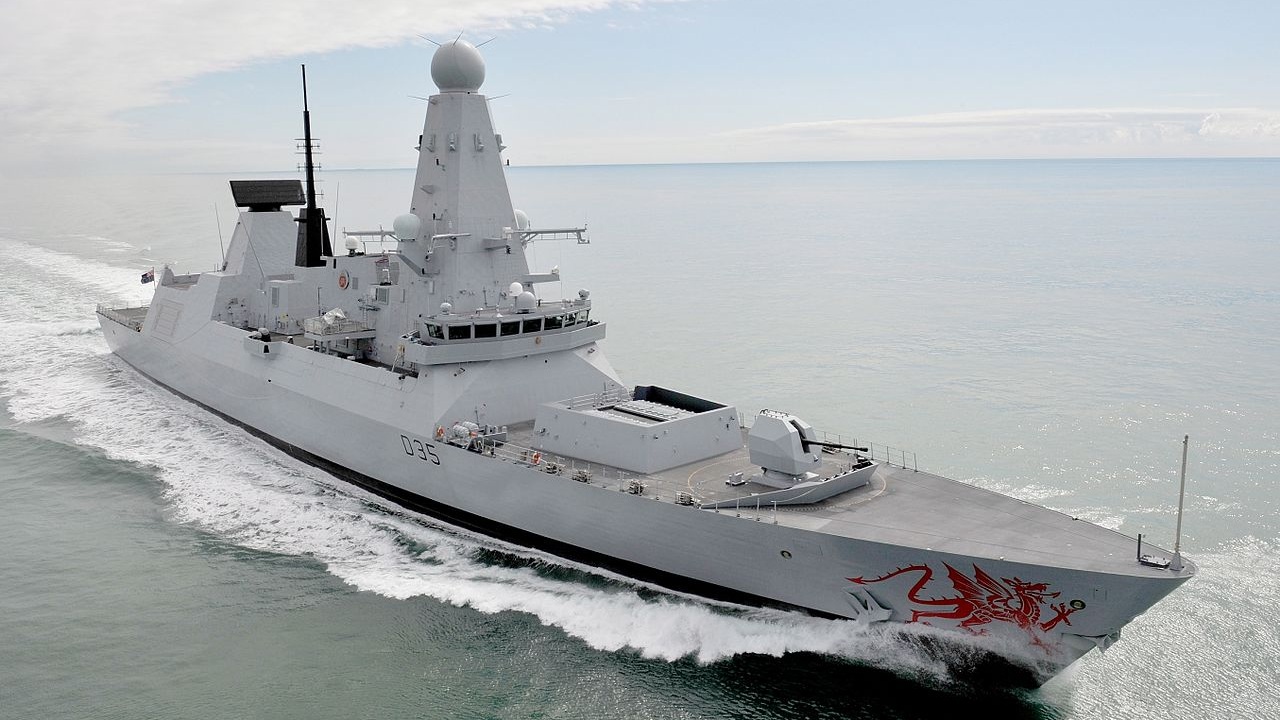
HMS Dragon was dispatched to the Eastern Mediterranean with only a few days’ notice, rather than the usual weeks. The results have been disappointing, if predictable.
The Royal Navy’s Type 45 Daring-class guided-missile destroyer HMS Dragon (D35) was the best that the British military could offer in response to Operation Epic Fury, the ongoing conflict in the Middle East.
This week, it became apparent that the best wasn’t good enough.
“HMS Dragon is undertaking a routine logistics stop and a short maintenance period in the eastern Mediterranean, allowing the ship to take on board provisions, optimise systems and conduct maintenance,” the UK’s Ministry of Defence announced this week, The Independent reported.
“HMS Dragon will remain at a very high level of readiness during this period, able to sail at short notice if required,” the MoD added—seemingly attempting to project confidence in the UK’s senior service. “The UK continues to maintain a robust and layered defensive presence in the eastern Mediterranean, working in coordination with allies.”
The Dragon’s Rushed Deployment Didn’t Help Its Readiness
The Type 45 guided-missile destroyer was deployed on March 10 to the Mediterranean to bolster the security around the Royal Air Force (RAF) Akrotiri base on Cyprus, after the island came under Iranian drone attack following the start of the US military’s Operation Epic Fury.
Even then, it served as a sad reminder that the Royal Navy has few options available. Neither of the service’s two conventionally powered aircraft carriers could head to the region, leaving HMS Dragon as the only vessel that could be dispatched, yet even that took some serious effort.
The destroyer was rushed to sea, with the crew completing pre-deployment work in six days that should have taken several weeks. Instead of highlighting that the Royal Navy could step up when needed, its best and only option has fallen short, as the warship was forced to head to port earlier this week due to technical issues with its water systems.
There is speculation that “rushed” may have meant things weren’t done as well as they could have been, and HMS Dragon may have needed some extra time to prepare for the mission.
“The fact that they have some defects, fine. All ships do. That’s part of the game,” Commodore (Ret’d) Steve Prest told BFBS’s Sitrep podcast.
“The worry for the operational commanders will be how many of those risks they’re carrying in total,” Prest added. “I suspect in the case of HMS Dragon, the fact that she came out of dock so quickly and was generated for operations at extraordinary speed – for which I think the commanding officer of the ship’s company and all the elements that supported them should be commended – they will have carried some risk.”
The Type 45 Destroyer’s Specifications
- Year Introduced: 2009
- Number Built: 6
- Displacement: 7,500 tonnes
- Length: 152.4 m (500 ft)
- Beam: 21.2 m (69 ft 7 in)
- Propulsion: Two Rolls-Royce WR-21 gas turbines
- Speed: 32 knots (36.8 mph, 59.2 km/h)
- Range: 7,000 nmi (8,055 mi, 12,964 km)
- Armament:
- “Sea Viper” Principal Anti-Air Missile System (PAAMS):
- One 48-cell Sylver A50 Vertical Launching System (VLS), equipped for
- Aster 15 short-range missiles
- Aster 30 medium-range missiles
- Two Mk. 141 quad missile launcher for up to 8 x RGM-84 Harpoon SSM
- One BAE Mark 8 Mod.1 gun
- Two DS30B Mk 1 30mm machine guns
- Two M134 six-barreled machine guns (minigun)
- Two Mk 15 Phalanx Close-in Weapons Systems (CIWS)
- Crew: 191, accommodating up to 285
HMS Dragon is one of the Royal Navy’s six Daring-class Type 45 guided-missile destroyers, considered among the most capable warships in the fleet.
The Type 45’s key capabilities are built around its air defenses, notably the Sea Viper Principal Anti-Air Missile System (PAAMS), which can simultaneously track and destroy multiple aerial threats, including supersonic missiles. The Sea Viper can engage multiple targets and launch eight missiles in under 10 seconds.
About the Author: Peter Suciu
Peter Suciu has contributed to dozens of newspapers, magazines and websites over a 30-year career in journalism. He regularly writes about military hardware, firearms history, cybersecurity, politics, and international affairs. Peter is also a contributing writer for Forbes and Clearance Jobs. He is based in Michigan. You can follow him on Twitter: @PeterSuciu. You can email the author: [email protected].