Editor’s note: This essay was delivered as an address on Saturday, March 21, 2026, at the Symposium on Transforming Culture, Benedictine College, Atchison, KS.
“The hand that rocks the cradle”, “The power behind the throne”—both of these sayings reveal the influence of women on culture. But there are good mothers and neglectful ones, great queens like Esther and wicked ones like Jezebel.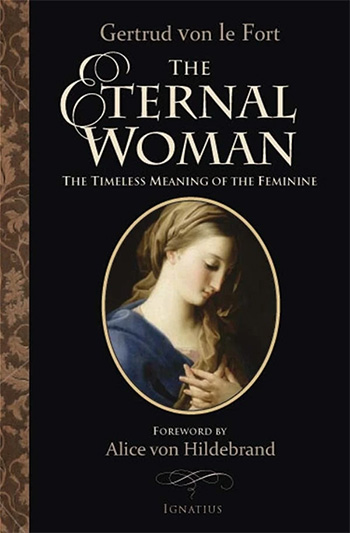
Where lies the difference?
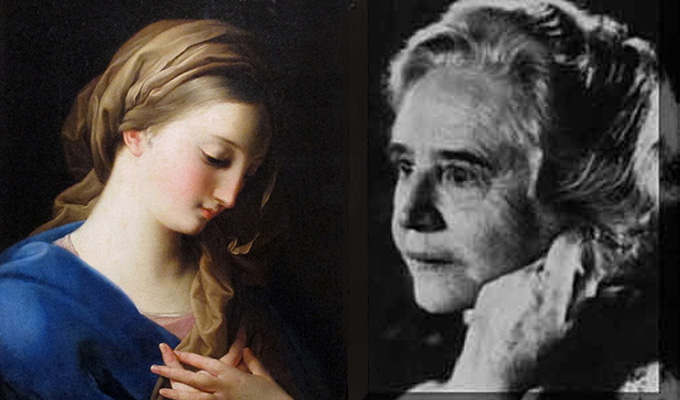
In her work The Eternal Woman (Ignatius Press, 2010, hereafter EW), the twentieth-century German author Gertrud von le Fort explains the metaphysical meaning of woman: She represents the human creature, male and female, surrendered to the Creator as his willing, fruitful coworker. The invisible beauty of the human soul in loving union with God is made visible in the virgin, the bride, and the mother, and these symbols are realized in the highest degree in God’s greatest creature of all: Mary. Her humble fiat is the key to understanding the beauty of being a creature in right relation with the Creator and, therefore, a good influence on culture.
Creation and cooperation
Let’s start at the beginning—at creation. The pinnacle of God’s handiwork is the human being—male and female. Unlike any of the other creatures on earth, men and women have minds and wills so that they can freely participate in the work of creation. God’s first command to them is “Be fruitful and multiply, and fill the earth and subdue it” (Gen 1:28). To do this requires the cooperation of man and woman, with God and with one another.
We know what happens next. The serpent deceives Eve. He tells her that God lied about the forbidden fruit. She will not die if she eats it, but will become wise like God, in other words, no longer dependent on him. Eve seizes the fruit and tempts Adam to do likewise. The accord between mankind and God, and between male and female, is broken, and death enters the world. We call this the fall of man, but le Fort makes a key clarification: “Creation fell in its womanly substance, for it fell in its religious sense” (EW, p. 13).
What does she mean by this?
For le Fort, woman represents mankind’s religious response to God, in other words, the choice to cooperate with God or not. Both men and women are, in a symbolic sense, female before God. He initiates and gives; we receive with humility, gratitude, and obedience . . . or not. We see this symbolism in the Old Testament, where God is not only the Creator, but the Lover pursuing his human beloved. God “marries” his people by making a covenant with them, and their idolatry is adultery. This symbolic language has been taken up by the Church, who understands herself as the Bride of Christ. Jesus is the Bridegroom, who lays down his life for his Bride and unites himself to her through the sacraments, thus making her the Mother of redeemed mankind.
The imagery is also seen in the Church’s Marian dogma, which applies not only to Mary but to all of us. Mary stands for “the creature in its totality”: she “represents at the same time both man and woman” (EW, p. 5). The Immaculate Conception reveals the human being in his unfallen state. In the Annunciation, we see the human being redeemed through cooperation with God. “In the humble fiat,” writes le Fort, “lies the mystery of redemption insofar as it depends upon the creature. For his redemption, man has nothing to contribute to God other than the readiness of unconditional surrender” (EW, p. 9).
Woman bears the sign of human cooperation with God, whether she listens to him or not. Indeed, whenever woman refuses God’s entry into the world, the sign becomes evident through the results. “If the sign of the woman is ‘Be it done unto me’, which means the readiness to conceive or . . . the will to be blessed, then there is always misery when the woman no longer wills to conceive, no longer desires to be blessed” (EW, p. 15).
Le Fort is quick to add that “this does not apply only in a biological sense”. She speaks at length about the spiritual motherhood of women who care for those who are not their offspring—as teachers, nurses, doctors, religious sisters, adoptive mothers, and so on. She also describes the mothering of nations by queens, the birthing of religious communities by saints, and the nurturing of cultures by muses, artists, and patrons of the arts. “It is not a matter of the destiny of the individual woman, but of her participation in the universal destiny of woman” (EW, p. 85). Whatever a woman undertakes in cooperation with God is the “working out” of her “motherliness” (EW, p. 87). Edith Stein wrote about the vocations of women in a similar way, and the theme was echoed by Pope John Paul II in his use of the expression “feminine genius”.
Though the sign of human cooperation with God has been entrusted to woman, and to Mary in particular, men must also be receptive to God in order to participate in creation and redemption. “Creative power can only be received,” writes le Fort, “and the man also must conceive the creative spirit in the sign of Mary, in humility and surrender, or he will not receive at all” (EW, p. 18). Thus, we see the mark of virgin, bride, and mother fall upon the man too:
Man as virgin: “The man also values virginity as adding help and intensity to the pursuit of his highest achievement. This is the meaning of the well-known counsel that priests . . . , in fact all whose duty is to devote their lives fully to a certain cause, should remain unmarried” (EW, p. 25)
Man as bride: “The mystery of Pentecost reveals man in an attitude of womanly acceptance” (EW, p. 11).
Man as mother: “Thus in the really heroic manifestations of manhood the strong strain of motherly compassion appears, but under a masculine aspect: to the chivalrous man belongs the protection of the weak and helpless” (EW, p. 4).
Men of arts and letters bear the marks of bride and mother. “Not only does [the author] create, but through him something is created. The true author knows that his object creates with him. He is aware of its mysterious entrance into him” (EW, p. 43).
The sign of woman
Of course, men also bear the signs of husband and father in the providing, protecting, generating, and governing that they do, but the silent, hidden force behind all human creative activity is God himself. “The masculine element alone, even the human element by itself, does not suffice,” says le Fort (EW, p. 52). Consider all those notes popping into the head of Mozart or the inspired works of author J.R.R. Tolkien and the glass artist Dale Chihuly, who describe their artistic process as “cocreation”. Now think of the priest at the altar and the words “through him, with him, and in him”. Thus, le Fort argues, the human “yes” to God, the “Be it done to me” of the creature, “is the concealed strength of all culture” (EW, p. 52).
A culture refusing God is ipso facto missing or at least undervaluing the sign of woman. “Faith in the hidden forces is replaced by confidence in bare evidence” (EW, p. 54). In other words, men and women replace trust in God with trust in themselves alone. “Man’s belief in his own creative powers is the specifically masculine madness of our secularized age, and it is at the same time the explanation of all its failures” (EW, p. 18). The delusion of self-sufficiency can result from “the arrogance of the self-assertive man, but it may also be the consequence of woman’s denial of her symbol” (EW, p. 64). And today, says le Fort, “both these perils have grown to colossal proportions.” (These words were first published in 1934.)
The male and female dynamics woven into the generation of everything that exists rise and fall together. When one is out of balance, so will the other one be. We see le Fort’s understanding of this in her treatment of feminism. Le Fort does not deal with the extreme elements in the writings and actions of some feminists. She focuses on feminism’s “spiritual roots in the dullness and narrowness of the middle-class family” in nineteenth-century Europe (EW, p. 56):
From the need of their unfulfilled souls the women of that period cried out for spirit and for love. Herein lies their profound and respect-commanding tragedy. They sought for inclusion into the man’s world and sought it outside the family, which could no longer accept them and be their fulfillment.
The European middle-class family in the 1800s, le Fort continues, “corresponded to a national and international family, which through the dissolution of the spiritual bond, had likewise been largely destroyed.”
The “dissolution of the spiritual bond” refers to the dismemberment of the Church in Europe through schism and religious war. At the same time, metaphysics took a back seat to mathematical physics, and the age of man as maker and master of his fate through science, industry, and the will to power was born. The sign of woman, of Mary, was diminished as a cultural force, and as a consequence, so was woman herself.
Meanwhile, men, women, and children were enslaved on plantations throughout the New World. They worked in mines and factories for twelve hours a day, six days a week, and still couldn’t make ends meet. Working-class neighborhoods in industrial cities were rife with illness, addiction, prostitution, crime—and despair. To glimpse these grim realities, we need only read Harriet Beecher Stowe, Charles Dickens, and Upton Sinclair. Novelists, yes, but their works did more to bring about reforms in Christian societies than any political pamphlet. And among those leading the charge for changes were women. “The woman of that time, ready to help, plunged into this cauldron of distress and struggle,” observes le Fort. “Woman found her way to the universal need, and to the concept of participation in social responsibility. This will remain forever as a page of honor in her history” (EW, p. 56).
The tragedy of feminism, according to le Fort, is that it “succumbed” to “the very one-sidedness, to the mistakes and dangers upon which the man of the period had sickened” (EW, p. 60). She means the mistake of materialism, whether of the capitalist, socialist, or communist variety, which summoned both men and women away from God. Sadly, as le Fort sees it, woman entered man’s public activity not as his forgotten other half—the bride of his spirit and the mother of their fruitfulness together—but as his rival in the “struggle of the sexes”, which is a Hegelian, Marxist dialectic. Esteem for bride and mother gave way to freedom from marriage, children, and others needing motherly care, which hinders female capacity for output measured in material terms.
Two centuries later, the metaphysical meaning of woman has been nearly obliterated from our consciousness. However, “it is not the man but the woman who must save the endangered feminine image,” argues le Fort (EW, p.61). And not just for woman’s sake, but for the sake of mankind. Everyone becomes alone and barren in a culture lacking openness to God. In fact, such a culture becomes, in the words of John Paul II, a “culture of death”.
The motherly woman lights the way
From here, we could look at le Fort’s explanation of the symbols in the Book of Revelation, including the Whore of Babylon, who represents “that absolute unfruitfulness of the world which must inevitably cause its death and destruction” (EW, pp. 32-33, italics added). But I prefer to turn briefly to one of her novels, The Wedding of Magdeburg (Ignatius Press, 2024), considered her greatest work.
As with all of le Fort’s fiction, this story is based on a historical event and includes both historical and fictional characters. It is about the infamous sack of Magdeburg, Germany, in 1631 during the Thirty Years’ War. The destruction of the city by fire and sword killed about 20,000 civilians out of an original 30,000.
Le Fort tells the story on three levels: 1) the relationship of the free Protestant city to the Catholic Holy Roman Empire, 2) the relationship of a man and a woman about to be married, and 3) the relationship of the soul to God. Le Fort did not project meaning where there was none. Historians had already named the battle the Wedding of Magdeburg.
Magdeburg was founded by Charlemagne in the ninth century, during the early years of the Holy Roman Empire, and named for the Blessed Virgin Mary. Over the north entrance of its originally Catholic cathedral is a relief of the Assumption. Below it and on either side of the door are sculptures of the wise and foolish virgins in the parable told by Christ. Le Fort’s novel opens with this image, and throughout the story, the question is raised: Which characters are the wise virgins, and which are the foolish ones? It applies to men and women alike, for every character has moments of Annunciation, when the person is being asked by God to trust him and to do what he asks—no matter how impossible it might seem.
Acceptance and refusal weave back and forth through everyone’s life, while the sign of Mary is held up as the standard for all. Even literally. There is a Marian standard that Count Tilly, the Catholic general leading the imperial army, carries with him into battle. Mary is the woman in the life of this unmarried professional soldier, and on the eve of battle, she shows him the error of trying to compel religious belief through military force.
There is a pivotal moment in the story when, standing before Tilly in the smoldering ruins of the city, there is a woman who gave birth to her fifth child while seeking refuge in the cathedral. “Remember your mother,” she says, pleading for his mercy (Magdeburg, p. 222). She is the humble, faithful wife of the Protestant rector of the cathedral, who had encouraged the revolt of the city against the Holy Roman Emperor. The mother is not only herself but also a sign of a truth the general recognizes—that he owes both his natural and eternal life to the love of a mother. Filled with tenderness for the woman and her children, and even for her foolish husband, who is partially to blame for the fall of the city, the general orders, “Give them all some bread!”
I’m reminded of a famous story about Mother Teresa during the bombing of Beirut, Lebanon, in 1982. On August 13, after she had learned that a hundred orphans and disabled children were abandoned in the besieged city, she begged a military officer for permission to enter Beirut and rescue them. The officer told her that it was impossible without a cease-fire.
“Ah,” Mother Teresa said, “but I asked Our Lady in prayer. I asked for a cease-fire for tomorrow, eve of her feast day.” She had also asked the U.S. ambassador to Lebanon to request a cease-fire from Israel. The ambassador had replied that a cease-fire would be highly unlikely. Yet, on the following day, the vigil of the feast of the Assumption, the bombing stopped, and Mother Teresa and her sisters were ushered into the city to save the children (Fady Noun, “Mother Teresa, the War in Lebanon and the Rescue of 100 Orphans and Children with Disabilities”, Asia News, September 2, 2016).
Thus, we see in both art and life what le Fort says about the need for woman to accept her meaning and reveal it. The motherly woman lights the way so that all can see the beauty of being a creature of God who willingly helps him to create and save.
If you value the news and views Catholic World Report provides, please consider donating to support our efforts. Your contribution will help us continue to make CWR available to all readers worldwide for free, without a subscription. Thank you for your generosity!
Click here for more information on donating to CWR. Click here to sign up for our newsletter.