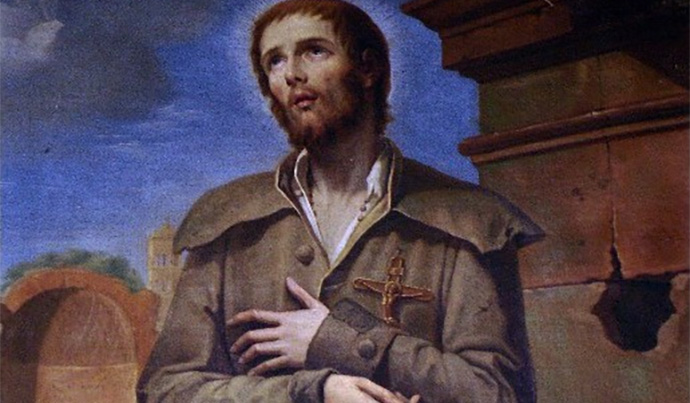
Saint Benedict Labre is commonly known as the patron saint of those who are homeless and those who are mentally ill. Did this eighteenth-century layman suffer from mental illness, or was there some other reason he chose not to bathe or sleep in a bed?
Benedict was born in 1748 into a prosperous, middle-class family in Amettes, France. His pious parents eventually had fifteen children, although only a handful of them survived to adulthood. Benedict was their oldest son and was devout and forgiving even as a boy. They were pleased, but probably not surprised, when he said he wanted to become a priest. They sent the twelve-year-old to study under his uncle, who was a parish priest.
That uncle died when Benedict was sixteen, and Benedict returned home. He lived for a time with another uncle, also a priest. However, Benedict soon became convinced that God was calling him to a life of greater penance and solitude than he could find serving in a parish church.
Over the next three years, Benedict tried to enter three of the most rigorous religious communities in the Catholic Church. Each time, his parents tried to discourage him because they were concerned that he would be unable to endure such a strict way of life. And the monks at a Trappist community, a Carthusian community, and a Cistercian community all agreed with his parents. Benedict’s health was so poor that the superiors refused to admit him, and the devastated young man returned home each time.
Perhaps it was all the walking that Benedict had undertaken as he traveled to each monastery that helped him realize what God wanted him to do next. Benedict had already been trying to prepare himself for the life of a religious by spending long hours in prayer and practicing physical mortifications. If he could not live a prayerful, penitential life among monks, he thought, perhaps he could live a prayerful, penitential life as a pilgrim.
It’s not as though Benedict Labre was the first Catholic to discern that God was calling him to spend his life as a pilgrim. Many great saints have undertaken pilgrimages that lasted for months or even years. The ten-day pilgrimages, which are so common today, are only made possible by modern transportation. Medieval European pilgrims traveling to the Holy Land knew that their journeys might take years and that they might never return home.
Thus, many holy men have died while on pilgrimage, while others have discerned God’s will for their lives apparently as a result of undertaking the sacrifice of a pilgrimage. Some saints became pilgrims when they could not return to their previous vocations. Holy women have also become known for their pilgrimages. One fifth-century married couple, Saints Melania the Younger and Pinian, traveled on pilgrimage to the Holy Land and were so inspired that they decided to separate from one another and enter religious life in Jerusalem, where they eventually died.
In fact, there are other canonized saints who have spent their entire lives traveling on pilgrimages to holy places. After all, that’s how Saint Fridolin the Wanderer got his name. Although Benedict Labre may not have known about Blessed Bernard the Penitent (d. 1182), a man who decided to atone for his dissolute youth by spending his life traveling from one holy place to another, dressed in rags, that’s exactly the vocation that Benedict chose for his own life.
Benedict received his father’s blessing, left his family home, and never returned, just as a vowed religious does when entering a cloistered order. And, also like a vowed religious, Benedict intentionally chose a life of poverty, which he did by begging, sleeping outdoors, and only accepting patched clothing and barely edible food. He lived his life in silence, and the fact that he was a Frenchman in Italy gave him an excuse to avoid answering people’s questions. His smelly clothes deterred many people from even approaching him, giving him the solitude he desired. His refusal to remove the lice from his clothing even seems to have been an act of mental discipline rather than a desire to be unclean.
The only uncleanness that horrified him was sin. During his studies under his uncle, Benedict had discovered the powerful writings of Fr. Jean Lejeune (1592-1672), who is sometimes also called the “Blind Father” because Lejeune became partially blind. Fr. Lejeune’s writings would seem harsh to us today, but to Benedict and many French peasants, the priest was only pointing out the bitter truth about sin and what a tragedy it is that sin separates us from God.
Some of the Italians who befriended Benedict worried that, being French, he was a follower of the dark, dismal heresy of Jansenism, which was common in France at the time. Fr. Lejeune’s writings appear to have erred in this direction, which is probably why Lejeune has never been canonized. But a few priests managed to break through Benedict’s perennial silence and speak to him about his faith, sometimes ordering the shy man to answer their questions out of obedience. Those priests became convinced that Benedict was a holy man far advanced in the way of perfection and not a Jansenist. Instead, Benedict had achieved the goal of a monk: he had grown so close to God, such a man of profound prayer, that even the smallest sin appeared horrible to him.
Although Benedict initially traveled throughout Europe, seeking holy places in which to meet God, he eventually settled down in Rome. Many citizens of Rome noticed Benedict’s presence and saw him as a holy man, not as a smelly, emaciated beggar. To some, his holiness seemed almost visibly present.
Witnesses later testified that they saw Benedict levitate during prayer. The poor people with whom he shared squalid hostels said that their food was sometimes miraculously multiplied due to Benedict’s prayers. A pregnant woman who invited him into their home attributed the birth of her healthy child to his prayers. Although he was a mere beggar, people who took the time to see past his outward appearance recognized his spiritual wisdom.
The citizens of Rome had nicknamed him “the beggar of the Forty Hours” because he was seen so often at that public devotion. He had looked so unwell for so long that people were not surprised when he died. But the outpouring of grief and veneration of his body exceeded anyone’s expectations.
Within fifteen days after Benedict’s death, sixty-three miracles had occurred. A Roman doctor wrote about the miraculous events that he saw occurring at Benedict’s tomb:
The dumb speak, the blind see, and paralysis and dropsy have been cured instantaneously. Only last Sunday a woman with dropsy was cured on the flagstone that covers the tomb. … And unbelievers have been moved to tears like everyone else. … No one here has ever seen anything like it. … Tremendous force is needed to control the crowds.
Within three months, the total number of miracles was 136. When an American Puritan minister named John Thayer traveled to Rome and heard the stories about Benedict, he decided to investigate the miracles to disprove them. The more he studied them, the more he was convinced that they were true, and he became a Catholic.
Was Benedict Labre mentally ill? In every time and place, it is sadly common for those who suffer from mental illness to become homeless. While Benedict must have encountered such people during his journeys, the interviews of witnesses do not indicate that they thought he suffered from mental illness. He was often silent, but he was not unable to communicate with others. He was poor and homeless, but by his own choice.
Only God knows whether Saint Benedict Joseph Labre was mentally ill or simply doing his best to live the life of a Trappist outside of a Trappist monastery. But his life is a powerful reminder of the power of pilgrimages to transform our souls, of the fact that we can find great penances in any vocation if we try, and of the graces that God pours into any soul willing to humble itself before Him.
And, of course, the truth that Jesus Christ may be as close to us as the homeless beggar we pass by today.
Endnotes:
If you value the news and views Catholic World Report provides, please consider donating to support our efforts. Your contribution will help us continue to make CWR available to all readers worldwide for free, without a subscription. Thank you for your generosity!
Click here for more information on donating to CWR. Click here to sign up for our newsletter.