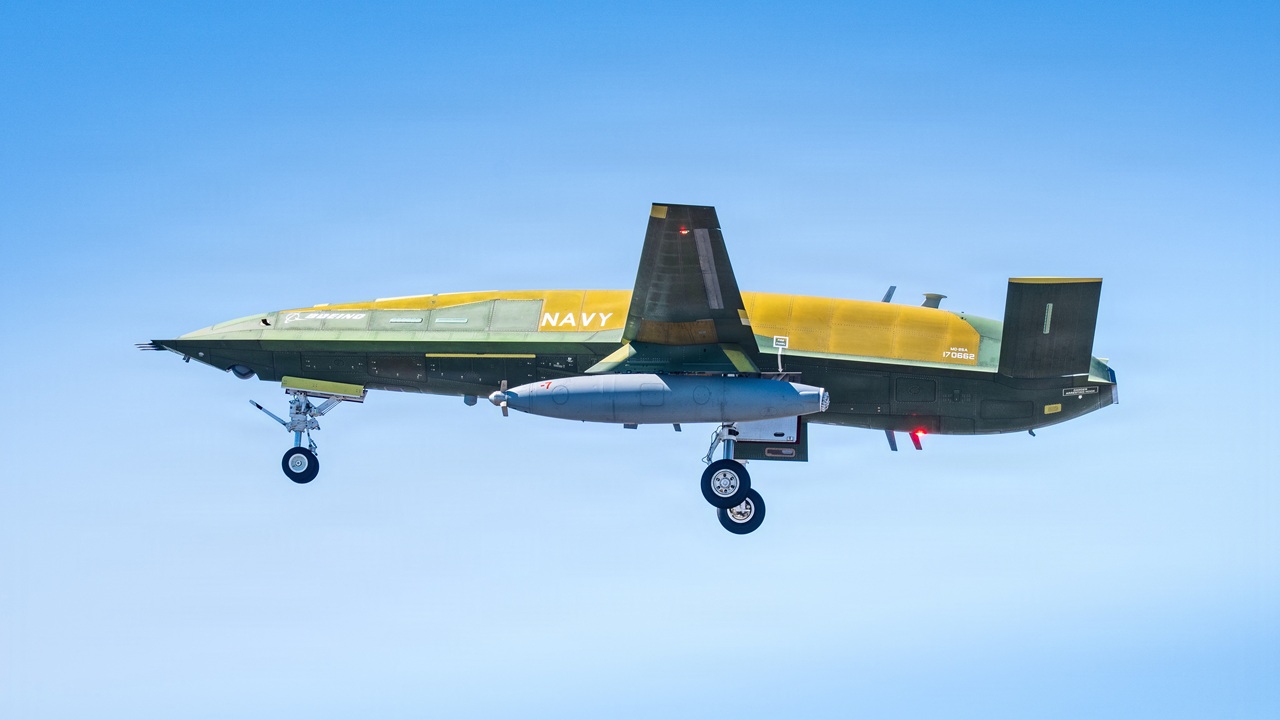
Unlike the Air Force’s Collaborative Combat Aircraft, the Stingray is not built to aid manned fighters in air-to-air combat; its role is far more crucial for naval operations.
The United States Navy and aerospace giant Boeing announced that the unmanned MQ-25A Stingray completed its maiden test flight last week from the company’s facility located at MidAmerica St. Louis Airport in Mascoutah, Illinois. It highlights the role that drones can play while serving alongside manned aircraft.
The MQ-25A flew for approximately two hours, with US Navy and Boeing Air Vehicle Pilots (AVPs) controlling the drone from “the Unmanned Carrier Aviation Mission Control System MD-5 ground control station that includes Lockheed Martin’s MDCX system,” according to a US Navy media statement. During the flight, the AVPs executed a series of maneuvers and tests that validated the drone’s “basic flight controls, engine performance, and handling characteristics.”
Although the flight was under human control, the program’s goal is for the Stingray to taxi, take off, fly, and land autonomously. The drone is designed to operate from the US Navy’s aircraft carriers and integrate with a carrier air wing.
“Achieving this first flight underscores the strong partnership between the Navy and our industry partners,” Rear Adm. Tony Rossi said.
“The MQ-25A is not just an aircraft: it’s the first step in integrating unmanned aerial refueling onto the carrier deck, directly enabling our manned fighters to fly further and faster,” added Rossi, who leads the Program Executive Office for Unmanned Aviation and Strike Weapons (PEO (U&W)). “This capability is vital to the future of naval aviation.”
The MQ-25A Stingray’s Specifications
- Year Introduced: Not yet introduced (prototype phase; projected introduction 2026)
- Number Built: Unknown
- Length: 51 ft (15.5 m)
- Height: 9.8 ft (3 m)
- Wingspan: 75 ft (22.8 m)
- Weight: 14,110 lb (6,400 kg) empty; 44,533 lb (20,200 kg) maximum takeoff
- Engines: One Rolls-Royce AE3007N turbofan engine; 10,000 lb thrust
- Top Speed: Mach 0.69 (525 mph, 845 km/h)
- Range: ~500 nmi (575 mi, 926 km)
- Service Ceiling: 39,370 ft (12,000 m)
- Loadout: No weapons (so far); up to 15,000 lbs of fuel, refueling four to six aircraft per mission
- Aircrew: 0
The MQ-25A Stingray Isn’t a “Loyal Wingman” Drone
The MQ-25A is not the only unmanned aerial system (UAS) now in development. The United States Air Force continues to conduct test flights of its Collaborative Combat Aircraft (CCA), the autonomous drones that could serve as “loyal wingmen” for its fifth- and sixth-generation manned fighters.
However, while the emphasis of the CCA program is on combat, the MQ-25A Stingray is less about stinging the enemy and more about ensuring that manned fighters, including the F/A-18 Super Hornet and F-35C Lightning II, can accomplish their respective missions. Accordingly, while the Air Force’s CCA prototypes—the YFQ-42A and the YFQ-44—are both focused on air superiority, the MQ-25A Stingray lacks weapons; it was developed primarily to serve as an aerial refueling tanker and to take over the refueling mission from crewed fighters. For this reason, the Stingray is far larger and slower than the Air Force’s combat drones.
Still, the importance of aerial refueling can’t be understated. As the ongoing Operation Epic Fury has demonstrated, the US Navy’s aircraft carriers may need to operate further away from potential targets to avoid being targeted by land-based cruise missiles and drones.
“The MQ-25A will significantly extend the combat range and effective strike capability of the Carrier Air Wing,” the US Navy wrote.
“By offloading refueling duties from manned aircraft, the MQ-25 Stingray tanker drone frees up fighters for combat missions, enabling carriers to strike from greater distances and avoid high-threat zones,” Brandon Weichert wrote for The National Interest last year.
“Years of Learning” Went into the MQ-25A Stingray
Dan Gillian, vice president and general manager at Boeing Air Dominance, said that last week’s flight built “on years of learning” from the company’s MQ-25A T1 prototype.
“The MQ-25A is the most complex autonomous system ever developed for the carrier environment, and this historic achievement advances us closer to safely integrating the Stingray into the carrier air wing,” Gillian added.
The US Navy and Boeing will conduct further test flights at MidAmerica Airport over the coming months to further validate the Stingray’s controls and capabilities. After those tests are completed, the aircraft will be transferred to Naval Air Station Patuxent River, Maryland, later this year, “to prepare for aircraft carrier qualifications. The Navy hasn’t set a timeline, but the MQ-25A T1 began test flights in 2019, accumulating around 125 hours. That laid the groundwork for the Stingray.
“Watching our first Navy aircraft complete an autonomous flight underscores what disciplined teamwork and rigorous testing deliver,” said Troy Rutherford, vice president of Boeing’s MQ-25 program. “[This] would not have been possible without the hard work and dedication of our Boeing, Navy, and industry team. Together, we are redefining the future of naval aviation and pushing the boundaries of what’s possible with autonomy.”
About the Author: Peter Suciu
Peter Suciu has contributed to dozens of newspapers, magazines and websites over a 30-year career in journalism. He regularly writes about military hardware, firearms history, cybersecurity, politics, and international affairs. Peter is also a contributing writer for Forbes and Clearance Jobs. He is based in Michigan. You can follow him on Twitter: @PeterSuciu. You can email the author: [email protected].