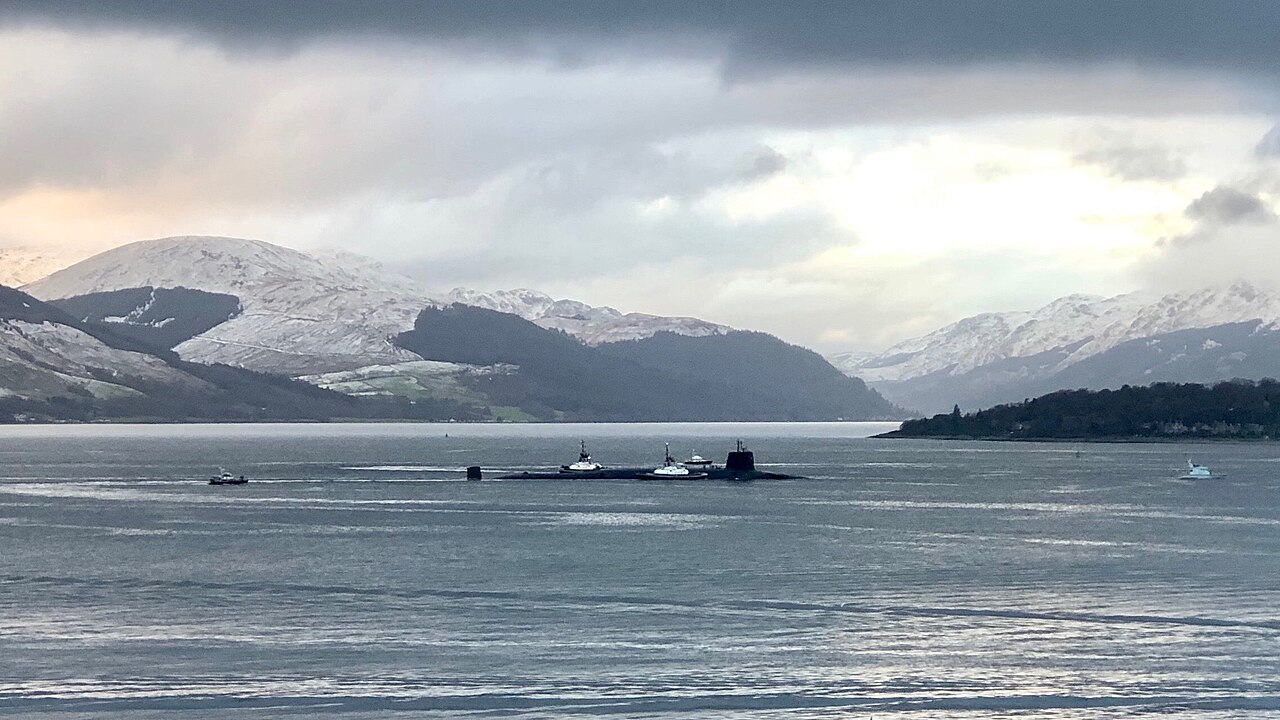
The UK’s Vanguard-class submarines are typically only equipped for 99-day patrols, leading to speculation that the vessel had quietly resupplied part of the way through its journey.
Spring is in the air across the northern hemisphere, and brisk mornings and increasing hours of sun may be especially welcome to the crew of one of the UK’s Royal Navy Vanguard-class nuclear-powered ballistic missile submarines. The boat recently returned to port following a 205-day deployment, spending most of the time underwater, where the sailors often lost all sense of day and light.
The crew received a hero’s welcome, including a visit from British Prime Minister Sir Keir Starmer, who boarded the submarine as it arrived at His Majesty’s Naval Base, Clyde (HMNB Clyde) in Scotland.
Starmer was joined by Defence Secretary John Healey, who also shared his good wishes to the submarine’s crew.
“Proud to welcome home and thank our submariners, who keep the UK and @NATO safe, every minute of every day,” Healey wrote in a post on X (formerly Twitter). “They and their families make huge sacrifices to protect us all, and our UK nuclear deterrent is more important now than ever. They are the very best of Britain.”
The Vanguard-Class Submarine’s Specifications
There are four Vanguard-class nuclear-powered submarines, all built by Vickers Shipbuilding & Engineering, Barrow-in-Furness. The boats include the HMS Vanguard (S28), HMS Victorious (S29), HMS Vigilant (S30), and HMS Vengeance (S31). All four submarines operate from HMNB Clyde in Scotland and maintain a continuous at-sea deterrence (CASD) posture.
- Year Introduced: 1996
- Number Built: 4
- Length: 149.9 m (491.8 ft)
- Height: 11 m (36.3 ft)
- Width: 12.8 m (42 ft)
- Displacement: 14,000 tons surfaced/15,980 tons submerged
- Powerplant: Rolls-Royce PWR-2 pressurized water nuclear reactor
- Speed: 18 knots on the surface/25 knots submerged
- Armament: 16 launch tubes for Trident nuclear missiles; four 21-inch torpedo tubes
- Crew: 135 (14 officers, 121 enlisted)
The Vanguard-Class Submarines Are the UK’s Deterrent of Last Resort
The British Ministry of Defence (MoD) didn’t specify which boat returned to Scotland, but there are only four Vanguard-class submarines in service. Several British media outlets reported that the vessel in question was the HMS Vanguard (S28), the lead submarine of the class.
The Vanguard class serves as the UK’s primary nuclear deterrent. During extended patrols, the crews spend months at sea, cut off from the outside world.
The MoD doesn’t announce the movements of the boats for obvious reasons, and the beginning of deployments is also rarely publicized. However, the Royal Navy has recently been more forthcoming when the patrols end. In March 2025, the service confirmed that another Vanguard-class submarine had returned to port after 204 days at sea—breaking a previous record for another boat that spent 201 days at sea.
Based on the lengths of previous deployments, it seems that 200 or more days at sea is the new norm, as another boat that returned from a deterrent patrol was out for 203 days. According to British media reports, all of the nine most recent patrols have exceeded five months at sea, or 152 days or more, and six-month deployments have been standard.
“On paper, longer patrols are more ‘efficient’ as it reduces the time spent in handovers and there are longer periods to conduct post-patrol maintenance, recover and prepare for the next,” Navy Lookout explained. “However, it also adds additional risk that the continuous nature of the deterrent could be compromised as these aging boats must avoid serious defects and stay at sea for longer.”
The Vanguard Submarines Are Spending a Long Time at Sea
The Vanguard-class submarines were designed for 99-day patrols, and have food stores and freezers that can support only three to four months at sea. That means stores are packed throughout the boat, with passageways covered with canned foods and other dry goods. There is no such thing as taking out the trash at sea.
“Some gash [trash or rubbish] can be ejected from the boat, but some of the waste has to be stored on board, crammed into spare compartments,” Navy Lookout wrote.
The Royal Navy hasn’t confirmed if the Vanguard-class submarines are ever resupplied midway through a patrol, which would seem to violate the key principle that the boats must remain submerged and therefore undetected at all times. If resupply does occur, it probably happens as discreetly as the Royal Navy can manage—likely at night and in an area hidden from public view.
The Royal Navy will likely continue to push the Vanguard-class submarines throughout the remainder of their service lives, until they are replaced by four new Dreadnought-class boats, which are expected to enter service in the early 2030s.
The Royal Navy’s submarine isn’t the only military vessel to see such an extended deployment. As of last week, the United States Navy’s newest and largest supercarrier, the USS Gerald R. Ford (CVN-78), set a record for longest post-Vietnam War deployments. As of Wednesday, April 22, the warship has been at sea for 302 days.
Of course, life on an aircraft carrier has advantages not available to the crew of a Vanguard-class submarine—namely regular access to fresh air and sunlight!
About the Author: Peter Suciu
Peter Suciu has contributed to dozens of newspapers, magazines and websites over a 30-year career in journalism. He regularly writes about military hardware, firearms history, cybersecurity, politics, and international affairs. Peter is also a contributing writer for Forbes and Clearance Jobs. He is based in Michigan. You can follow him on Twitter: @PeterSuciu. You can email the author: [email protected].