
Author Wynton Hall reveals in his new book Code Red: The Left, the Right, China, and the Race to Control AI that the worship of artificial intelligence as a literal deity is not science fiction. It is already happening, complete with IRS-registered churches, robot priests, and AI confessionals.
CODE RED explains that a former Google AI engineer and self-driving car pioneer named Anthony Levandowski filed paperwork with the IRS in 2017 to register a new church called “Way of the Future.” Its stated doctrine was centered on “the realization, acceptance, and worship of a Godhead based on Artificial Intelligence (AI) developed through computer hardware and software.” In an interview with Wired, Levandowski described AI in blunt terms: “What is going to be created will effectively be a god. If there is something a billion times smarter than the smartest human, what else are you going to call it?”
Levandowski was sentenced to eighteen months in prison in 2020 for theft of Google trade secrets, received a full pardon from President Trump in 2021, and temporarily folded his AI church that same year, donating its remaining $175,172 to the NAACP Legal Defense and Educational Fund. But as Hall documents, the church came back. In November 2023, Levandowski told Bloomberg that Way of the Future wasn’t finished. AI would generate “abundance on [the] planet” and create “what other religions would call Heaven on Earth,” he said. “You don’t even have to die and go up to Heaven; you can just enjoy it today—all we have to do is improve the technology.” An article published by the European Academy on Religion and Society offered a different assessment, calling Way of the Future an “AI cult” that offers people “no hope of eternal bliss, just the goal of keeping AI from turning human reality into a dystopian temporal hell.”
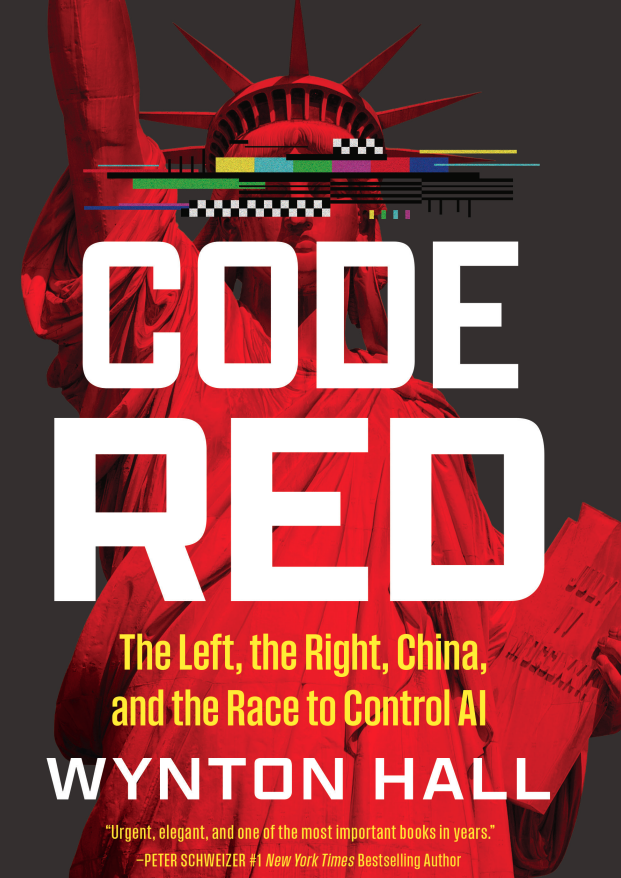
Way of the Future is not alone. Hall documents a wave of AI-religion integration across faiths CODE RED. In Kyoto, Japan, a Buddhist robot priest named Mindar delivers sermons at the Kodaiji Temple. When BBC News asked a Buddhist monk, Tensho Goto, whether the robot is sacrilegious, he replied, “It is not blasphemy. Although it’s a gradual process, AI is going to create a change in other religions too.” In Lucerne, Switzerland, St. Peter’s Church created an AI Jesus avatar dubbed “Deus in Machina” (God in the Machine) inside a confessional booth. Two-thirds of those who interacted with it reported having a “spiritual experience.” On Twitch, an AI Jesus chatbot called “ask_jesus” has more than eighty-eight thousand followers.
Hall writes in CODE RED:
Undergirding all of this is something bigger than blasphemous bytes or attempts to deify AI. Beneath the surface of these public clashes between traditional theology and techno-secularism’s worship of AI lies a heuristic fault line that has existed for centuries, one that will continue to be in conflict as the AI revolution unfolds.
What’s really at stake, Hall argues, is the oldest argument in Western civilization: secular humanism’s belief that mankind is innately good and perfectible through engineering, versus the Judeo-Christian belief in fallen human nature that requires divine redemption, not technological upgrades. “Artificial intelligence is defective in the same way that a natural man is defective,” Hall quotes the pastor and theologian John Piper as saying. “It can rise no higher than the natural, fallen, unregenerate heart of man.” The Reverend Billy Graham agreed: “The real problem, you see, isn’t with computers or the code someone devises to control them. Our real problem is within us—within our own hearts and minds. . . . This is why our greatest need is to have our hearts changed—and that is something only God can do.”
The transhumanist movement, which Hall explores at length in CODE RED , takes the logic further still. In a famed 2004 issue of Foreign Policy on the theme of “the world’s most dangerous ideas,” political scientist Francis Fukuyama singled out transhumanism as the chief menace, warning that its incremental advance makes it appear “downright reasonable” until we start nibbling at “biotechnology’s tempting offerings without realizing that they come at a frightful moral cost.” Former Trump campaign strategist Stephen K. Bannon called it an “immoral Godless technological tsunami that openly declares its intent to transform human beings into a ‘posthuman’ state.”
Hall’s closing note, though, is not doom. He points to Y Combinator CEO Garry Tan, who now holds large gatherings in his home where Christians discuss faith with seekers in Silicon Valley. Just a few years ago, Tan said, such gatherings would have been “reviled in San Francisco.” He added: “People are so ready to make AGI their god. What we’re trying to do with events like this is give them an alternative.”
Senator Marsha Blackburn (R-TN), who was named one of TIME’s 100 Most Influential People in AI, praised CODE RED as a “must-read.” She added: “Few understand our conservative fight against Big Tech as Hall does,” making him “uniquely qualified to examine how we can best utilize AI’s enormous potential, while ensuring it does not exploit kids, creators, and conservatives.” Award-winning investigative journalist and Public founder Michael Shellenberger calls CODE RED “illuminating,” ”alarming,” and describes the book as “an essential conversation-starter for those hoping to subvert Big Tech’s autocratic plans before it’s too late.”