In her later years, the sculptor Louise Nevelson (1899–1988) was one of the most famous artists of the time, appearing on the covers of Look and The New York Times Magazine. Her extravagant, hieratic appearance in the tradition of Edith Sitwell and Isak Dinesen, with a face like that of an Aztec priestess, was photographed by Vogue. The New Criterion’s founding editor, Hilton Kramer, wrote in Arts Magazine in 1958—the year she became famous with her first large-scale “environment,” Moon Garden Plus One, and Sky Cathedral, her vertical tribute to New York—that her works were “appalling and marvelous, utterly shocking in the way they violate our received ideas on the subject of sculpture and the confusion of genres, yet profoundly exhilarating in the way they open an entire realm of possibility.” Kramer was averse to modish artist gimmicks, and his friendly support for Nevelson over the years bears remembering. Since her death, her popularity has somewhat dipped on the Continent (her last show in France was in 1974) but remains steady in the United States, where Pace Gallery has organized several Nevelson retrospectives since the 1960s, including an exhibition reviewed in these pages last year.
For many visitors, “Louise Nevelson: Mrs. N’s Palace” will be a revelation. Its title comes from Nevelson’s last—and only intact—monumental “environment,” donated by the artist to the Metropolitan Museum of Art. “Mrs. N” was how the artist’s neighbors in New York’s Little Italy addressed her.
Louise Nevelson was born Leah Berliawsky in 1899 to Jewish parents in the Kyiv region, then part of the Russian Empire. Fearing pogroms, in 1905 her family immigrated to Rockland, Maine, and Leah became Louise. Decades later, when asked about her habit of finding wood and other materials in the streets to be recycled into sculptures, Nevelson joked that she came from the Old World, where it was assumed that the streets of the New were paved with gold.
In 1920, obeying her parents’ wishes, she married the well-off Charles Nevelson and had a son, Myron Irving Nevelson (better known as Mike), who, though estranged in adulthood from his mother, also became a sculptor. The young family moved to New York, which to Louise was “an immense sculpture.” There, she studied singing with the retired soprano Estelle Liebling and took classes in drawing, painting, and sculpture at the Art Students League. Her in-laws were unhappy about her artistic pursuits. Louise said later that the Nevelsons were the kind of cultured people who revered Beethoven but did not want a Beethoven in their family. She had her own way, studying drama at the International Theatre Arts Institute in Brooklyn and practicing eurythmy, a form of free dance associated with anthroposophy, with Ellen Kearns, whom she met through Diego Rivera and his wife Frida Kahlo in New York in 1933. The first part of the exhibition explores how Nevelson used her theatrical interests in her intensely dramatic sculptures.
In 1931, she left her husband and packed off her son to her parents in Maine so that she could study Cubism in Munich. Four years later, back in New York, the New Deal’s Works Progress Administration gave her a living space and a shared studio. In 1941, Karl Nierendorf, who also exhibited Paul Klee, Otto Dix, and Wassily Kandinsky, organized her first solo show at his gallery. Although she felt most at home in New York because of the city’s endemic chaos, Mexico, with its Mayan sites in the Yucatan, was for her “a world of geometry and magic” and had a strong effect on her art. In addition to her sculptures, she created collages and enigmatic pictures on paper that betray a Surrealist influence, such as The Magic Garden (1953–55), which features mysterious floating figures and uncanny expressions. In the same period, she made Goddess from the Great Beyond. An angular face stares out at the viewer, while the fluid outlines of the rest of the body seem to contain a dark sky dotted with isolated stars. These etchings resemble a child’s deranged dreams. In 1956, the Brooklyn Museum bought her First Personage, a large, vertical black slab that is sleek on one side but has spikes coming out from the other. Nevelson called the work her autobiography, although to a less attuned viewer it might seem more like a life-size turnstile. A picture of Nevelson standing next to the sculpture reveals a challenging kind of beauty reminiscent of Greta Garbo. By 1958, Nevelson’s works were being exhibited not only in New York but also in Paris, at the Galerie Jeanne Bucher.
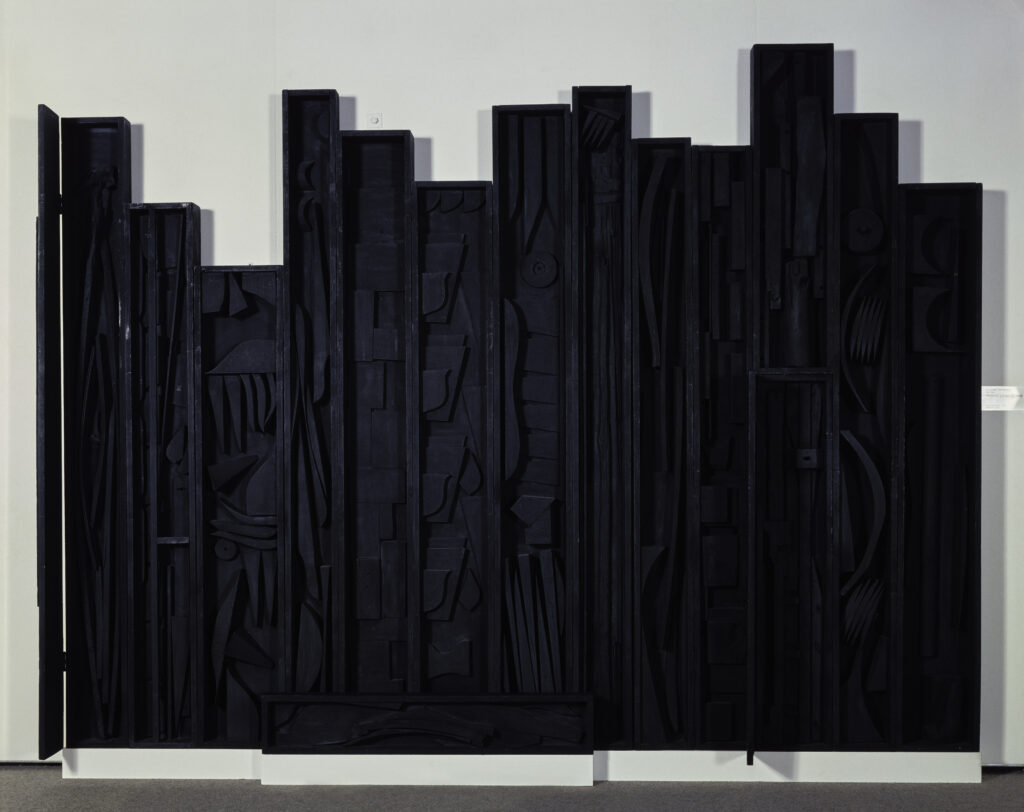
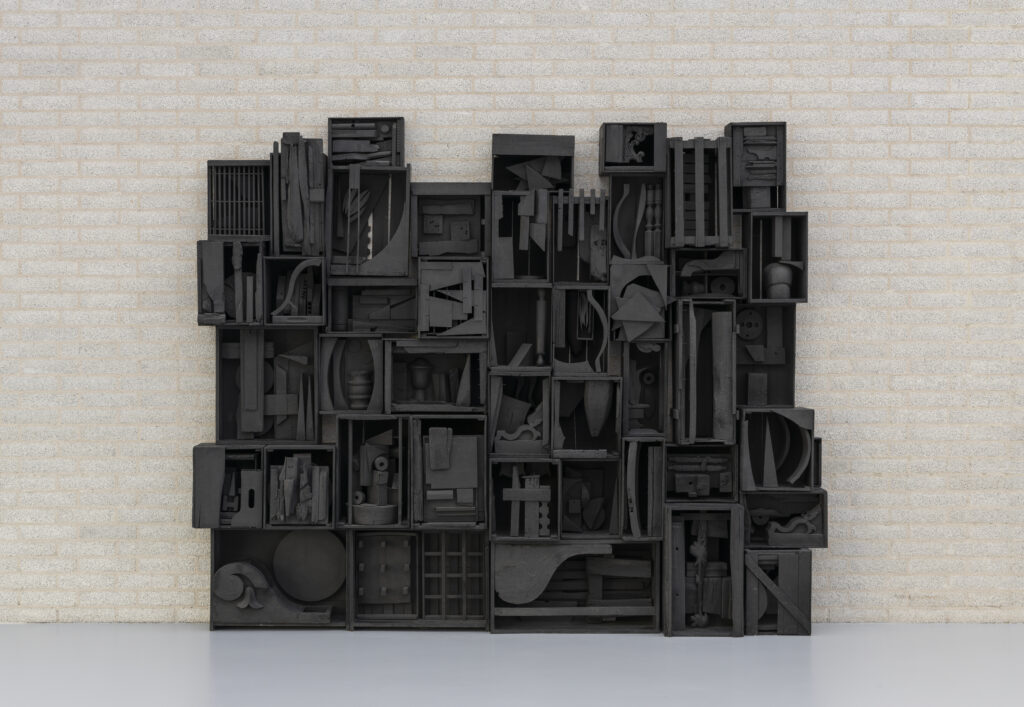
Most of her statues were made of wood painted black, which was her favorite color. Tropical Gardens II (1957), which formed part of Moon Garden Plus One, looks like a bunch of joined elongated boxes reminiscent of skyscrapers. It is unfortunate that the environment was dismantled, since the various parts were designed to complement each other in a kind of dance. After the darkness of night comes morning’s light, and 1959 brought Nevelson’s first white environment in Dawn’s Wedding Feast, which resembles an immense, intricate timekeeping mechanism.
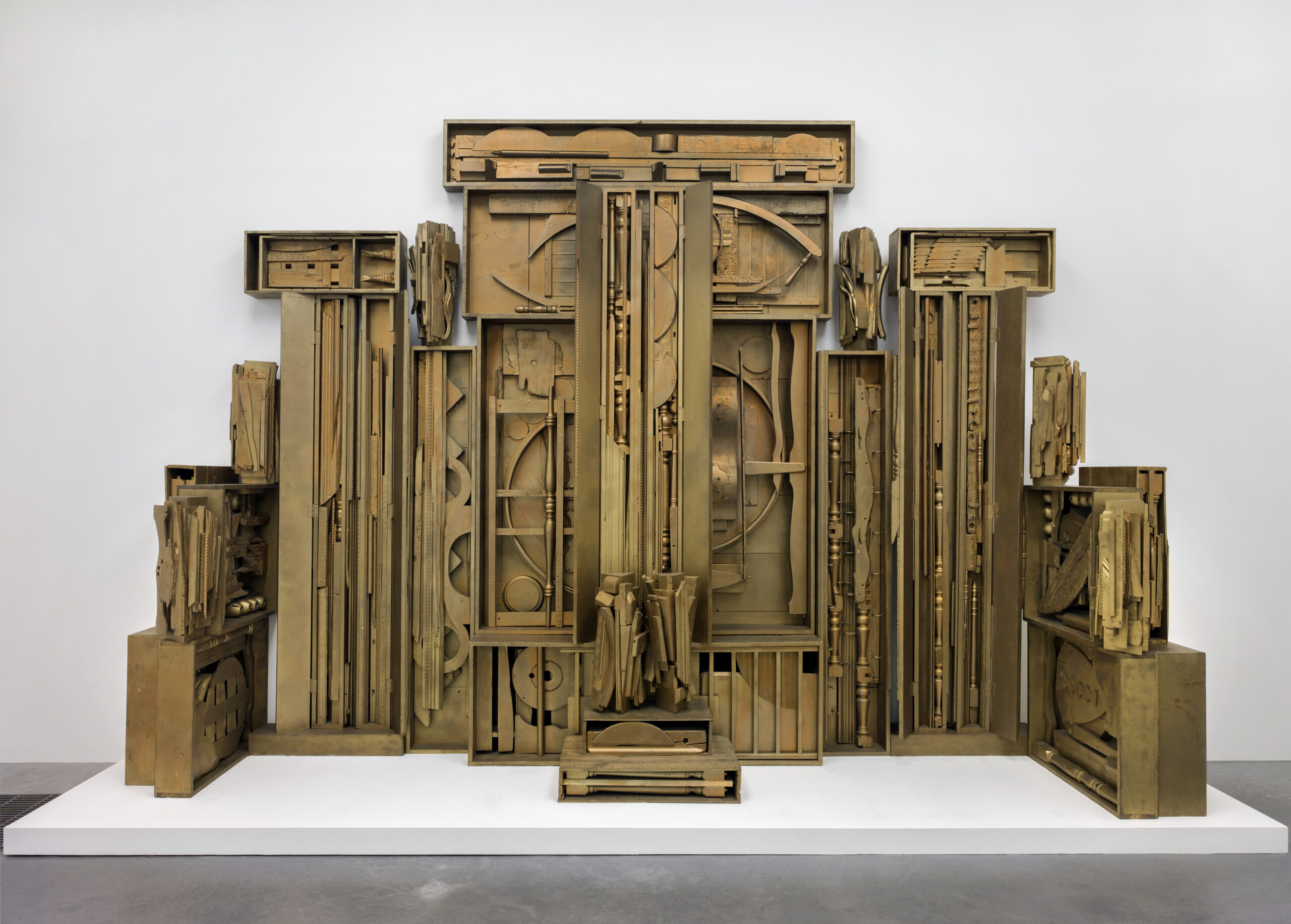
The Royal Tides (1961–63) and An American Tribute to the British People (1960–65) are for me the most impressive pieces in the exhibition, perhaps stemming from my belief in the importance of the union between the English-speaking peoples. Both works are painted in gold, a color Nevelson valued for its earthy origins. On first seeing An American Tribute to the British People, I mistook it for a great pipe organ. It turns out that Nevelson herself acknowledged the influence of Bach’s fugues on her work. This skillfully designed exhibition provides a fascinating overview of a highly original artist. Bring a folding chair, because these sculptures are worth taking in at leisure.