The White House has dispatched a “Marine Expeditionary Unit” of 2,500 troops to the waters off Iran—but is unlikely to launch a full-scale ground invasion with so few soldiers.
Operation Epic Fury might soon take an unexpected turn. The Department of Defense is sending thousands of ground troops to the Middle East as policymakers and military commanders consider their options to reopen the vital Strait of Hormuz.
There Are “Boots on the Ground” Near Iran—but Not Inside (Yet)
The US Central Command (CENTCOM), the combatant command responsible for running military operations in the Middle East, requested the deployment of thousands of Marines to the region as the Pentagon considers its options against Iran’s closure of the Strait of Hormuz.
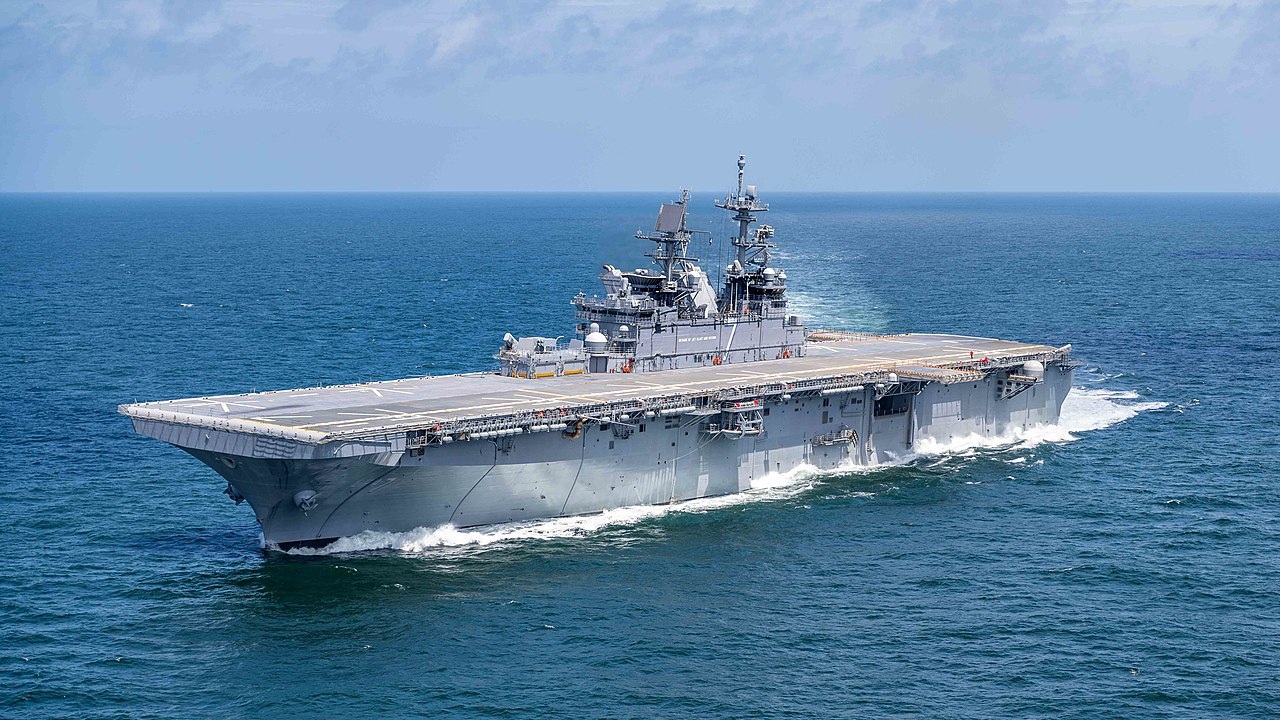
The 31st Marine Expeditionary Unit, usually based in Japan, is heading to the Middle East. Carrying the 31st MEU are the USS Tripoli amphibious assault ship and USS San Diego and USS New Orleans amphibious transport docks. The task force consists of approximately 2,500 Marines and 20 F-35B Lightning II fighter jets.
Since Tehran ordered the closure of the Strait, Iranian forces have attacked several merchant vessels attempting to pass through the Strait. The Trump administration has mulled escorting commercial shipping with naval vessels, but has not yet decided on a course of action.
Why the Strait of Hormuz Matters
The Strait of Hormuz is one of the most important maritime lanes in the world. Approximately 20 percent of the world’s global oil supply, or roughly 20 million barrels of oil, sails through the narrow waterway every day. Its closure by Iran has sharply increased oil prices, threatening the stability of the global economy.
Last week, the International Energy Agency (IEA) gave the green light to its constituent members to release 400 million barrels of oil from their stockpiles, addressing the supply disruption resulting from the closure of the Strait. However, this is only a temporary solution.
The Strait of Hormuz is bordered by Iran to the north and Oman and the United Arab Emirates to the south. Given its immense strategic importance, Iran has centered its naval strategy around obstructing access to the strait during times of crisis. Much of the Iranian Navy consists of “fast attack boats,” or heavily armed speedboats capable of laying mines and carrying out hit-and-run attacks against commercial vessels before hiding along Iran’s rocky coastline to escape Western retaliation.
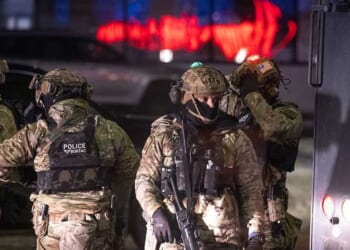
As the United States considers its options with regard to the situation, the possibility of putting boots on the ground in the Iranian coastline that controls the northern part of the Strait is becoming increasingly likely. Thus far, the US military has relied on stand-off air and naval strikes to conduct Operation Epic Fury. An amphibious operation supported by overwhelming air power and naval fire could capture Iran’s coast. But a military deployment inside Iran proper would likely require far more than the 2,500 Marines heading to the region.
The physical presence of US troops in Iran will also increase the risk of casualties. The US forces have already suffered more than a dozen killed in action, while hundreds of troops have been wounded (most of them lightly).
Perhaps a more likely target for the incoming Marines is Kharg Island. The small island is located about 16 miles off the Iranian coast and serves as the loading depot for Tehran’s oil exports, with around 90 percent of Iranian oil passing through Kharg.
“It’s not high on the list, but it’s one of so many different things, and I can change my mind in seconds,” President Donald Trump said on Friday morning about the possibility of a physical assault against Kharg.
What Is a “Marine Expeditionary Unit”?
A Marine Expeditionary Unit (MEU) is a rapid-reaction force designed to respond to contingencies around the world. Versatile and self-sufficient, an MEU can operate independently and in coordination with other Marine Corps and Army units. Each MEU has fully integrated ground, air, and logistics components, including artillery, attack helicopters, transport helicopters, fighter jets, air defense units, reconnaissance assets, a field hospital, and mechanized infantry, enabling it to fight without much outside support.
About the Author: Stavros Atlamazoglou
Stavros Atlamazoglouis a seasoned defense journalist specializing in special operationsand a Hellenic Army veteran (national service with the 575th Marine Battalion and Army HQ). He holds a BA from the Johns Hopkins University and an MA from the Johns Hopkins’ School of Advanced International Studies (SAIS). His work has been featured in Business Insider, Sandboxx, and SOFREP.