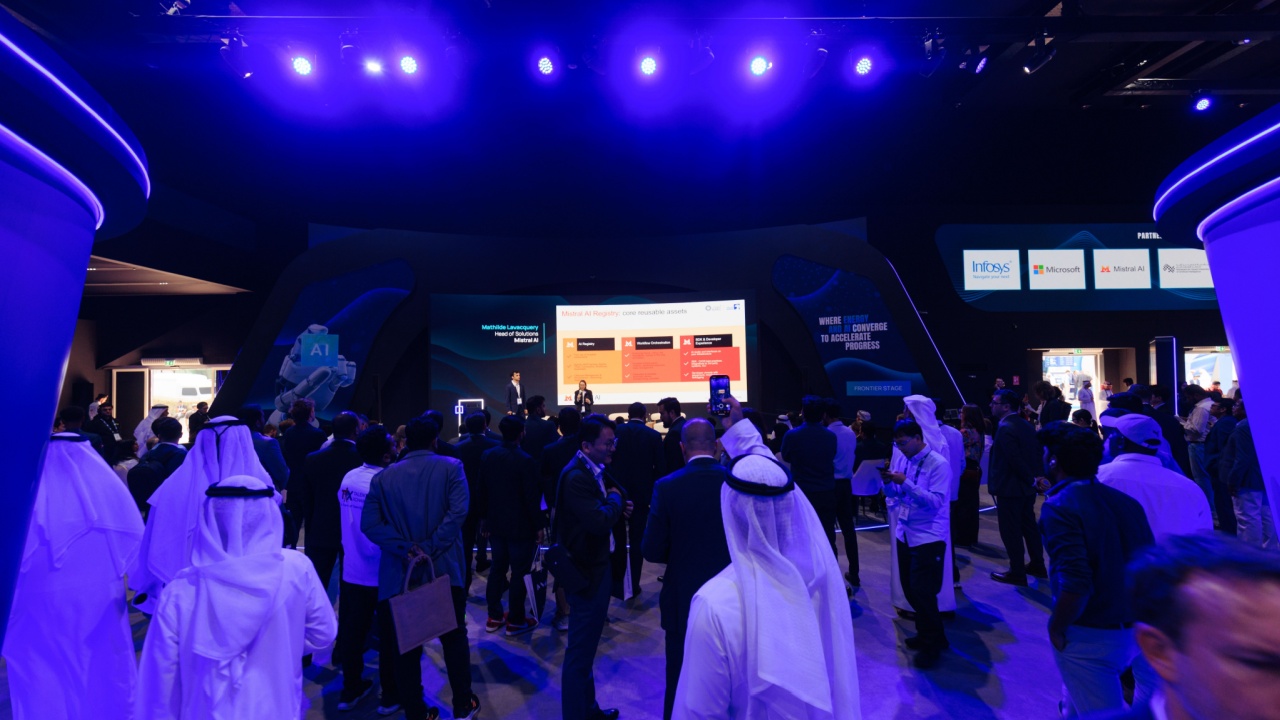
Despite seemingly bottomless funds, the oil-rich monarchies of the Persian Gulf face serious challenges on the road becoming an artificial intelligence hub.
Last month, following Saudi crown prince Mohammed bin Salman’s White House visit, the US Commerce Department approved an estimated $1 billion sale of 35,000 advanced Nvidia chips to Saudi Arabia’s HUMAIN and the UAE’s G42. The move signals Washington’s willingness to enlist Gulf energy wealth in its AI race with China, which President Trump has called a “national security imperative.”
The approval marks a sharp reversal from the Biden administration’s restrictive approach to AI chip exports, reflecting a new calculus that views Gulf allies as partners rather than risks in the technology competition with Beijing. The Gulf has the ambition and the financial muscle, but building data centers in one of the world’s hottest, driest regions presents challenges that money alone can’t solve.
Why Build Data Centers In The Desert?
Global demand for AI is straining data center capacity worldwide, creating an opening the Gulf intends to fill. Saudi Arabia has committed over $100 billion to AI development under Vision 2030, including plans for massive data center zones in NEOM and Riyadh. The UAE has positioned itself as the region’s tech hub through state-backed firms like G42, which recently secured $1.5 billion in investment from Microsoft and is building Stargate UAE, a hyperscale AI data center set to go live in 2026.
Qatar is leveraging its LNG wealth to invest in next-generation cooling technologies as part of Qatar National Vision 2030’s push toward a “non-oil economy.” Even smaller GCC members like Oman, Kuwait, and Bahrain are pursuing digital strategies, though with more modest infrastructure goals. For the major energy producers (Saudi Arabia, the UAE, and Qatar), the underlying logic is consistent: abundant energy can offset other constraints.
The Gulf’s advantages extend beyond energy costs. Its geographic positioning between Europe, Asia, and Africa makes it a natural connectivity hub, while its experience in mobilizing foreign labor proves valuable for constructing infrastructure in extreme climates. The region is also investing in human capital: Qatar’s Education City hosts Carnegie Mellon, while Saudi Arabia and the UAE have partnerships with MIT and Stanford. Tax-free salaries help attract global tech talent.
For companies like Oracle and Google already operating in the region, patient capital from sovereign wealth funds—Saudi Arabia’s Public Investment Fund, the UAE’s Mubadala, and the Qatar Investment Authority—combined with minimal regulatory friction, makes the Gulf an increasingly attractive destination.
The Gulf also benefits from favorable structural conditions. Rapidly growing populations across the region are driving surging demand for digital services, creating a built-in customer base for data centers beyond serving global AI needs. Regional data sovereignty laws, which require data generated in Middle Eastern countries to be stored and processed locally, create additional regulatory demand for regional data centers.
Unlike established data center markets with a mix of older and newer facilities, the Gulf has minimal legacy infrastructure, allowing it to design cutting-edge, energy-efficient facilities from scratch rather than managing a patchwork of systems from different generations. Yet none of these strengths alone can overcome the region’s most fundamental constraint: water.
Water: The Critical Constraint
Data centers consume enormous quantities of water for cooling systems, both directly through chillers and cooling towers, and indirectly through the water-intensive processes required for electricity generation. A medium-sized 15MW data center uses as much water annually as three hospitals or two 18-hole golf courses. The problem is compounded by limited water reuse: during cooling, freshwater evaporates, leaving the remainder as wastewater contaminated with chemicals and minerals, making it difficult to recirculate efficiently.
By 2027, global AI demand is expected to require between 1.1 and 1.7 trillion gallons of water withdrawal annually. The Gulf faces this challenge from a position of acute scarcity. The World Resources Institute identifies Gulf countries as among the most water-stressed regions on Earth, relying on fossil groundwater and desalination for over 90 percent of their water supply. This creates a vicious cycle: building more data centers increases cooling demand, which requires more desalinated water.
Desalination itself is energy-intensive, consuming the cheap electricity that is the Gulf’s primary advantage while generating additional heat. While Gulf states are investing heavily in next-generation cooling technologies, these solutions remain largely unproven at the massive scale the region envisions. The water constraint alone raises serious questions about long-term sustainability, but it is not the only obstacle the Gulf must navigate.
Security Concerns Still Haunt Gulf Development
The Gulf’s location in one of the world’s most volatile regions creates risk premiums that multinational companies cannot ignore. Houthi attacks on Saudi oil infrastructure and this year’s missile strike on Doha demonstrate that even the wealthiest Gulf states remain exposed to regional conflict. For companies contemplating multi-billion-dollar investments in mission-critical AI infrastructure, the question is not just whether the Gulf can build data centers, but whether it can guarantee uninterrupted operations in a region exposed to broader Middle Eastern conflicts.
Beyond security concerns, the Gulf faces a deeper challenge: can it develop authentic AI capabilities rather than simply replicating Western models? While partnerships with major US tech firms provide access to cutting-edge technology, true leadership requires indigenous innovation. There are early signs of progress. Qatar’s Fanar and the UAE’s Falcon represent efforts to build Arabic language models tailored to regional needs.
Saudi Arabia is investing in homegrown AI research through KAUST and other institutions. Yet the reality remains that most Gulf AI infrastructure relies heavily on imported chips, foreign expertise, and Western platforms. Whether the region can transition from hosting AI infrastructure to actually leading AI development will determine if this bet represents genuine diversification or expensive dependence.
Environmental concerns add another layer of complexity. Major Western tech companies have committed to carbon neutrality and net-zero emissions targets. Yet, the region’s data centers would rely heavily on natural gas-powered electricity, even as renewable energy capacity expands. Shareholders and climate advocates are increasingly scrutinizing where companies build infrastructure, and the Gulf’s carbon-intensive energy mix creates reputational and regulatory risks that could complicate partnerships or force costly investments in green energy.
Can The Gulf Pivot from Oil to AI?
The Gulf’s AI ambitions face real constraints, but dismissing them would be premature. The region has successfully built world-class infrastructure before, from ports to airlines to financial hubs, by leveraging capital and state capacity to overcome geographic disadvantages. Water scarcity presents a more fundamental challenge than previous projects, but ongoing investments in cooling technology and desalination efficiency could make large-scale operations viable.
For Washington, the strategic logic is straightforward: integrating Gulf states more deeply into the US technology ecosystem reduces their incentives to align with China. Trump’s willingness to sell over a million chips to companies like G42 represents a significant gamble that the Gulf can be integrated into the US tech ecosystem without creating future strategic liabilities.
The real question is not whether the Gulf can build data centers but whether it can build them sustainably, operate them securely, and transition from hosting Western AI infrastructure to developing indigenous capabilities. The answer will reveal whether this represents the Gulf’s successful pivot to a post-oil economy or whether environmental and geopolitical constraints will prevent the region from achieving its AI ambitions.
About The Author: Wasay Mir
Wasay Mir is a geopolitical risk analyst covering the Middle East and South Asia, focusing on economic and energy policy, regional security, and emerging technologies. He holds fellowships at the Pulitzer Center and Johns Hopkins SAIS, and his work has appeared in Al Jazeera, Gulf News, DAWN, and Qatar Tribune. He is currently based between Washington, DC and Doha. Connect with Wasay on X or LinkedIn and find him at www.wasaymir.com.
Image: Captured Blinks / Shutterstock.com.