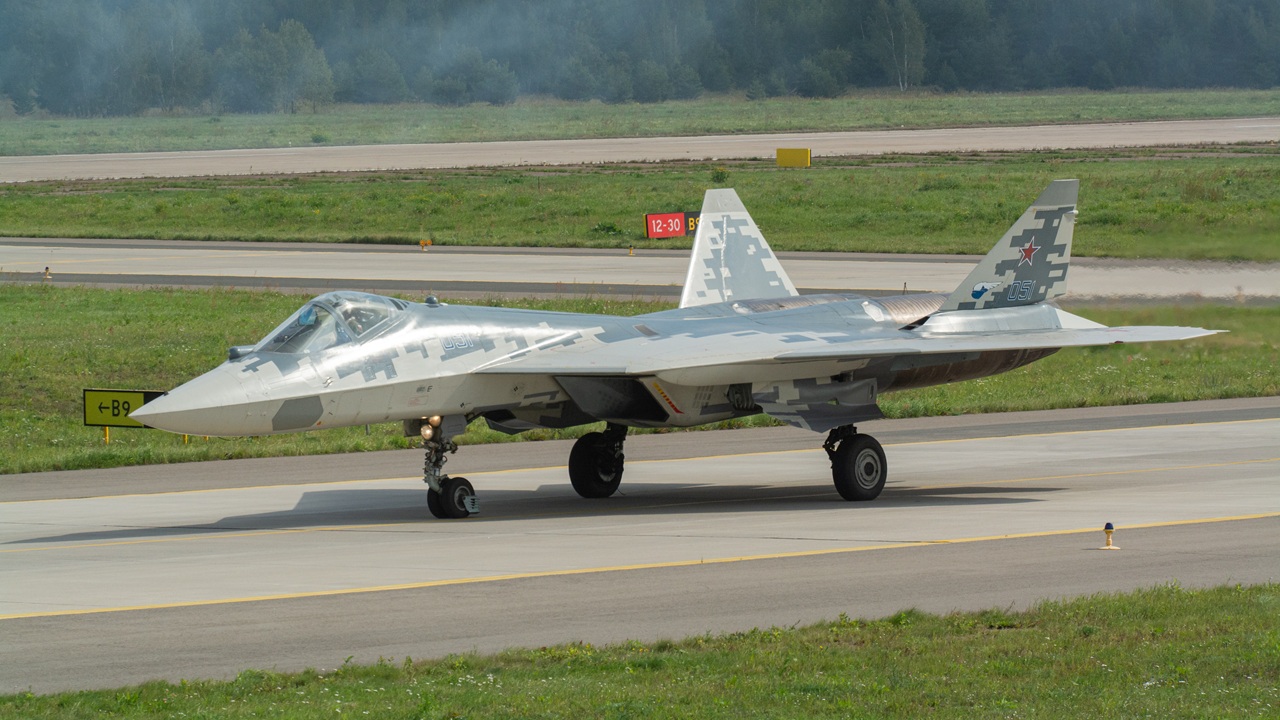
Despite the West’s best efforts, India and Russia have maintained close military cooperation—but it is still unclear if New Delhi will buy the Su-57 Felon fighter jet.
Russian President Vladimir Putin is set to travel to India on December 4, where he will meet with Indian Prime Minister Narendra Modi. Among the expected topics the two leaders will discuss is India’s potential adoption of the Sukhoi Su-57 (NATO reporting name “Felon”) fifth-generation stealth fighter, and the S-500 air defense system.
“Highly on the agenda, and this could be discussed. Our military industry is working pretty well. Russian arms 36 percent in Indian armed forces and hopefully will continue,” Kremlin spokesperson Dimitry Peskov announced in a press statement.
“Russia also hopes to discuss the possibility of India acquiring the Su-57 fifth-generation stealth fighter,” Peskov added. “The Su-57 is the best plane in the world. Su-57 will be on the agenda.”
India already operates the S-400 Triumf air defense system, which New Delhi claimed was used to shoot down multiple Pakistani aircraft during their border flare-up earlier this year. Pakistan has denied these reports.
India and Russia Have a Special Relationship
As Russia has drawn closer to China, India’s main regional adversary, the United States has attempted to drive a political wedge between New Delhi and Moscow. It redoubled its efforts following the Russian invasion of Ukraine in February 2022, seeking to build up its defense partnership with India to compensate for a drawdown in Russian military exports.
However, India remains the largest foreign buyer of Russian military hardware, and that isn’t likely to change, even as New Delhi continues to push its “Make in India” initiative. India has made great strides in its indigenous arms industry, including the construction of a domestic aircraft carrier, and is on track to construct its own fifth-generation fighter—the Advanced Medium Combat Aircraft (AMCA)—by the early 2030s. But it has also considered offers from Russia to co-produce the fifth-generation Su-57, especially as Moscow has included technology sharing and domestic production opportunities to sweeten the deal. In essence, instead of simply buying the aircraft, India would play a role in its further development.
Russian state-owned military-industrial conglomerate Rostec’s United Aircraft Corporation (UAC) had sought to close a deal with New Delhi for years. It had more recently floated an unprecedented co-production agreement—something that would not be included in any other aircraft deal, notably the US-made Lockheed Martin F-35 Lightning II.
Moreover, technology transfer from the Su-57 Felon could enable New Delhi to integrate its technology into its indigenous AMCA program.
The main sticking point for New Delhi may be Moscow’s growing ties with Beijing, but New Delhi’s options are limited. India’s Hindustan Aeronautics Limited (HAL) already manufactures a licensed version of the Sukhoi Su-30MKI (NATO reporting name “Flanker-H”), a two-seat, twin-engine multirole air superiority fighter for the IAF.
The other system that is likely to be on the table is the S-500 Prometheus. Similar to other modern air defense platforms, including the S-400 Triumf, the S-500 is more than a single component. It consists of six interconnected modules, which include the 77P6 launch vehicle, 55K6MA and 85Zh6-2 command posts, the 91N6A(M) acquisition and battle management radar system, the 96L6-TsP acquisition radar, and the 76T6 multimode and 77T6 ABM engagement radars.
All the elements of the S-500 are mounted on Russian BAZ multi-wheeled trucks or trailers. It requires a mini-convoy anytime it is on the move.
The Prometheus can employ either the 40N6M missile in its primary air defense role or the 77N6/77N6-N1 anti-ballistic/anti-satellite missile. The platform’s maker, Almaz-Antey, has also claimed that the S-500 can detect and simultaneously engage up to 10 ballistic hypersonic missiles flying at 7,000 meters (4.3 miles) per second and at altitudes of more than 180 km (110 miles). However, that hasn’t been confirmed.
Moscow has further stated that the S-500 can successfully target fifth-generation stealth aircraft, notably the American-made Lockheed Martin F-22 Raptor and F-35 Lightning II fighters, as well as the Chinese Chengdu J-20 Mighty Dragon. Although such claims are unproven, and the Prometheus has never gone head-to-head against any of these systems, it should nonetheless be considered an advanced air defense system—and one that New Delhi could certainly use in its arsenal.
About the Author: Peter Suciu
Peter Suciu has contributed over 3,200 published pieces to more than four dozen magazines and websites over a 30-year career in journalism. He regularly writes about military hardware, firearms history, cybersecurity, politics, and international affairs. Peter is also a contributing writer for Forbes and Clearance Jobs. He is based in Michigan. You can follow him on Twitter: @PeterSuciu. You can email the author: [email protected].
Image: Shutterstock / Andrey Kryuchenko.