The F-22 Raptor could be retired well before any US adversary can build a plane that approaches its strength.
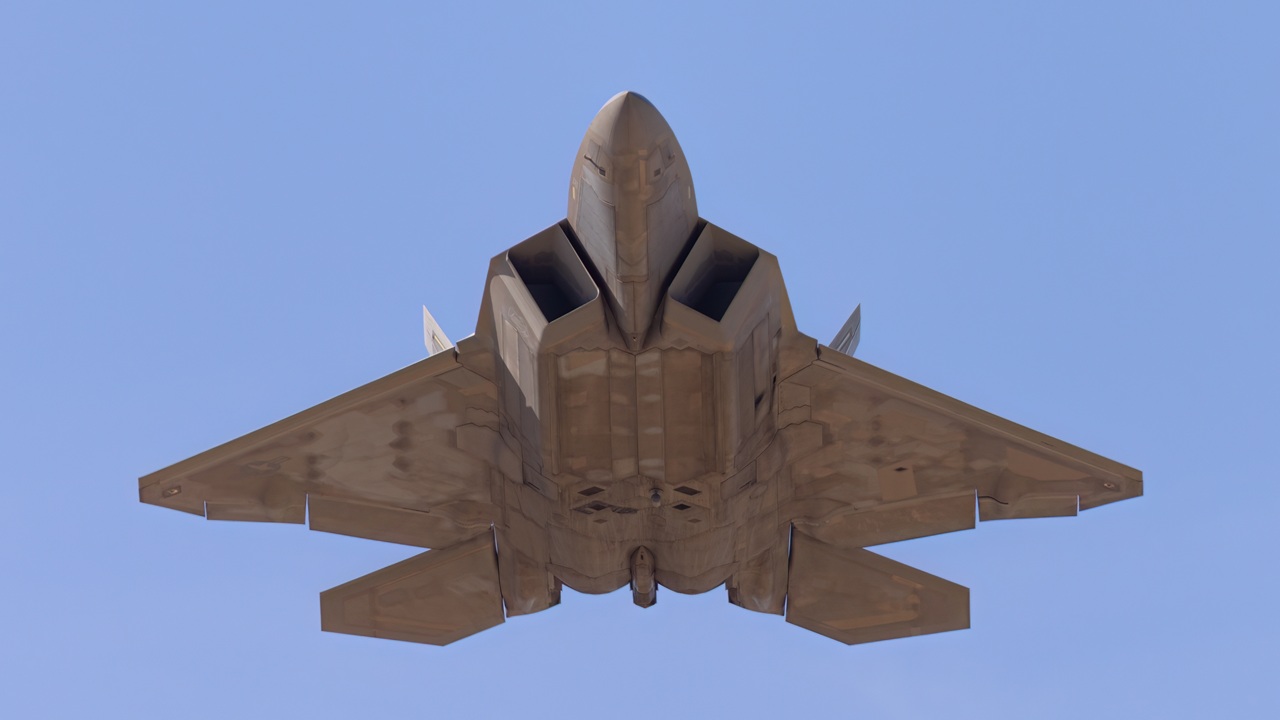
The F-22 Raptor remains the most dominant air-to-air fighter ever built. That’s what she was built for, after all: to dominate the air, to serve as a pure air superiority platform. No airframe has ever integrated stealth, super cruise, extreme maneuverability, long-range sensors, and advanced avionics so successfully into a single platform. The result is the F-22—an aircraft a full generation ahead of its time, unrivaled in aerial combat.
The F-22 Raptor’s Specifications
- Year Introduced: 2005
- Number Built: 195 total (187 operational + test aircraft)
- Length: 62 ft 1 in (18.9 m)
- Wingspan: 44 ft 6 in (13.6 m)
- Weight (MTOW): ~83,500 lb (37,875 kg)
- Engines: Two Pratt & Whitney F119-PW-100 turbofans (≈35,000 lbf / 155.7 kN each with afterburner)
- Top Speed: ~1,500 mph (2,414 km/h) / ≈ Mach 2.0
- Range: ~1,600 mi (2,575 km) with external tanks; ~460–600 mi (740–965 km) combat radius
- Service Ceiling: ~50,000+ ft (15,240+ m)
- Loadout: Internal bays for up to 6× AIM-120 + 2× AIM-9; external pylons optional for non-stealth loads
- Aircrew: 1
The US Air Force Accidentally Built a Super-Plane
Towards the end of the Cold War, as the Soviets unveiled intimidatingly capable fighters like the MiG-29 and Su-27, US war planners dreamed up a counterweight—a platform that would control the skies anywhere, no matter which Soviet aircraft was operating nearby.
The F-22 was the first true stealth air superiority fighter. Internal weapons bays reduce the radar cross-section (RCS) while a sculpted airframe and RAM coatings, designed specifically for front-aspect invisibility, enable stealth in BVR engagements. Basically, the F-22 was designed to see the enemy before the enemy sees it, shoot first, and disappear.
Stealth is only part of the platform’s advantage, though. The F-22 also features supercruise capability—the ability to sustain supersonic flight without using its fuel-intensive afterburner. The key advantages here are faster intercepts, quicker engagements/disengagement, and extended missile kinematics, with its relatively modest fuel consumption rate giving the Raptor a superb range.
While designed for BVR engagements, the F-22 also excels in-tight, thanks to thrust vectoring and extreme agility. Two Pratt & Whitney F119 engines with vectoring nozzle control give the F-22 unrivaled pitch authority. This allows for dazzling post-stall maneuvers, high alpha, rapid nose pointing, etc. So even when the BVR advantage is lost, the F-22 can maintain superiority through maneuverability. The F-22 is also superlative with respect to sensor fusion and granting the pilot situational awareness. While the F-35 has since become the gold standard in this respect, the F-22 is impressively outfitted with the AN/APG-77 AESA radar, passive sensors and electronic support measures. And for weaponry, the F-22 is armed with AIM-120D AMRAAM missiles for long-range kills, AIM-9X missiles for dogfighting, and internal cannons for emergencies.
The F-22 Is Still Valuable—Mostly as a Threat
Originally, the US Air Force had intended to procure over 750 F-22s. But the F-22 only came into existence after the Soviet Union had collapsed, destroying the United States’ only near-peer adversary. Accordingly, only 187 of the planes were ultimately delivered. And without the Soviet threat, the F-22’s operational application has been limited relative to its abilities.
Still, the F-22 is the obvious choice for establishing air dominance in the earliest hours of the conflict, penetrating contested air space, and clearing out enemy fighters and radar. The F-22 also serves an important defensive counter-air role, defending the homeland.
Essentially, the F-22 has been used as an insurance policy, guaranteeing US air dominance in any major conflict—even if it hasn’t really been needed. The mere presence of the aircraft prevents adversaries from contesting airspace, shaping their own strategy before the war begins. The F-22 is a symbolic and psychological deterrent, causing enemies to assume that they will lose BVR engagements, deflating their will to engage.
The F-22 fleet remains relevant but a replacement is already under development; the F-47 NGAD sixth-generation fighter will ultimately replace the F-22, and when that happens, the F-22 will retire as one of the most capable yet under-used platforms in aviation history.
About the Author: Harrison Kass
Harrison Kass is a senior defense and national security writer at The National Interest. Kass is an attorney and former political candidate who joined the US Air Force as a pilot trainee before being medically discharged. He focuses on military strategy, aerospace, and global security affairs. He holds a JD from the University of Oregon and a master’s in Global Journalism and International Relations from NYU.
Image: Shutterstock / ranchorunner.