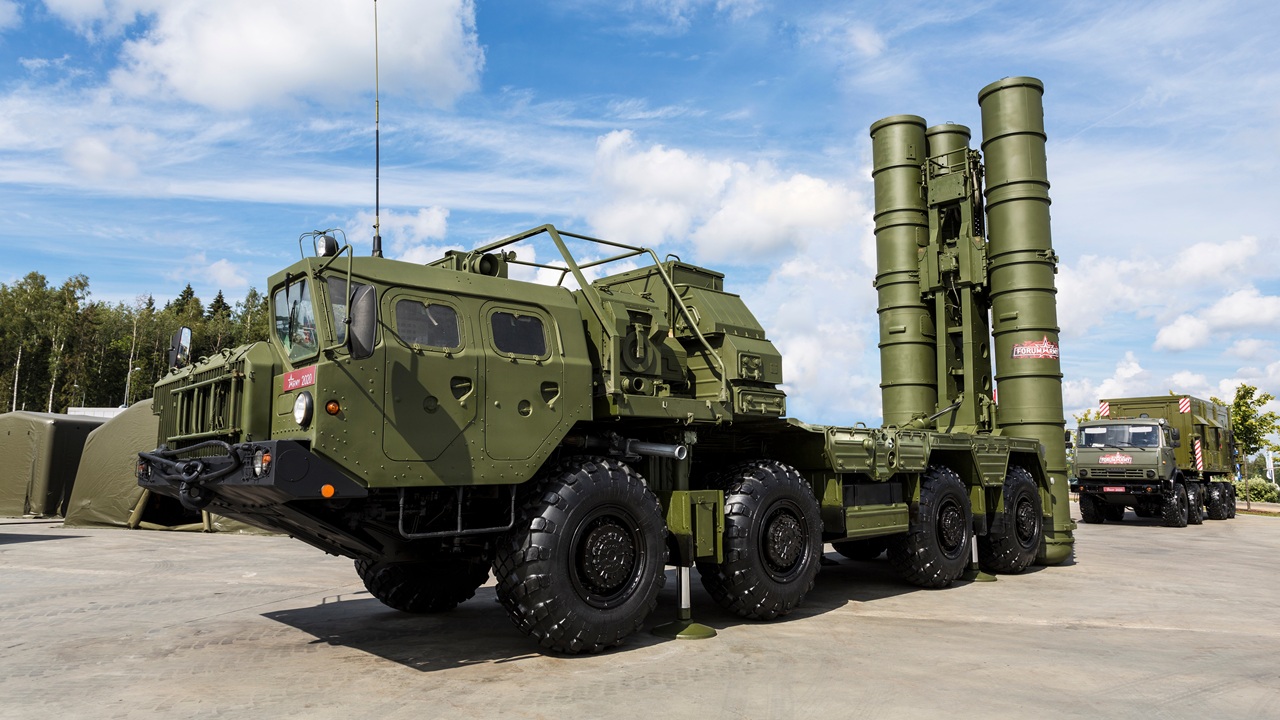
Turkey has kept the S-400 systems deactivated for nearly a decade as it has sought re-entry into the US-led F-35 program.
In a little over a week, millions of American consumers will be returning holiday gifts they didn’t like. Now, NATO member Turkey is attempting to do the same with a certain “unused” piece of military hardware that it bought more than a decade ago—the S-400 Triumf air defense system, originally purchased from Russia but never turned on.
Turkish President Recep Tayyip Erdogan reportedly raised the issue with Russian President Vladimir Putin during a leaders’ meeting in Turkmenistan last week.
There has been growing speculation that Turkey would seek to return the S-400 (NATO reporting name SA-21 Growler) that it acquired during the first Trump administration, which ultimately led to Ankara’s ejection from the F-35 Lightning II program. Washington and NATO leaders expressed serious concerns that the S-400 wasn’t compatible with the F-35 and would affect the stealth fighter’s security.
At the time, Turkey refused to back down, but over the past decade, it has repeatedly attempted to resolve the matter. Various solutions have been proposed, including Ankara’s transfer of the still non-operational units to the US military, notably the Incirlik Air Base in the country’s south, or a sale to a third party such as India or Pakistan. New Delhi has also adopted the S-400 and is awaiting additional batteries to enable the transfer, addressing two problems.
Bloomberg first reported on Wednesday that Erdogan personally raised the issue with Putin, but the Turkish presidency and Ministry of Defense declined to comment, and the Kremlin denied that any such request was made during the recent meeting.
Why Turkey Bought the S-400 System
The decision to adopt the S-400 Triumf may be one Ankara now regrets, but it was made during what Bloomberg described as a “period of estrangement from its North Atlantic Treaty Organization allies.” The chill in relations first began under the Obama administration, which objected to Erdogan’s crackdown on anti-government demonstrations in May 2013. Relations grew worse in 2016 after Erdogan’s government survived a coup attempt by a faction within the Turkish military. Erdogan blamed the attempt on US-based Turkish anti-government cleric Fethullah Gülen and requested his extradition, which Washington refused to grant.
At the time, Turkey was seeking to buy the US-made MIM-104 Patriot air defense system, but “Washington was not committed to finalizing a deal.” This led Ankara to turn to Russia for the S-400—a step that was immediately met with condemnation from Washington and NATO over F-35 concerns. During the first Trump administration, Washington imposed sanctions on Turkey under the “Countering America’s Adversaries Through Sanctions Act (CAATSA).
Despite acquiring two S-400 batteries, both of which have been delivered, neither has been activated.
Turkey’s Complicated East-West Balancing Act
Turkey remains NATO’s second-largest military power by size, while also balancing its ties with Russia. Ankara did not impose sanctions on Moscow, even as it restricted naval access to the Black Sea and has provided weapons to Ukraine.
Erdogan has said that Turkey’s location requires a balanced foreign policy, much to the chagrin of Washington. Yet, Ankara has continued to serve as a mediator in the ongoing war between Russia and Ukraine.
Even as the Kremlin denies that a return of the S-400 was discussed, there are reasons to believe it would be in the two countries’ interests. Russia has lost several air defense batteries in its unprovoked war with Ukraine, and has outstanding orders to fill with India.
The S-400 could be used as a bargaining chip between the two countries over the oil and natural gas Turkey imports from Russia.
Turkey Could Be a Huge Market for American F-35s
Turkey had initially planned to buy approximately 100 F-35s and was a major partner in the program. Beyond the capabilities denied to its air force, Turkey was excluded from the Lockheed Martin F-35 Lightning II supply chain after reportedly paying $1.25 billion to participate in the program.
Production of parts for the Joint Strike Fighter was expected to generate $9 billion in revenue for Ankara, while six F-35 aircraft produced for Turkey were not delivered.
In August 2024, Turkish businessman Cavit Caglar, who served as minister of state in the early 1990s, publicly stated that Ankara should seek a foreign buyer, perhaps from India or Pakistan, as such a move could win Washington’s favor.
Turkey paid approximately $2.5 billion for four S-400 air defense systems, with 45 percent paid upfront and the remaining amount financed by a Russian loan. Earlier this month, reports indicated that Ankara was exploring a return to the F-35 program.
“The cost of S-400 missiles and radars pales in comparison with the diplomatic capital Turkey could gain with NATO allies—and Trump in particular—if it gets rid of the system,” Bloomberg added, citing people familiar with the matter.
This is the season of miracles, and also the time when there are many returns for items people don’t want. This is likely to include the S-400 Triumf sooner or later.
About the Author: Peter Suciu
Peter Suciu has contributed over 3,200 published pieces to more than four dozen magazines and websites over a 30-year career in journalism. He regularly writes about military hardware, firearms history, cybersecurity, politics, and international affairs. Peter is also a contributing writer for Forbes and Clearance Jobs. He is based in Michigan. You can follow him on Twitter: @PeterSuciu. You can email the author: [email protected].
Image: Shutterstock / volkova natalia.