Pressure on Israel is the best way to keep the Lebanese ceasefire from unraveling.
One year after the so-called “ceasefire” between Israel and Lebanese Hezbollah began, Israel could be set to renew full-scale hostilities against the group, further confirming that the agreement is anything but a real cessation of hostilities. Indeed, the context of Lebanon offers a clear case that Israel and Washington’s “peace through strength” approach—code for overt aggression against real and perceived enemies to achieve short-term tactical policy victories as opposed to major strategic wins—will not seriously alter today’s geopolitical makeup in the Middle East without a serious reassessment.
To be sure, efforts to disarm Lebanon, let alone south of the Litani River—as stipulated in the faulty ceasefire—was always one of the most difficult issues in an already issue-plagued Middle East. Still, per the November 2024 agreement, both Hezbollah and Israel were to evacuate their forces and military assets from Lebanon’s south, ceasing fire on each other’s positions and broader civilian locations. As the thinking went, Hezbollah had been weakened to the point that Israel could step back and achieve sustainable gains in the country and against one of its non-state nemeses.
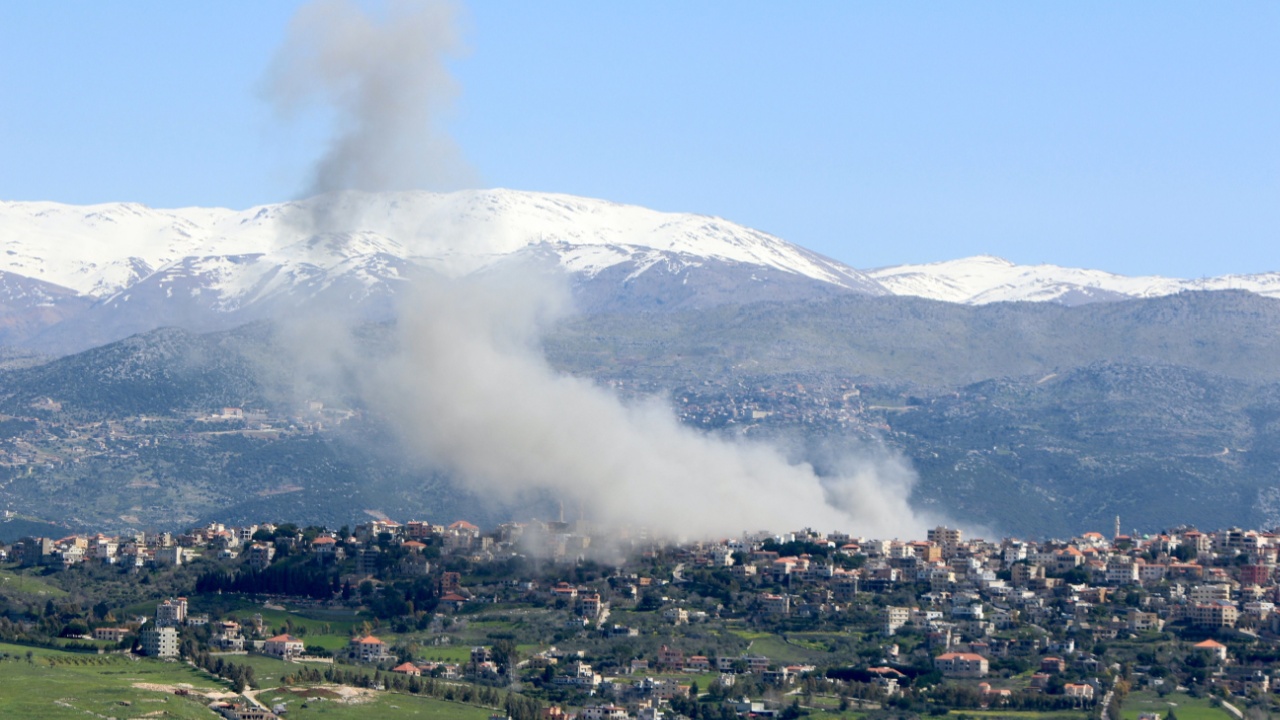
Rather, Israel refused to leave five key points along the disputed Israel-Lebanon border, opting to continue near-daily strikes on its northern neighbor—including in southern Beirut—amid sporadic incursions into south Lebanon villages and persistent efforts to demolish civilian infrastructure. Israeli political leadership continues to insist that it will not leave sovereign Lebanese territory that it illegally occupies without a full confirmation that Hezbollah disarms across the entirety of the country. It continues to threaten a return to full-scale hostilities to pressure Lebanon’s political leadership to lean on the group and, likely, to bolster Israeli prime minister Benjamin Netanyahu’s far-right political coalition, which keeps him in power.
Understanding the precariousness of the situation, Beirut has opted for a gradual—and thus less intense—disarmament effort, with the Lebanese Armed Forces (LAF) increasingly deploying to the south. That effort is central to the ceasefire. However, Israel’s ongoing operations have severely hampered it, with numerous LAF soldiers killed by the Israeli military as they have attempted to move south. Those operations have also targeted the United Nations peacekeeping mission in the country, the United Nations Interim Force in Lebanon (UNIFIL).
For Lebanon’s political leadership, this dynamic presents a dangerous situation: It is being pressured by Israel and the broader West to take a harder line on Hezbollah, on one side, and by Hezbollah and its allies to cease its close collaboration with these Western actors on issues like disarmament on the other. That scenario is a lose-lose for the government of reformist President Joseph Aoun and Prime Minister Nawaf Salam, who understand all too well how easily Lebanon’s domestic political situation can unravel after having lived through the country’s 15-year civil war just a few decades ago.
Hezbollah also understands the dynamic at play, even if operating from a position of weakness. The group knows that it cannot simply be uprooted or wiped out, especially after watching Hamas hold out in Gaza. Israel’s ongoing occupation only hardens its resolve by bolstering its raison d’être: resisting Israeli occupation. Simply put, the longer Israel remains on Lebanese territory, the more Hezbollah’s political base will support the group in resisting as it continues to reject disarmament.
This catch-22 will not yield a serious resolution but will instead exacerbate conflict in a country already struggling to handle and internalize additional instability. And yet, for Israel, the status quo appears to be the point. It feels emboldened to create facts on the ground that allow it to make maximal demands of its real and perceived enemies. That means taking actions that give it infinite freedom of action across the region and, particularly, within and against its neighboring countries, barring agreements with those actors that fully secure its geopolitical interests and negate the need for the given status quo.
But just as Lebanon’s political leadership is stuck between a rock and a hard place, Jerusalem cannot achieve its maximalist demands either. Whether its political leadership recognizes this reality is unclear today, but it would match what appears to be an updated version of “mowing the grass” in Lebanon. Persistent Israeli promises of a renewed, full-scale military campaign in Lebanon further suggest this dynamic is at play, especially as the alternative—inducing another Lebanese civil war that forces Lebanon’s political forces to fight Hezbollah on its behalf—is hardly a rosy alternative.
The case of Syria is telling here. In a nearly identical approach to Lebanon, Israel illegally occupies sovereign Syrian territory as part of its new national security doctrine, externalizing its security while making maximalist demands. It continues to reserve its perceived right to strike the country at will as talks languish in perpetuity. For Jerusalem, that status quo appears to work for its political and military leadership, especially as freedom of action in Syria allows them to strike Iran at will, should it desire to do so.
Thus, the evolving geopolitical situation in the Levant and the broader Middle East reflects an Israeli effort to maintain hegemonic control over its neighbors. It does so through US support—political, military, and economic—as Jerusalem would be unable to sustain its efforts without it. Rumored US efforts to expand its military presence in Syria, alongside Israel, reflect a Washington willing to backstop Israeli hegemony at a new level while micromanaging its junior partner and weaker neighbors in the region.
Yet in the so-called “New Middle East,” this project merely repeats the past. Cementing an unsustainable status quo undergirded by occupation and military violence will not achieve a long-elusive “peace in the Middle East.” Doing so in the past produced the horrors of today—including Hamas’ October 7, 2023 attacks, attacks and Israel’s invasion of Gaza. Suggesting that a weakened Iran and its so-called “Axis of Resistance” present a unique moment in which these same interventionist strategies can finally work this time around constitutes the definition of insanity, not sound policymaking.
After one year of a disastrous, one-sided “ceasefire, Lebanon and President Donald Trump’s broader Middle East strategy sit at a crossroads. If he is truly a dealmaker and provisioner of peace, President Trump should recognize Israel’s role as a spoiler of deals and peace in the Middle East, reining in its junior partner by utilizing the profound levels of influence Washington holds over Jerusalem to end its deference to instability and chaos at the expense of its neighbors. The alternative—holding steady on the current path—will delegate this administration’s Middle East strategy to the dustbin of history, where it would deservedly belong given the failures it is and will continue to produce if implemented.
About the Author: Alexander Langlois
Alexander Langlois is a foreign policy analyst, the senior editor at DAWN, and a contributing fellow at Defense Priorities. He is focused on the geopolitics of the Levant and the broader dynamics of West Asia. Langlois holds a Master of Arts degree in International Affairs from American University. He has written for various outlets, including The Carnegie Endowment for International Peace’s Sada, the Atlantic Council’s MENASource, the Lowy Institute, the Gulf International Forum, the New Arab, the Nation, and Inkstick. Follow him on X: @langloisajl.
Image: Ramiz Dallah / Shutterstock.com.