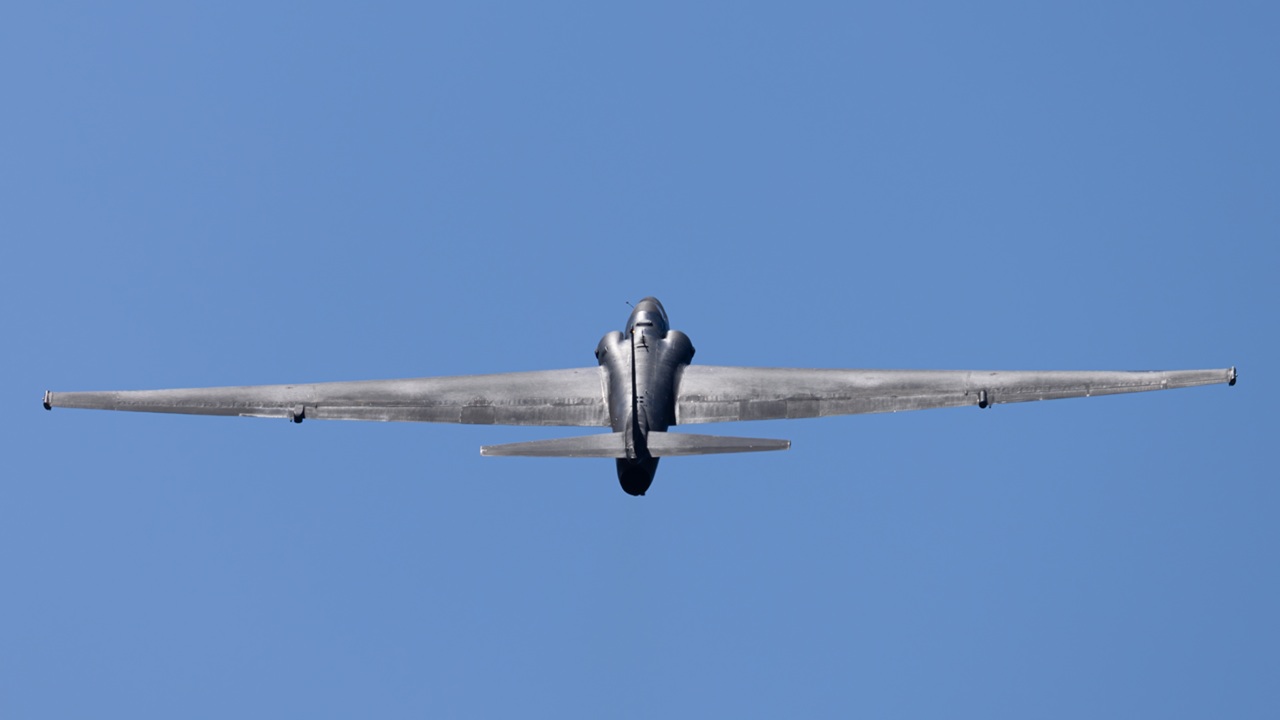
The Lockheed U-2 Dragon Lady routinely operates above 70,000 feet, an altitude few aircraft can reach or sustain. At those heights the air is thin, the margins between stall and overspeed are razor-thin—only around ten knots. To engineer an aircraft capable of operating in such an environment, designers had to overcome a variety of technical challenges, to create something that carefully balanced aerodynamic design, propulsion, and materials—all while being able to fulfill a vital strategic purpose.
The U-2 Dragon Lady’s Specifications
- Year Introduced: 1955
- Number Built: ~104 (all variants)
- Length: 63 ft 0 in (19.2 m)
- Wingspan: 103 ft 0 in (31.4 m)
- Weight (MTOW): ~40,000 lb (18,100 kg)
- Engines: One General Electric F118-GE-101 turbofan (≈17,000 lbf / 76 kN thrust)
- Top Speed: ~500 mph (805 km/h)
- Range: ~6,500 mi (10,460 km)
- Service Ceiling: ~70,000+ ft (21,300+ m)
- Loadout: No weapons; modular ISR sensor payloads (SIGINT, IMINT, radar, atmospheric sampling)
- Aircrew: 1
Why the U-2 Was So Innovative
The U-2 was developed in the early Cold War. The US faced a critical intelligence gap, with the Soviet Union closed to overflight, in the years before satellites existed. To better understand what was happening behind the Iron Curtain, the US needed an aircraft that could physically penetrate the air space, flying above Soviet air defenses, relying on altitude for evasion in the years before stealth existed. Altitude was the key because early Soviet SAMs and fighters operating within a limited ceiling. Accordingly, the U-2 design prioritized one performance metric above all others: altitude.
The U-2’s primary role was to perform high-altitude intelligence, surveillance, and reconnaissance (ISR). Missions included optical and radar imaging, signals intelligence, and atmospheric sampling. But the U-2 remains relevant today because it can carry large, swappable sensor payloads, loiter for long periods, and be retested mid-flight, proving useful in an ISR niche between satellites and drones, which have their own respective limitations.
But creating an aircraft that could fly above 70,000 feet presented an engineering challenge, particularly in the 1950s when the U-2 was first conceived of. At extreme altitudes, the air is so thin that lift is hard to generate, engines struggle to breathe, and control surfaces lose their effectiveness. Aircraft must compensate somehow, generating enough lift at low air density, avoiding stalls at low speed while also avoiding overspeed.
The solutions, in the case of the U-2, were complex and overlapping, starting with an enormous, high-aspect-ratio wing. The concept is similar to a sailplane, with long wings, minimal drag, and efficient lift generation. The benefits here are sustained flight in thin air and low wing loading. The tradeoffs are real, though, including fragile structure and terrible low-altitude handling characteristics—which makes landing the U-2 uncommonly difficult.
Flying the U-2 Has Zero Margin for Error
The U-2 was constructed to be lightweight. At 70,000 feet, every single pound matters. So, designers used lightweight alloys with minimal structural redundancy. Accordingly, the U-2 has limited armor and no excess whatsoever. This featherweight concept allowed for a higher ceiling and longer endurance, but increased the plane’s vulnerability and maintenance complexity.
And of course, at 70,000 feet, ambient pressure is insufficient for human life. Designers had to create a variety of systems to sustain the pilot’s life, starting with a full pressure suit, similar to what astronauts wear, and also including oxygen systems, temperature regulation systems, and fatigue management systems; the human body was not meant to exist at the altitudes the U-2 routinely operates, causing pilot survival to become a primary design choice.
The U-2 proved that altitude could substitute for stealth or speed, at least in the early days of the Cold War. SAM technology has long since improved, rendering the U-2 vulnerable, but not obsolete. She still flies today—still higher than anything else in the sky.
About the Author: Harrison Kass
Harrison Kass is a senior defense and national security writer at The National Interest. Kass is an attorney and former political candidate who joined the US Air Force as a pilot trainee before being medically discharged. He focuses on military strategy, aerospace, and global security affairs. He holds a JD from the University of Oregon and a master’s in Global Journalism and International Relations from NYU.
Image: Shutterstock / ranchorunner.