Can the Donald Trump administration stomach the short-term political costs of engaging with Afghanistan for the long-term benefit of US influence in Central Asia?
Before Afghanistan in 2021, America was last defeated by a national liberation movement in Vietnam in 1975. After the fall of Saigon, the “domino theory” assured Americans that Asia would quickly fall to Communism. That didn’t happen, and the ensuing violence (Vietnam’s 1979 invasion of Cambodia and China’s attack on Vietnam) didn’t affect American security. But Eurasia in 2026 is another situation entirely. While Washington waited 19 years to establish diplomatic relations with the Socialist Republic of Vietnam, it shouldn’t delay diplomatic recognition of the new regime in Afghanistan.
There is a lot going on: Nuclear-armed India and Pakistan fought a short war in May 2025; relations between Pakistan and Afghanistan are tense over the activities of the Tehrik-e-Taliban Pakistan (Pakistani Taliban) and the Baluchistan Liberation Army; Iran has been accused of developing nuclear weapons and was recently attacked by Israel and America; the region is host to several nascent connectivity networks, and may possess abundant rare earth elements; the Central Asian republics’ economies are rapidly growing; and, everyone depends on Afghanistan for water.
Recent US-Afghanistan history is a history of misunderstandings that caused both sides to commit strategic blunders.
After the 9/11 attacks, the Taliban erred by not rendering Osama bin Laden to the United States and then proposing that he be tried by a court in an Islamic country. The United States subsequently attacked and occupied the country for 20 years.
After the US attack and rout of the Taliban forces, Taliban leaders attempted to surrender several times, but Washington, intoxicated by a brew of post-Cold War triumphalism and post-9/11 grievance, wanted to make an example of them. America was still the “indispensable nation,” and its neoconservative curators were anxious to operationalize their sacred text, the Fiscal Year 1992 Defense Planning Guidance.
The Americans failed to understand that the Taliban were Afghan nationalists inspired by Islam instead of transnational Islamists like Al Qaeda or the Islamic State. This misunderstanding was the root of the argument that Afghanistan would become a center of terrorism against the West; however, in 2024, a CIA official reported, “The dire predictions have not come to pass.”
In the 1990s, the only major infrastructure project in the region was the UNOCAL natural gas pipeline from Turkmenistan to Pakistan via Afghanistan. The project collapsed as Afghanistan’s civil war made construction impossible and the Taliban’s international isolation made financing difficult. After the 1998 US embassy bombings, UNOCAL withdrew entirely as the US government claimed Usama bin Laden, who was believed to be in Afghanistan, was behind the bombings.
But in 2026, Afghanistan will be a key part of most of the regional connectivity projects.
There is the TransAfghan Multimodal Transport Corridor, which aims to create a “southern corridor” linking Central Asia to the Arabian Sea, ultimately connecting to Jebel Ali Port in the United Arab Emirates (UAE); the Termez-Mazar-i-Sharif-Kabul-Peshawar Railway (Kabul Corridor). Uzbekistan is leading the push to revive this long-planned corridor, which would provide Central Asia with direct access to Pakistan’s seaports; and the Turkmenistan-Afghanistan–Pakistan Railway (Western Corridor), a parallel route to the Kabul Corridor, as Turkmenistan aims for more direct access to Pakistan’s ports, and Kazakhstan wants to diversify its southern transit options.
The Iran-Afghanistan-China Strategic Railway Link is a strategic railway linking Iran to China through Afghanistan, and avoids maritime chokepoints between China and West Asia. It was added to Iran’s working agenda in 2025.
Then there is road network expansion in Afghanistan as the government aggressively pursues road upgrades to complement rail corridors and improve internal logistics. And in December 2025, Afghanistan’s Ministry of Finance announced a memorandum of understanding with DP World of the UAE to study potential investment in Afghan port infrastructure. If an agreement is finalized, DP World could help modernize ports such as Hairatan, bordering Uzbekistan, and Torkham, bordering Pakistan.
According to the China Belt and Road Initiative (BRI) Investment Report 2025 H1, the first half of 2025 saw the highest engagement for any six-month period ever, with $66.2 billion in construction contracts and $57.1 billion in investments (greater than BRI engagement in all of 2024, which was $122 billion) BRI’s total engagement since the program’s start in 2013 now totals $1.3 trillion.
Of that spending, $39 billion went to Africa, and $25 billion went to Central Asia. That’s impressive on a per capita basis, as Africa’s population is about 1.5 billion and Central Asia’s is about 84 million.
At the September 2025 summit of the Shanghai Cooperation Group in Tianjin, China, Chinese president Xi Jinping met one-on-one with all the leaders of the republics. In the official picture of the meeting attendees, the five republics’ presidents are standing in the front row, a clear signal of China’s intent.
China looks to be in the driver’s seat, but in June 2025, the Taliban shocked Beijing by cancelling the 25-year contract to develop oil fields in the Amu Darya River basin; China had pledged to invest $540 million in the first three years. Each side blamed the other, and Afghanistan has no formal process to resolve disputes, so a resolution may not be imminent.
In December 2025, Amir Khan Muttaqi, Afghanistan’s foreign minister, told former US ambassador to Kabul Zalmay Khalilzad that US-Afghanistan relations are in a “new phase” and that bilateral relations can be developed through sustained dialogue. Any salesman would recognize that as a “buy signal.”
In July 2025, Russia became the first country to recognize the Taliban government. But will this delay more American engagement with Afghanistan if President Donald Trump resists being a follower of Russia’s move?
Improved roads in faraway places don’t excite Americans much, but Americans held hostage to unfriendly governments do. In March 2025, The Wall Street Journal reported there were seven Americans “wrongfully detained” in Afghanistan. Five Americans were released in 2025, and the Taliban likely hoped for a positive response from Washington, but nothing happened.
If President Donald Trump just pockets the winnings, that will weaken the Taliban, who want better ties with Washington; they will be less likely to accommodate the next American initiative, as the penalty may be more severe than premature retirement followed by a think tank sinecure.
Trump would prefer to get the remaining detainees immediately, but an opportunity may come when he visits Central Asia (he has been invited several times to Uzbekistan and Kazakhstan). Tashkent has long dealt with the Taliban and can facilitate the release, but it won’t want to midwife an unfair deal with Kabul, its “forever neighbor.” And Uzbekistan has yet to work out a water-sharing agreement with Kabul over the waters of the Amu Darya, the most critical file for Tashkent.
President Bill Clinton was criticized for restarting ties with Vietnam, and Trump can expect the same for outreach to Afghanistan. In any case, hyperventilating about the Taliban hosting Al Qaeda looks unserious since an Al Qaeda alumnus (Syrian president Ahmed al-Shara) visited the Oval Office and was spritzed with cologne.
The Taliban beat America fair and square. Now, if Trump really wants to advance US engagement in Central Asia, which includes Afghanistan, he must move beyond low-hanging fruit, like inviting Uzbekistan and Kazakhstan to the next G20 meeting, and take decisive action. Clinton weathered the storm, so will Trump.
About the Author: James Durso
James Durso is a regular commentator on foreign policy and national security matters. Mr. Durso served in the US Navy for 20 years and has worked in Kuwait, Saudi Arabia, and Iraq. Follow him on X: @james_durso.
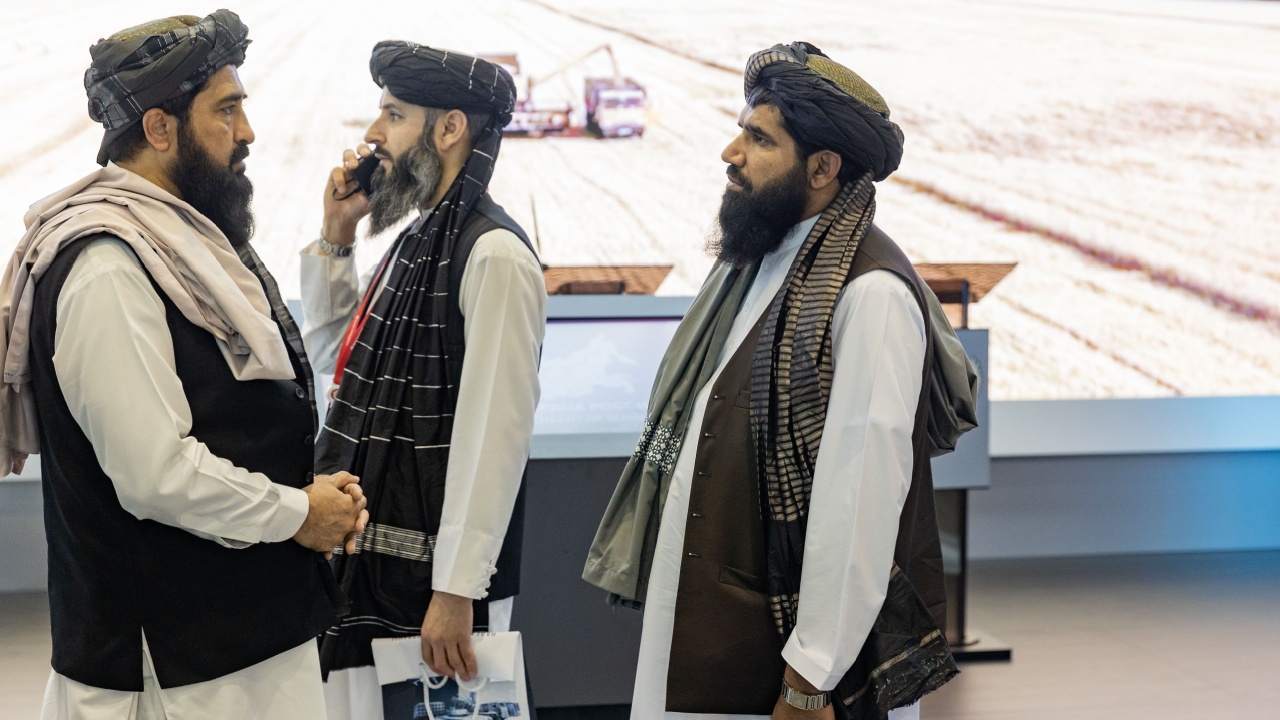
Image: Aleksey Smyshlyaev / Shutterstock.com.