The Red Wolf has an effective range of more than 200 miles—giving the Marine Corps greater flexibility in its operations in the Indo-Pacific.
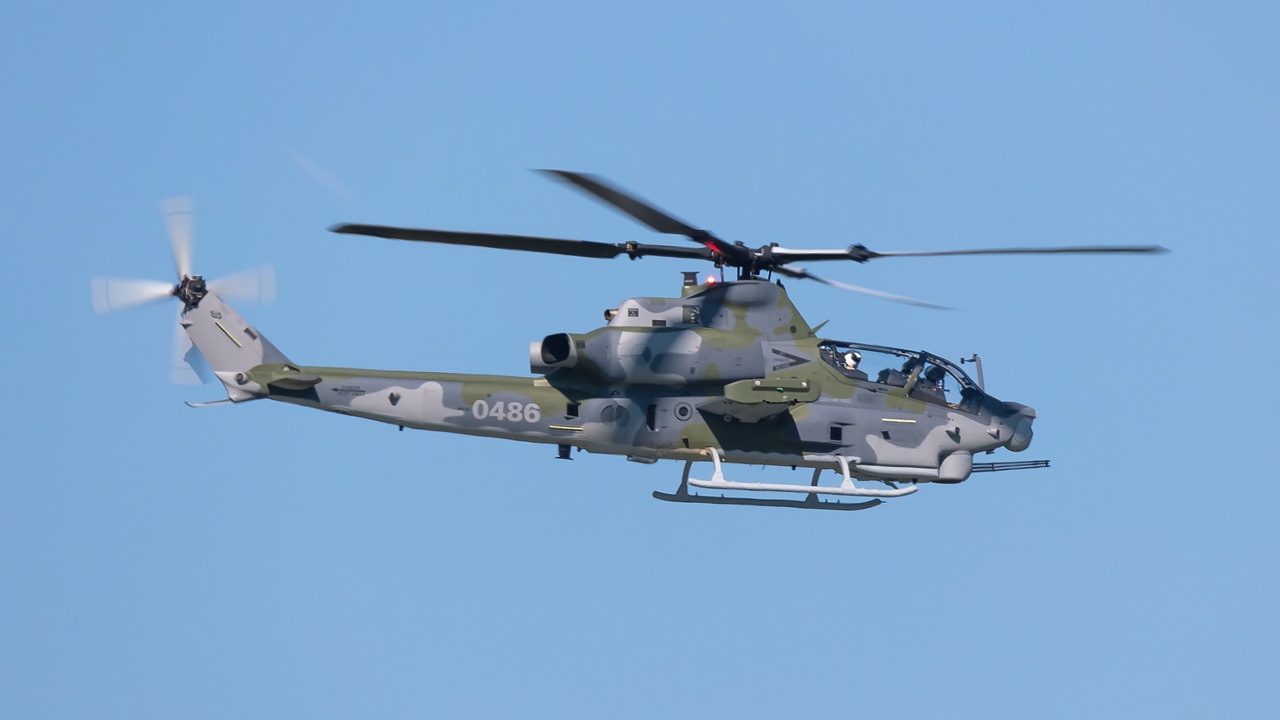
The United States Marine Corps’ Bell AH-1Z Viper attack helicopters will be equipped with the “Red Wolf” air-launched weapon system developed by L3Harris Technologies. The company announced that it had been selected by the US Naval Air Systems Command to “develop, test and manufacture” the Red Wolf vehicles for the Marine Corps’ Precision Attack Strike Munition (PASM) program.
“L3Harris’ Red Wolf systems will fill a gap in modern warfare with long-range precision weapons capabilities,” the company said in a statement. The defense contractor was awarded an $86.2 million contract to deliver an unspecified number of Red Wolf weapons by the end of fiscal year 2027 (FY27).
What Exactly Is the “Red Wolf” System?
The PASM program has sought to provide the USMC with a close-effect, longer-range, precision weapon that could “deliver diverse effects (kinetic or non—kinetic) from AH-1Z aircraft in land and sea-based environments.”
The Red Wolf system was selected following 52 successful launches of effect vehicle flights, including a low-altitude test conducted by a US Marine Corps AH-1Z Viper rotary-wing aircraft.
“We are proud to partner with L3Harris Technologies to deliver a system that will provide a decisive advantage to Marine Corps pilots and support their missions worldwide,” said Rear Adm. Tony Rossi, who oversees the Program Executive Office for Unmanned Aviation and Strike Weapons (PEO (U&W)).
L3Harris describes the Red Wolf as a “kinetic vehicle for long-range precision strikes,” rather than simply as a missile, although it effectively functions as one. It is intended to partner with a sister system, the “Green Wolf,” which provides electronic warfare support.
The platform was developed to extend the range of air-launched weapons to proven distances exceeding 200 nautical miles when fired by a vertical take-off and landing platform. That is greater than the “single-digit range” of existing rocket-launch missiles. It provides beyond-visual-line-of-sight communication and autonomous over-the-horizon engagements, which would increase the number of aircraft available for strike missions.
Recent conflicts and incursions over NATO airspace, particularly with the increased use of mass-produced drones, demonstrate the urgent need for cost-effective alternatives to exquisite munitions,” explained Christopher Kubasik, chairman and CEO at L3Harris. “Our proven Red Wolf system can bring affordable mass to the Marines’ arsenal of advanced munitions within the timeline US officials have outlined to support the most lethal fighting force in the world.”
The Red Wolf was fielded through the Department of the Navy’s Long-Range Advanced Missile program and the Defense Innovation Acceleration program. Flight testing of the launched effects system began in 2020, and it has been successfully employed on both manned and unmanned fixed-wing and rotary aircraft, as well as on ground-based platforms.
Formed from a merger of L3 Technologies and Harris Corporation in June 2019, L3Harris Technologies is now the sixth-largest defense contractor in the United States. It is headquartered in Melbourne, Florida.
The Red Wolf Will Strengthen the Marines in the Indo-Pacific
The contract award for the Red Wolf is part of the USMC’s increased focus on operations in the Indo-Pacific region—part of their pivot away from land-based operations to amphibious ones. The new system is expected to increase the capabilities of the Bell AH-1Z Viper, the service’s primary attack helicopter.
The United States Marine Corps operates approximately 189 Vipers, with the final aircraft delivered in November 2022. The Viper replaced the older AH-1W Super Cobra for attack, armed escort, and close air support, as part of the Marine Corps Force Design 2030 plan.
About the Author: Peter Suciu
Peter Suciu has contributedover 3,200 published pieces to more than four dozen magazines and websites over a 30-year career in journalism. He regularly writes about military hardware, firearms history, cybersecurity, politics, and international affairs. Peter is also a contributing writer for Forbes and Clearance Jobs. He is based in Michigan. You can follow him on Twitter: @PeterSuciu. You can email the author: [email protected].
Image: Shutterstock / Soos Jozsef.