Washington does not seem to realize that it holds more leverage over the wealthy petro-monarchies of the Persian Gulf than vice versa. It should use it.
On September 9, 2025, 15 Israeli fighter jets fired 10 missiles at a building in Doha, Qatar that housed members of Hamas’ negotiation team. Six people were killed in the attack, including a Qatari police officer who was on the scene. Israel’s attack on Qatar, home to the largest US military base in the Middle East, elicited a mix of shock and indignation from members of the Gulf Cooperation Council (GCC).
Gulf leaders have long sought closer security ties with the United States by purchasing American weaponry or hosting US military bases on their soil. The strategy was borne out of the belief that entangling their security interests with Washington would shield them from the chaos plaguing the rest of the region. The strikes on Doha have shattered such illusions. Nevertheless, for an attack described by Mohammed bin Abdulrahman Al Thani, Qatar’s prime minister, as “a pivotal moment” in the region’s history, the response from Gulf states has been lackluster. Rather than decoupling from the US security architecture, GCC states have doubled down on American security assurances.
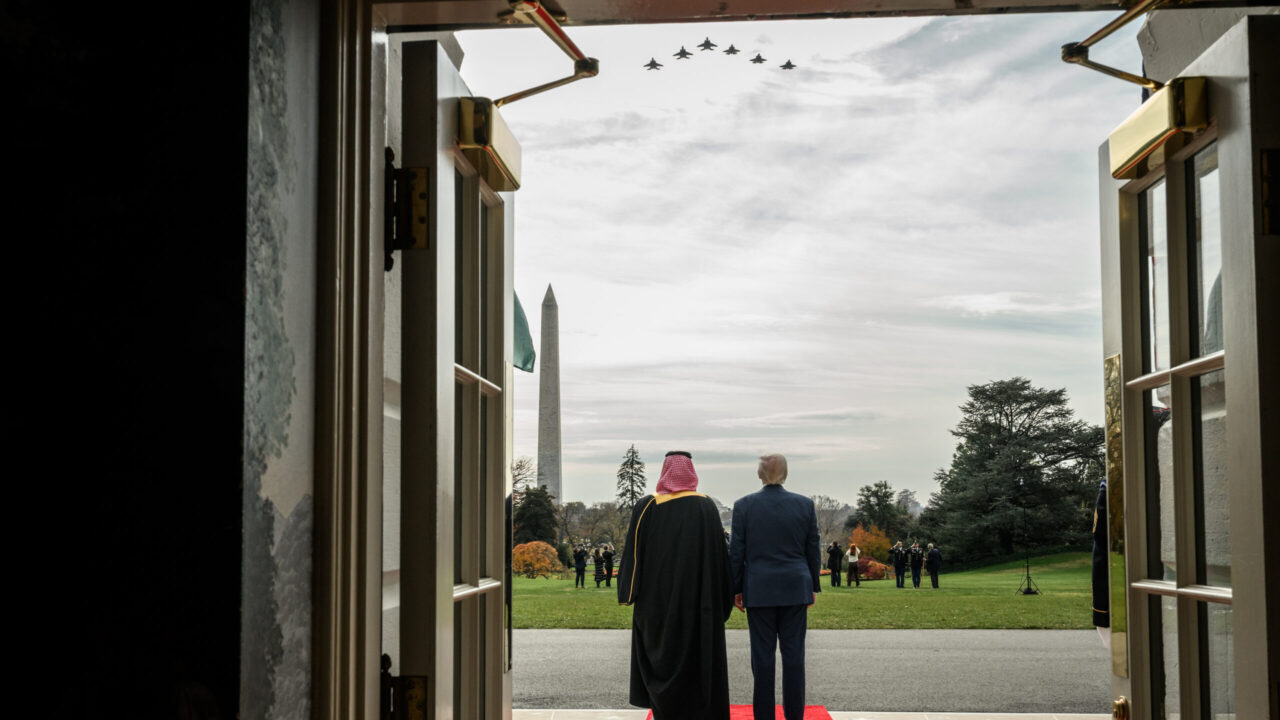
Qatar deepened defense ties with the United States by signing a mutual defense agreement, which considers any armed attack on Doha a “a threat to the peace and security of the United States.” Similarly, during his recent visit to Washington, Saudi crown prince Mohammed bin Salman (MBS) signed a major defense agreement, which, according to the White House, “affirms that the Kingdom views the United States as its primary strategic partner.”
The decisions made by Gulf leaders in the aftermath of Israel’s attack on Qatar reflect their precarious regional position. Gulf states recognize that no global power can supplant Washington’s role as a security guarantor. Moreover, GCC states are unable to hedge against US security assurances by strengthening defense ties among themselves, as their respective strategic autonomy agendas clash with the multilateralism inherent to collective defense organizations. Washington must leverage its privileged bargaining position by not overextending security guarantees to Gulf states, which would further entangle it in the region.
Why Gulf States Are Seeking Strategic Autonomy
The 2011 Arab Spring protests and the subsequent turmoil were among the primary factors that drove Gulf leaders to pursue strategic autonomy. The fall of Hosni Mubarak’s regime in Egypt, a close ally of Saudi Arabia, and the Obama administration’s calls for the Egyptian president to step down forced Gulf leaders to confront fundamental questions. After all, if the United States stood by and allowed Mubarak’s 30-year regime to fall, who is to say they would be of any assistance if Gulf monarchies found themselves under similar public pressure to abdicate?
Closer to home, the 2011 uprising in Bahrain hit at the heart of Gulf leaders’ anxieties, as the predominantly Shia makeup of the protests aroused suspicions of Iranian meddling in the domestic politics of the region. Saudi Arabia, with a substantial Shia population in the oil-rich eastern part of the country, viewed Iranian interference in Gulf politics as existential to its security. The kingdom expected a US response that matched the gravity of the situation. However, instead of supporting the Bahraini monarchy, the Obama administration condemned violence against protesters and urged restraint.
Washington’s response enraged Gulf leaders and prompted a shift in mindset toward American security assurances. This new strategy was expressed concisely by Anwar Gargash, former Emirati minister of state for foreign affairs: “No outside country will any longer guarantee regional security, as Britain once did, and as the United States did until recently. We [Gulf states] must step up.” However, in pursuit of self-sufficiency, Gulf leaders sought American expertise to build domestic capacity, thereby locking themselves in a dilemma that increased their reliance on the United States.
Gulf States and the Dilemma of Military Self-Sufficiency
From conducting organizational assessments to commanding entire special operations units, American expertise underpins the Gulf states’ military modernization agendas. A series of 2022 Washington Post investigations highlighted the staggering extent to which Gulf leaders enlisted the assistance of retired US military personnel to oversee reforms. The Post’s reporting found as many as 280 former US service members working as contractors in the UAE and 500 in Saudi Arabia. US contractors serve in a variety of roles, including strategic consultants, drone operators, and missile-defense experts. The investigations also identified several retired senior US military officials who have lent their expertise to Riyadh and Abu Dhabi.
Stephen Toumajan, a retired US Army lieutenant colonel, was tasked by UAE President Mohammed bin Zayed (MBZ) with commanding Group 18, the Special Operations helicopter unit of the Presidential Guard, which saw heavy combat during the UAE’s war in Yemen. Toumajan would later take charge of the UAE’s Joint Aviation Command, which operates most of the country’s combat helicopters.
Similarly, in Saudi Arabia, Crown Prince Mohammed bin Salman enlisted the help of James L. Jones, a retired United States Marine Corps four-star general, to conduct an organizational assessment of the Saudi armed forces. In 2017, Jones agreed to carry out the project and assembled a team of retired American four-star generals to assist with the mission.
The examples of Gen. Jones and Lt. Col. Toumajan demonstrate the disconnect between the lofty goals of strategic autonomy espoused by Gulf leaders and the methods they employ to pursue self-sufficiency. Instead of adopting a bottom-up approach to acquiring indigenous military expertise, Gulf states succumbed to the allure of outsourcing and cut corners. This policy decision created a paradox of dependency: in their attempt to lessen reliance on a government in Washington that they deemed unreliable, Gulf states pursued a policy of self-sufficiency underpinned by the continued outsourcing of American expertise. The Gulf States’ intervention in Yemen would highlight the superficial nature of their strategic autonomy agendas.
The Yemen War and the Mirage of Gulf Strategic Autonomy
On March 26, 2015, a coalition of Gulf states led by Saudi Arabia embarked on a campaign to eliminate the Houthis, an armed group viewed by Riyadh and Abu Dhabi as an Iranian proxy. Gulf leaders dreaded the prospect of a “Shia full moon,” which could materialize due to the emergence of Iranian-friendly regimes in Yemen, Iraq, and Syria, a trend they believed posed an existential threat to regional security. Ironically, for a conflict hailed by Gulf leaders as a demonstration of their new assertiveness and their ability to “take the lead,” the Yemen War had the opposite effect, exposing the Gulf states’ dependence on the United States.
The coalition’s ferocious air campaign at the start of the war, which in fall 2015 peaked at 300 sorties per day, would not have been feasible without extensive logistical support from the United States, including aerial refueling, intelligence sharing, and aircraft maintenance. The Saudi Air Force was the biggest beneficiary of US-provided mid-air refueling due to Riyadh’s focus on the air campaign and its decision to fly sorties from bases in the north of the kingdom rather than from bases in the south, closer to Yemen’s border. US support allowed Saudi F-15s to fly for longer hours and take off from safer air bases that are less threatened by Houthi attacks.
The substantial support that Washington provided to the Saudi-led coalition gave it significant leverage over how Gulf states conducted the war. It allowed the Obama administration, in 2016, to dissuade the UAE from launching an amphibious assault on the Houthi-controlled port city of Hodeidah. The administration feared that an assault on the city would worsen the country’s already dire humanitarian crises. The pushback from Washington forced the UAE military to go “back to the drawing board,” highlighting that, despite proclamations of strategic autonomy, Washington could override key battlefield decisions made by the UAE.
The Gulf States Can’t Depend on Russia and China
The Gulf states’ dependence on American military support has constrained their decision-making abilities. As a result, Gulf leaders have made diversifying their defense relations a core pillar of their strategic autonomy agenda. In pursuit of self-sufficiency, Gulf states have worked to reduce their reliance on US weaponry by acquiring defense systems from rival great-power suppliers, which offer several advantages over their US counterparts.
To start, systems supplied by China and Russia are significantly cheaper than their American-made equivalents. For instance, the Wing Loong II, China’s answer to the US-made MQ-9 Reaper drone, is 15 to 30 times cheaper than its US competitor. Moreover, Washington’s adversaries don’t impose stringent political restrictions on their arms deals, as is often the case with US weapons. This upside is especially relevant for Gulf states, whose arms import deals from the United States are regularly scrutinized in Washington due to the authoritarian nature of their regimes.
However, despite the aforementioned conveniences, GCC states cannot depend on Washington’s adversaries for their security needs. To begin with, advanced Chinese and Russian weapons, such as Russia’s S-400 air defense system, are incompatible with the Gulf armies’ existing arsenal of US weaponry. Turkey experienced this firsthand when it was kicked out of the F-35 program for purchasing the S-400 air defense system, a move that US officials found disqualifying due to concerns that the Russian system would jeopardize the aircraft’s security.
Moreover, as recent regional events demonstrated, neither Russia nor China appears willing or capable of serving as a security guarantor in the Middle East. This was evidenced by Russia’s indifference toward the decisive rebel offensive against the Assad regime in Syria and the lackluster support Washington’s adversaries provided to Iran during its 12-day war with Israel.
While Israeli airstrikes pummeled Tehran, Russia and China offered only diplomatic support, despite the Iranian government’s demands for more substantial material aid. Similarly, in Syria, Russia stood by as rebel forces swept aside Assad’s troops, ultimately leading to the ousting of Moscow’s long-term ally. The conduct of Washington’s adversaries in recent regional conflicts is hardly the behavior of two nation-states capable of replacing American security assurances, a fact that Gulf leaders are acutely aware of.
Beyond external limitations, decoupling from the US security architecture would require Gulf states to act as a bloc, a task they have often found challenging. No individual GCC state is willing to take a lone-wolf approach, largely due to fears of missing out on the latest capabilities offered by the US arms industry. Additionally, without a viable and immediate alternative to American security assurances, any Gulf state that attempts to decouple would find the balance of power on the Arabian Peninsula tipped heavily against it.
Why a Gulf State NATO Won’t Happen
In response to the perceived weakness of US security assurances following Israel’s attack on Qatar, some observers predicted that Gulf leaders would hedge against US security guarantees by establishing the long-discussed Gulf NATO. However, unlike the North Atlantic Treaty Organization, the GCC has never possessed the characteristics of a traditional security community.
In his 1957 book Political Community and the North Atlantic Area, Karl W. Deutsch introduced the concept of a security community, defining it as “places where the nations within them have achieved dependable expectations of peaceful change.” In essence, a region qualifies as a security community when, through sustained cooperation over the years, states within it are not expected to use or threaten to use military force against each other, but rather to resolve issues peacefully.
The Gulf Cooperation Council, however, fails to meet Deutsch’s definition. This is illustrated by the 2017 Gulf diplomatic crisis, during which Qatar was embargoed by three of its fellow GCC member states (Saudi Arabia, the UAE, and Bahrain) after being accused of aiding terrorism and having close ties with Iran. The three states cut diplomatic ties with Doha, closed their airspace to Qatar Airways flights, and prohibited Qatari ships from docking at their ports. In response, Qatar began signaling its willingness to climb the escalation ladder.
On December 15, 2017, during Qatar’s National Day parade, the Qatari armed forces showcased a previously unannounced Chinese-made SY-400 short-range ballistic missile system. The system had a maximum range of 400 km, providing Qatar with the capability to strike Saudi Arabia, Bahrain, and the UAE, but not Iran. By displaying a missile system with such a limited range, Qatar sought to send a threatening message to its fellow GCC states, signaling that it viewed them (not Iran, the traditional regional adversary) as the primary threat to its security.
Tensions would continue to escalate between Qatar and its fellow GCC states, and at the height of the crisis, Saudi Arabia and the UAE had reportedly considered the military option of invading Qatar. However, due to President Donald Trump’s mediation, the region avoided a costly military confrontation. Ultimately, and as a final demonstration of the GCC’s irrelevance, the Al-Ula Agreement, which ended the confrontation by restoring ties between Doha and Riyadh, was signed bilaterally rather than through the GCC’s multilateral framework.
While Qatar’s cordial relations with Iran and its support for Islamist groups were some of the contributing factors that led to the 2017 Gulf Crisis, the origin of the confrontation lay deeper. In his 2023 book New Military Strategies in the Gulf, Jean-Loup Samman noted that the crisis was fundamentally about “the ability of a Gulf state, Qatar, to conduct its own independent foreign policy agenda.” As Gulf leaders pursued their respective strategic autonomy agendas, it became difficult for them to develop a common threat perception, hindering their ability to pursue collective defense initiatives.
GCC States Have Differing Threat Perceptions
In contrast to the North Atlantic Treaty Organization, where a broad historical consensus exists among NATO members that Russia is the alliance’s main adversary, GCC states have divergent threat perceptions. This was highlighted by the bloc’s fragmented response to the Saudi-led intervention in Yemen. While the UAE and Saudi Arabia saw the Iranian-backed Houthis as a significant threat to regional security and contributed substantial resources to defeating the group, the rest of the GCC states played a negligible role in the military operation.
Qatar’s contribution to the campaign was modest, deploying a small contingent of 500–1,000 troops to secure Saudi Arabia’s southern border. Doha would later withdraw from the coalition after the 2017 crisis. Meanwhile, Oman and Kuwait refused to participate in the campaign in a military capacity, preferring instead to play a mediating role.
Moreover, although the UAE foreign minister, Sheikh Abdullah bin Zayed Al Nahyan, described the Houthis as “a strategic threat to the security of GCC states,” the operation in Yemen was not orchestrated under the unified command of the GCC. Instead, it was conducted by the Joint Forces Command, headquartered in Riyadh, even though the Yemeni government had officially requested the GCC’s intervention through its Peninsula Shield Force.
Likewise, Israel’s attack on Qatar has highlighted the diverging threat perceptions among GCC states. In the aftermath of the attack, Qatar’s Prime Minister, Mohammed bin Abdulrahman Al Thani, declared: “We have reached a turning point for there to be a response from the entire region against such barbaric conduct.” However, the unified response that Doha sought from its neighbors did not materialize.
Despite Qatar’s calls for the UAE to close its embassy in Tel Aviv, Abu Dhabi has refused to take such a drastic measure, valuing its newly normalized and economically fruitful relations with Israel over Qatari protests. The UAE’s self-assertive position in the face of mounting pressure to sever ties with Israel was expressed in a tweet by prominent Emirati academic Abdulkhaleq Abdullah: “The UAE alone, according to its own calculations and national interests, decides when it will sever relations with Israel.”
GCC States Do Not Wish to Surrender Their Sovereignty
In 2011, while speaking at a security conference in Riyadh, former Saudi ambassador to the United States Turki Al Faisal called for the establishment of a unified military force in the Gulf, declaring: “The security of one people is that of all, the stability of one is that of all, the misfortune of one is that of all.” He urged Gulf states to put aside what he described as “petty differences,” adding, “Ceding bits of individual sovereignty is an attractive proposition which reinforces our collective sovereignty.”
Following the 2011 GCC intervention in Bahrain, which was essentially a Saudi-led operation, Riyadh had been emboldened by the success of its newly assertive regional position. This momentum culminated in a proposal by Saudi King Abdullah calling for “single unity” among GCC states. However, Abdullah’s calls for unity would go unanswered by other Gulf states, with only Bahrain expressing interest in the proposal.
“We are against a union,” Omani Foreign Minister Yusuf bin Alawi declared at the Manama security conference, later clarifying, “We will not prevent a union, but if it happens, we will not be part of it.” Qatar, Kuwait, and the UAE also expressed a similar sentiment, albeit in a more diplomatic tone, acknowledging the need for greater GCC cooperation but stopping short of agreeing to a formal union.
The reluctant reaction from smaller Gulf states to Saudi calls for GCC unity stemmed from concerns over Riyadh’s ulterior motives. As the bloc’s largest country in both size and economy, Saudi Arabia would be the primary beneficiary of greater GCC integration, enabling it to leverage its outsized influence by institutionalizing its regional leadership through the organization. As a result, Riyadh’s proposals for collective defense initiatives have often been met with apprehension from its Gulf neighbors, who worry about losing autonomy over national security decisions. Fears over ceding sovereignty have often hindered the GCC’s ability to cooperate on major security initiatives, such as integrating ballistic missile defense systems.
Despite the rising threat of Iran’s ballistic missile program, efforts to integrate the region’s missile defense systems have failed to get off the ground. In 2015, a team of GCC missile defense representatives met in Kuwait to discuss the development of an integrated air defense system. However, disagreements over the nationality of system operators brought the meeting to an unfruitful end, with the outsized presence of Saudi personnel the main topic of contention. Saudi Arabia already hosts the GCC’s unified military command and contributes the majority of personnel to the Peninsula Shield Force, and handing Riyadh control over their air defense system was seen as a step too far by other GCC states.
At the heart of the disagreement, however, was the question of sovereignty: who has the right to shoot down an incoming ballistic missile? For instance, if a missile were launched at a target in the UAE and it passes Saudi airspace on its way, should it be Abu Dhabi’s responsibility to shoot it down or Riyadh’s? These questions highlight the main hindrance to any significant GCC collective defense initiatives: mistrust among member states. As the 2017 Gulf crisis demonstrated, the GCC is not sufficiently mature as a security community to rule out armed conflict between member states. As a result, Gulf states do not trust one another enough to relinquish autonomy over defense matters for the sake of greater regional security.
The US Is Wasting Valuable Leverage
The foreign policy decisions made by GCC states in the aftermath of the attack on Qatar have laid bare the uncomfortable truth facing Gulf leaders: they have no cards to play and see no viable alternative to US security guarantees. Despite their hedging strategies toward China and Russia (which US policymakers too often overreact to) and their aspiration for strategic autonomy, Gulf states are unable to pursue a foreign policy that strays too far from Washington’s purview. Nor can they turn to each other by strengthening joint defense due to deep-seated mistrusts.
Yet despite these constraints, Gulf leaders continue to successfully play on the anxieties of US policymakers, who, out of misplaced fears that Gulf states might decouple from the US security architecture, have rushed to extend security guarantees that would unnecessarily entangle the United States in the region. Washington must recalibrate its relationship with Gulf states to reflect its status as their sole security provider, ensuring that any decision to extend security assurances is not made under undue pressure and is in alignment with US interests.
About the Author: Omar Abdelrahman
Omar Abdelrahman is a former Marcellus Policy fellow at the John Quincy Adams Society. He holds a Bachelor’s degree in Government from the University of Texas at Austin. His research focuses on Gulf security issues and the governance models employed by Islamist militant groups.
Image: The White House / Wikimedia Commons / Public Domain.