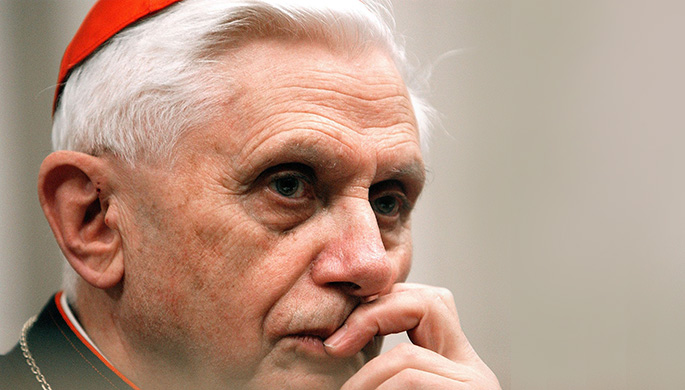
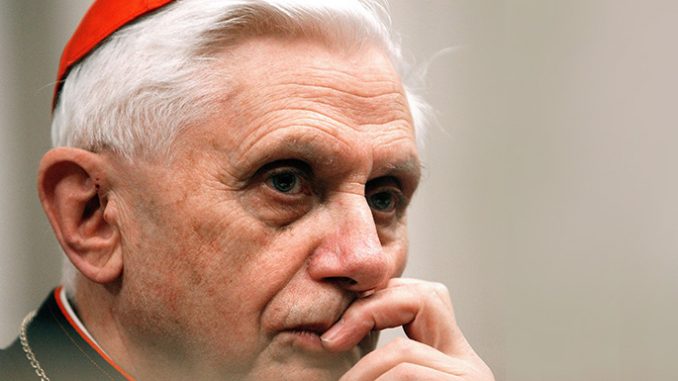
December 31, 2025, marked the third anniversary of the death of Pope Benedict XVI. Perhaps, therefore, now is as good a time as any to look back and reflect on his legacy.
But why yet another retrospective of Pope Benedict? I think it is because his legacy is more important now than ever—especially in one important area, which I will explore here.
The famous debate
The legacy of Joseph Ratzinger/Benedict XVI includes his undeniable importance as an influential theological peritus at Vatican II. He was one of the most important periti at the Council. There is also the brilliance of all of his theological writings, texts which have enriched the Church beyond measure. As a young seminarian, I was deeply influenced by his groundbreaking book Introduction to Christianity. And I am not alone in my lofty assessment of that text.
His legacy as the Supreme Pontiff included three encyclicals, numerous speeches, and other writings. He issued the motu proprio Summorum Pontificum and established the Anglican Ordinariate, both of which created enormous ripple effects in the Church. He is also now famous for being the first pope in centuries to resign the papacy.
Nevertheless, and perhaps strangely, it seems to me that as consequential as his papacy was, it can be argued that the most important event of his post-conciliar career took place when he was still a cardinal and the head of the CDF under Pope John Paul II. This event may not have seemed quite as important in its original setting, but the passage of ecclesial time and further events have sharpened its significance.
I am speaking of the famous theological debate he had with Cardinal Walter Kasper in 2001 in the pages of America magazine concerning the proper relationship between the local and the universal Church.
The details of this debate are deftly recounted by James T. Keane in an article posted a few days after the death of Benedict, and it also contains links to the original articles of Cardinal Kasper and the subsequent response of Cardinal Ratzinger.
The essence of the disagreement
In a nutshell, Cardinal Kasper expressed a desire for the local bishop to have more authority within his diocese and more freedom from interference from Rome when it came to the proper pastoral application in concrete cases of the universal moral doctrines of the Church, as well as sacramental discipline and ecumenical outreach.
Kasper says all the right things about not changing any immutable doctrines and insists that a greater emphasis on local autonomy from Rome did not imply the opening of a Pandora’s box of pastoral mayhem, as some of his critics claimed would happen. And one of the issues he had in mind, already in 2001, was the pastoral question of communion for the divorced and civilly remarried who have not procured an annulment.
Kasper takes the unusual approach of breaking with the standard ecclesial decorum amongst cardinals and calls out the theology of Cardinal Ratzinger by name. In so doing, he was in effect giving voice to many academics in the theological guild who believed that the pontificate of John Paul II was overly oppressive toward theological disagreements with his papacy and that the CDF under Ratzinger had become little more than the theological policing arm of the regime. And this accusation later gave rise to the now-famous pejorative description of Ratzinger as the “Panzer Cardinal”. Therefore, in his response to Kasper’s article, Ratzinger pointedly describes it as an “attack” on him.
Before readers rush in to see in Kasper’s proposal nothing more than liberal modernism, three things must be kept in mind.
First, Cardinal Kasper is a brilliant theologian in his own right and can hardly be described as a straight-up “progressive” theologian, even if he has some leanings in a more liberal direction. In other words, his “attack” on Ratzinger was taken seriously by Ratzinger precisely because of the theological stature of Cardinal Kasper. One could expect such an attack from Hans Küng. But et tu, Kasper?
Second, Kasper’s complaint that there is too much centralization of power in Rome and that there is a greater need for a more diffuse model of episcopal authority vis-à-vis the Vatican is hardly a wild-eyed or revolutionary claim. Even Ratzinger, in his response, acknowledges that the priority of the universal church over the local church does not necessarily imply a highly centralized apparatus. And how many traditionalists today, after what they view as the disastrous pontificate of the “liberal” Pope Francis, now speak of the horrors of what they call “hyperpapalism”?
Third, in many ways, Kasper’s call for a more merciful pastoral application of universal moral norms, especially when it comes to divorced and remarried Catholics, can be viewed uncharitably, if one so chooses, as a nod in the direction of the mores of modern liberal secularity. But it can just as easily be interpreted more charitably as a Latin Church version of the Eastern Orthodox practice of oikonomia in moral matters, especially regarding failed marriages.
Furthermore, it is an approach that seems to have gained much favor under Pope Francis and which undergirds chapter 8 in particular of Amoris Laetitia, with its now well-known call for greater pastoral “discernment” and “accompaniment” for sinners, and for the divorced and civilly remarried in particular.
I have endeavored to “steel man” the argument of Cardinal Kasper for two reasons. First, to underscore the fact that it is a theological argument of some depth and is no superficial exercise in theological cotton candy spun out of sugar into gossamer-thin liberal wispiness.
Second, to highlight the fact that the issues he raised, and to which Ratzinger responded, are still with us today and remain a bone of contention. Indeed, one could argue that it remains, next to liturgical debates, the single biggest ongoing argument within the Church.
Bishops and bishop conferences
For what was—and still is–all of this chatter about synodality if not a version of this battle of the proper relation between the local and universal Church? Furthermore, the question of the ecclesial authority to be granted to episcopal conferences is still being debated. In his many writings at the CDF (and implied in his response to Kasper) was Ratzinger’s claim that only bishops as individuals have authority, and only collectively when speaking with one voice in union with the pope through ecclesial venues such as ecumenical councils, and therefore that the ersatz invented creature of “episcopal conferences” have no authority other than consultative authority.
No less a light than the synodal Pope himself, Pope Francis, seems to have agreed with Ratzinger’s assessment that collegiality is primarily a function of the relationship of the local bishop with the Pope, and not of the relationship between the Pope and national episcopal conferences. This is important because it removes any hint of a Gallican national autonomy from the universal Church when it comes to allegedly “purely pastoral” matters.
Furthermore, it undermines the baneful tendency of national episcopal conferences to overshadow and even ride roughshod over the authority of the local bishop. Finally, it also correctly identifies the rise of national episcopal conferences as a typically modern bureaucratization of the Church with newly added “layers upon layers” of committees, subcommittees, “study groups”, and “study groups to analyze the dynamics of study groups.” In an article in the National Catholic Register covering an interview with Francis in America magazine, this point is driven home by Pope Francis:
The question is good because it speaks about the bishops. But I think it is misleading to speak of the relationship between Catholics and the bishops’ conference. The bishops’ conference is not the pastor; the pastor is the bishop. So one runs the risk of diminishing the authority of the bishop when you look only to the bishops’ conference.
“Jesus did not create bishops’ conferences,” he added. “Jesus created bishops, and each bishop is pastor of his people.”
Therefore, if Pope Leo is going to continue down the path of establishing a more “synodal Church”, it behooves us to revisit Ratzinger’s answer to Kasper.
And right out of the chute in his response, we see a vintage Ratzingerian emphasis upon the Christological foundations for our understanding of episcopal authority. And by extension, the Christological foundations for Petrine authority as the guarantor of ecclesial unity.
The theological genius of Ratzinger comes to the fore quickly as he points out (as he always pointed out) the essentially sociological and bureaucratic/political reductionism inherent in so many of the calls for structural ecclesial reform. Ratzinger had no issue with the notion of collegiality or of the need for a less centralized form of ecclesial governance. But any such reform must be grounded in the Christological truths of Revelation and not in some putatively more “democratic Church”.
A Christological foundation moves us in the direction of emphasizing the unity of the Church as the one expression of the one body of Christ, all gathered around the one Eucharistic table with a shared baptism. In other words, the universal Church, for strong Christological reasons, has theological and ontological priority over the local church. James Keane quotes Ratzinger in this regard:
The basic idea of sacred history is that of gathering together, of uniting human beings in the one body of Christ, the union of human beings and through human beings of all creation with God. There is only one bride, only one body of Christ, not many brides, not many bodies. The bride is, of course, as the fathers of the church said, drawing on Psalm 44, dressed in many-colored robes; the body has many organs. But the superordinate principle is ultimately unity. That is the point here. Variety becomes richness only through the process of unification.
Ratzinger saw the dangers of a “synodalism” that was not grounded in this Christological reality and which, in very subtle and seductive ways, substituted largely secular understandings of authority as a kind of functionalist, horizontalist proceduralism of merely human creation, for a properly theological understanding of authority in the Church as something coming “from above”.
Why it still matters today
What is at stake is the very constitution of the Church as a divinely instituted reality—a truly “theological thing” and not a purely “mundane thing”—and that the Church is not just the construct of the mythopoetic projections of some of the early followers of Jesus. What is at stake is whether there can be such a thing as a truly theandric reality grounded in a robust affirmation of the Incarnation as a divine initiative and as the dense theological event upon which all of creation turns.
The very fulcrum that balances all of human history in its wake. The Church is also human and is riddled with sins. Therefore, she is always in need of reform. But all genuine reform must be Christological and pneumatic in the sense of it constantly refocusing the Church on the paschal mystery as her deepest foundation and missional vocation. Reform cannot be based upon a purely worldly calculus of “shared power”, which is really what the Kasper proposal was ultimately all about.
And what of the hidden ends of such proposals for shared power?
What was merely latent or only vaguely hinted at during the early days of Kasper’s proposal is now openly embraced and explicitly promoted in the German synodal way. The claim is now made, in the name of “local autonomy and subsidiarity and synodality”, that the Church in Germany can now renegotiate the binding force of moral commandments in the name of “changing times”. What was once merely whispered and hinted at is now the stated goal of the German episcopal conference.
Cardinal Kasper noted in 2001 that he was at least partially motivated by his perception of a growing “gap” between the teachings of the universal Church, especially in moral matters, and the viewpoints and lifestyles of modern Germans. And therefore, he wanted the local Church to have more authority to apply those teachings with greater flexibility and mercy. In other words, to treat the universal norms of the moral law as “ideals” that nobody ever reaches perfectly and therefore should be applied in different ways to different people in different “difficult circumstances”.
What is at stake in this debate is the normative nature of moral commandments. And, as John Paul would also emphasize later in Veritatis Splendor, the moral commandments are of divine origin, grounded in divine revelation. They are not ideals to be striven for asymptotically, but binding addresses from God, calling out to human moral agency to fulfill itself in a higher theological register. Holiness is not an option for the few, but something mandated for all. And while it is true that the Church is in the business of mercy, compassion, and forgiveness, she must not be the faux mercy of a secular avuncular kindness, but the mercy that provokes us and beckons us to “come up higher”.
With this debate in mind, the legacy of Joseph Ratzinger/Pope Benedict gifts us with a much-needed illumination as we debate what a “synodal Church of accompaniment” should look like. There are hopeful signs that our Holy Father, Pope Leo XIV, understands well what is at stake. I pray that those signs portend a robust reform of the Church in a synodal direction, but where the Church as universal is given priority, and that all bishops are “sub Petro et cum Petro” when it comes to central doctrines of faith and morals.
Along these lines, I can think of no better summation of what is at stake in the old Ratzinger/Kasper debate than a recent statement from Bishop Robert Barron on the social platform X concerning synodality:
I understand that one of the topics under consideration at the consistory of Cardinals is synodality. I’m speaking as a bishop who was an elected delegate to both rounds of the Synod on Synodality in Rome and who has just presided over a local synod in my own diocese. Synods are good and useful tools for the determination of practical pastoral strategies, but they oughtn’t to be forums for debate regarding doctrine. When settled teaching becomes a subject for synodal determination, the Church devolves into relativism and self-doubt – as is clearly evident in the misconceived “Synodal Way” in Germany. … The great Communio theologians said that councils are indeed sometimes necessary in the life of the Church but that one sighs with relief at the end of a council, for the Church can then return to its essential work. As long as it sits in council, the Church is in suspense, usure of itself, wringing its hands. It was precisely the perpetuation of the spirit of Vatican II that led to so much vacillation and drift in the years when I was coming of age.
If we must continue with synodality, let it be dedicated to the consideration of practical means by which the Church can more effectively do its work of worshipping God, evangelizing, and serving the poor. And let it not be a defining and permanent feature of the Church’s life, lest we lose our verve and focus.
If you value the news and views Catholic World Report provides, please consider donating to support our efforts. Your contribution will help us continue to make CWR available to all readers worldwide for free, without a subscription. Thank you for your generosity!
Click here for more information on donating to CWR. Click here to sign up for our newsletter.