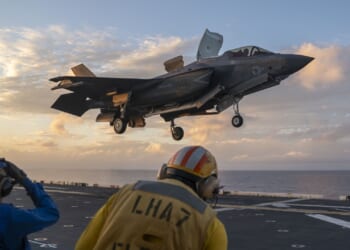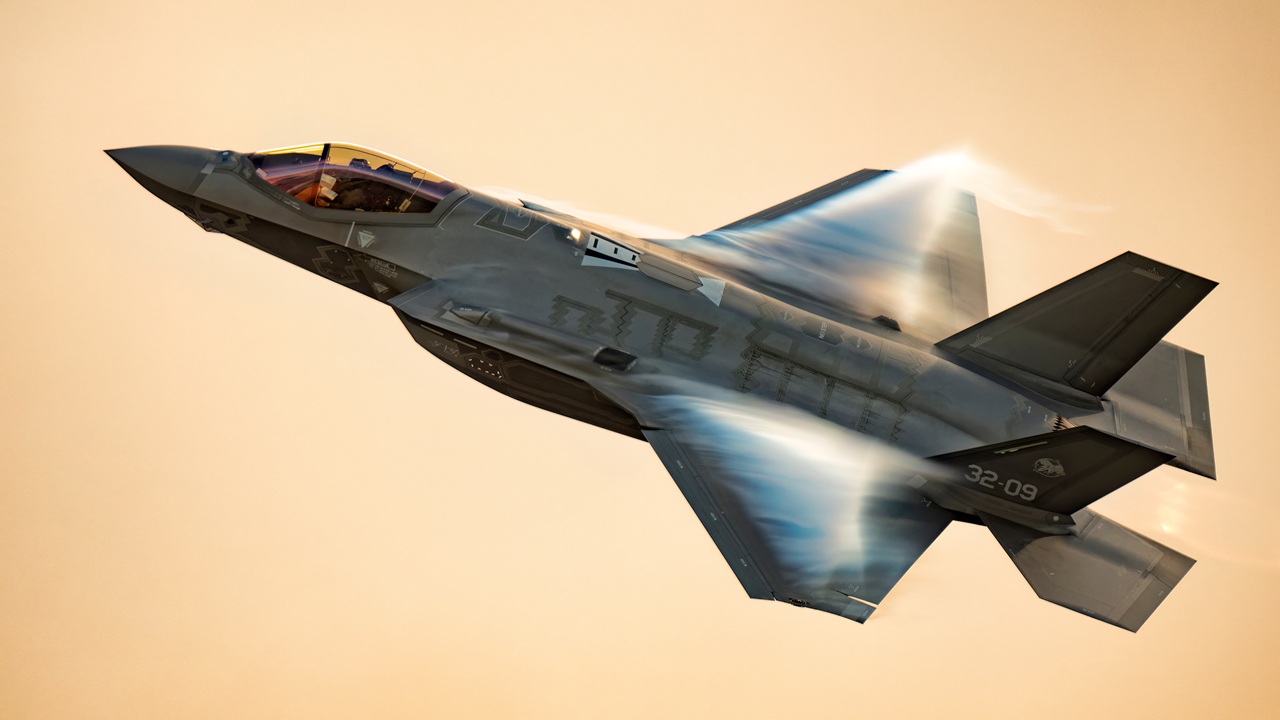
The scheduled acquisition of F-35 fighter jets has grown controversial in Switzerland following the Trump administration’s imposition of high tariffs.
Multiple NATO members, including Denmark, Romania, and Germany, have expanded their acquisition of the Lockheed Martin F-35 Lightning II. However, Spain has opted to cancel its order for the fifth-generation stealth fighter.
Switzerland, which is a neutral nation but has invested heavily in its own defense, is taking a middle-ground approach. It hasn’t entirely canceled its planned purchase of the F-35A, the conventional takeoff and landing (CTOL) variant of the Joint Strike Fighter, but will reduce its order from the initial 36 that Bern had sought to acquire.
Last week, at a meeting of the Swiss Federal Council, Switzerland’s collective head of state, it was determined that it wasn’t “financially viable to maintain the originally planned [order] of 36 F-35As.” The Federal Council instructed the Federal Department of Defense, Civil Protection and Sport (DDPS) to “procure the maximum possible number” of the stealth fighters that were within the approved 6 billion Swiss Francs ($7.5 billion) “budget approved by the electorate.”
It is unclear how many F-35As Switzerland will ultimately receive.
“Talks held with the US in the summer revealed that Switzerland cannot enforce the contractually agreed fixed price for the F-35A fighter jet,” explained the Swiss Federal Council’s statement on the matter. “The US cites increased costs due to inflation, rising raw material prices, and other factors.”
The Swiss government viewed the deal as fixed-price, whereas the United States claimed it was a misunderstanding and noted that costs had increased.
No Set Cost for the Swiss Lightning II
Military aircraft typically don’t have a per-unit set price, and pricing can vary widely depending on the program and the number of aircraft being acquired. As The War Zone explained, Finland closed a deal valued at $9.4 billion for 64 F-35As, but “additional costs of infrastructure, weapons, maintenance equipment, spare parts, training, and other systems and services need to be factored in. In the case of the F-35, in particular, these costs are uniquely high.”
Bern’s Federal Council selected the F-35 under the Air2030 program, which sought to replace the aging F/A-18 Hornets. The fifth-generation fighter beat out competing aircraft, including the Eurofighter Typhoon, but its adoption sparked significant political debate, including the “Stop F-35” initiative. Despite objections, a contract for 36 jets was signed in 2022.
Over the past summer, the program faced additional turbulence, with some Swiss lawmakers seeking to exit entirely after US President Donald Trump imposed a 39 percent tariff on the Alpine nation. A deal was negotiated, but even in August, it was clear that Switzerland would reduce the order size.
Lockheed Martin, the F-35’s prime contractor, responded to the report on Monday, stating that production has already begun on the first Lightning IIs for the neutral country.
“We value our partnership with the Swiss government and industry and are committed to delivering the world’s most advanced fighter jet, the F-35A Lightning II, to Switzerland,” a Lockheed Martin spokesperson said in a statement to Breaking Defense. “Components of Switzerland’s first F-35 recently started production. Major assembly work will begin early next year, with deliveries planned to begin in 2027.”
To date, more than 1,100 F-35s have been delivered to the US military, its allies, and foreign partners.
About the Author: Peter Suciu
Peter Suciu has contributed over 3,200 published pieces to more than four dozen magazines and websites over a 30-year career in journalism. He regularly writes about military hardware, firearms history, cybersecurity, politics, and international affairs. Peter is also a contributing writer for Forbes and Clearance Jobs. He is based in Michigan. You can follow him on Twitter: @PeterSuciu. You can email the author: [email protected].
Image: Shutterstock / Maciej Kopaniecki.