Why do people refuse to accept God in their lives? What makes a person decide to be an atheist? Why does someone have faith, then lose it? Then again, why do others have faith their entire lives despite being surrounded by atheists and agnostics?
Only God can truly know the answers to these questions, since only He intimately knows the hearts and souls that He created. This being said, He did endow these very souls with the ability to reason. Hence, it is reasonable to speculate on some of the rationale for turning away from Him, which may shed light on the human frailty that stops many from fully accepting God in their lives.
I think that this negation of God is fear.
Growing Out of Childlike Trust
To begin, there are many reasons for believing in something or in someone. Love and trust are usually a part of it. Have you ever heard your child repeat what the teacher said at school? They will defend their position for the mere reason that “the teacher said it.” They do not fear believing their educator, because they love and trust this person. The same is true of children who love and believe their parents; they will defend whatever they hear at home with the usual phrase, “my mommy said so.”
However, as they grow older, this blind trust and belief gradually fade into either indifference or resentment, for the simple reason that they are exposed to different people who will influence them in different ways, and sometimes not for the good.
This often happens with faith. I have heard acquaintances, colleagues, friends, and family members scoff at their childhood faith, saying they lost it during college. They say that they “evolved” and “discovered” science, which, for them, excludes God. One would think that science would have given them ample proof of God’s existence.
Humanism and Environmentalism
Another reason given is that they met someone who believed in man and nature, not in God. While our fellow man and the environment are well and good, they did not create the world. They are a part of the world created by a supreme Being: God. Humanism and environmentalism are a substitute for something greater.
Sensual Gratification
Another major factor for the gradual erosion of faith is the “discovery” of all things sexual. Humans are carnal beings and oftentimes let themselves be led by their impulses and yearnings for pleasure. This leads to an abandonment of their faith, or a refusal to let themselves believe in God and follow Him, because they view Him as being an impediment to their pursuit of sensual gratification. In time, they become so entrenched in their own style of living that they fear losing control over their lives and their decision-making faculties. This fear of giving themselves over to a higher Being is stopping them from being the child of God that they are meant to be.
Fear of Losing One’s Control
If a person sincerely pondered what is blocking their assent to accepting God, they might realize that it stems from a fear of not being able to do what they desire. It doesn’t happen overnight; it usually begins by refuting parental authority, mainly after being exposed daily to external factors, such as their peers and visual stimuli like social media, video games, and porn, in some form or other. They feel a false sense of freedom when they are independent of the “shackles” of their parents, whom they view as restraining their individual liberty. It is therefore very easy for them to discard God the same way.
Oftentimes, people who refuse to acknowledge God view the concept of God as that of a dictator who wants to control them. I remember one of my former students loudly proclaim in religion class that no one and no god would dictate to her what to do. In rather vulgar terms, she said she would have sex with whoever she wanted and whenever she wanted. She was only fifteen years old. Somewhere along the way, she decided that no one and nothing would exert any “control” over her. With this type of mindset, the one thing one fears is “losing control.”
I don’t believe that anyone has complete control over their lives. Unforeseen circumstances will always happen. For example, no matter how much contraception a woman uses, she might still be shocked to learn that, someway, somehow, she got pregnant. Then, instead of accepting the pregnancy, which was out of her control, she will compound her refusal of acceptance by opting to abort her child.
Once again, this is unconsciously (or perhaps, consciously) a refusal of God’s permissive will. Rather than accept the gift of the child in her womb, and accept her role as a mother, the woman wants to stubbornly keep control over her body and her life. Her pregnancy could have been a turning point for closeness with God through the miracle of motherhood, yet the fear of losing control leads her further away from Him.
Familial Environment
God gave proper and holy authority over children to parents. Rearing offspring in the faith is a part of parenting. However, we have observed less focus being put on God during the formative years of childhood. This is a reflection of the gradual loss of faith of the parents, who were once children themselves, who rebelled against their own parents’ authority, and thus against God’s. This led to the godless society of the present culture. A hedonistic society who wants to do only what they desire. No one, let alone God, will tell them what to do. Hence, so-called sexual liberty, abortion, transgenderism, euthanasia, drugs and alcohol, porn, you name it, are the order of the day. Anything goes. In fact, everything is sought and permitted, except, of course, God.
Our Restless, Seeking Hearts
Everyone is searching for something, or someone, to believe in. Atheists are willing to devote their lives to some cause or other, in order to feel morally equal, if not superior, to others: animal rights, climate change, deforestation, “reproductive freedom” (a.k.a. abortion), supporting the arts, etc., rather than opening themselves up to God’s love.
As St. Augustine said, our hearts are restless until they rest in God. It is time for the fear of God to stop. There is nothing to fear about God. He is love and mercy itself. He patiently waits for us to come to Him. He is not a puppet master. We have free will to choose the good and righteous path.
This life, here on earth, is not the end of the line. Our soul is eternal. There is life after death. I am reminded of the great mathematician Blaise Pascal’s wager of believing in God: if He does not exist, we lose nothing; if He exists, we gain everything. Even an atheist must have questions and doubts at some point; why not take a chance on God being real when doubt creeps in. Let fear depart from your heart and open wide your arms to embrace Him.
Editor’s Note: This article was originally published on the author’s blog and reprinted here with kind permission.
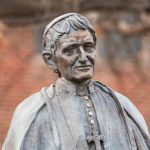
Photo by Christy Joseph Jacob on Unsplash