Pakistan has historically been weaker than India in the naval domain—a liability that became readily apparent during the recent four-day war.
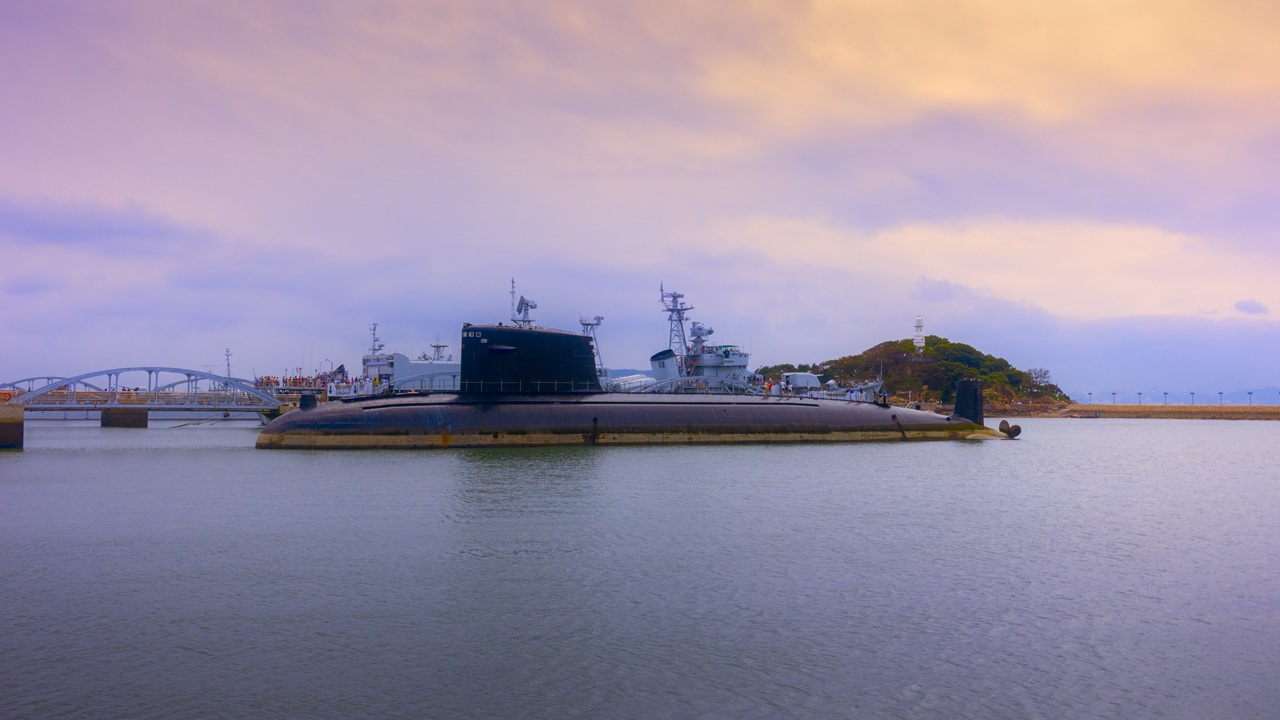
Pakistan’s Hangor-class submarine is an export variant of the Chinese Type 039A/039B Yuan-class conventional (diesel-electric) submarine. In 2015, Pakistan signed a deal with China Shipbuilding & Offshore International Co. (CSOC) for eight of these submersibles. Of the eight, four are being built in China, while the other four will be built in Pakistan at the Karachi Shipyard & Engineering Works (KS&EW) under a technology-transfer program.
The Hangor-Class Submarine’s Specifications
- Year Introduced: Not yet introduced
- Number Built: ~3 (8 planned)
- Length: 76 m (249 ft 4 in)
- Beam (Width): 8.4 m (27 ft 7 in)
- Displacement: 2,800 tonnes
- Engines: Four CSOC CHD620 diesel engines; air-independent propulsion (AIP)
- Top Speed: ~20 knots (23 mph, 37 km/h)
- Range: ~2,000 nmi (2,300 mi, 3,704 km); 65 days’ endurance
- Armaments: Unknown; likely six 533mm torpedo tubes and anti-ship missiles
- Crew: ~36
Understanding the Hangor-Class Submarine
The first Hangor-class submarine was launched in China in April 2024. The second was launched in March of this year, with a third, PNS Mangro, floated out in August. The submarines have not been commissioned into the Pakistan Navy yet, but according to its leadership, the first batch is expected to enter service in 2026.
Naval News, a trade publication, assesses that the Hangor-class sub uses a Stirling-based air-independent propulsion (AIP) system, which lets it remain submerged longer without surfacing. Army Recognition claims that it is using Chinese CHG620 diesel engines. Earlier plans reportedly involved German engines, but this had to be changed as there were export restrictions imposed upon those German engines going to China.
Pakistan’s new Chinese-made subs have high-strength hull steel and modular construction. These boats are designed with low acoustic signatures to enhance stealth. Six 533mm torpedo tubes are on each Hangor-class. Naval Today believes that these submarines can launch anti-ship cruise missiles.
It is likely that Pakistani Babur-3 submarine-launched cruise missiles (SLCMs) are compatible with these submarines. The Babur-3 would give each Hangor-class a deep strike potential—enhancing the reach and capabilities of Pakistan’s Navy.
The Hangor-class significantly strengthens Pakistan’s submarine fleet, especially in terms of stealth and sustained underwater presence. This assists Pakistan’s desire to create an anti-access/area-denial (A2/AD) capability in the Arabian Sea and parts of the Indian Ocean—key buffers against unwanted incursions and threats from the Indian Navy.
China Is Propelling Pakistan’s Military Modernization
Even though the Pakistani Air Force (PAF) performed well (unexpectedly) against the Indian Air Force (IAF) in the Indo-Pakistani War earlier this year—thanks in large part to Pakistan’s use of advanced Chinese warplanes and missiles—the one area where the Pakistanis were truly vulnerable was in the maritime domain.
As it became impossible to deny, the Pakistanis were resisting Indian advances in the air, so New Delhi sought to acquire advantages in the naval domain. Reports proliferated that midway through the war, the Indian Navy was assembling a flotilla to either blockade and/or attack the key Pakistani port of Karachi.
These Chinese-provided Hangor-class submarines are meant to even the odds whenever the next round of hostilities erupt between Pakistan and Israel. And that next round could open at any moment.
What’s more, this deal reflects the deepening of the China-Pakistan strategic and defense relationship. The fact four subs will be built in Pakistan (with technology transfer) also helps Pakistan build its own shipbuilding and sub-building capacity. Building half the submarines domestically helps Pakistan’s naval industrial base; over time, this could reduce dependence on foreign suppliers, at least for hull construction/maintenance. Interestingly, the original plan for delivery was to occur between 2022-28, but progress has been slowed.
The Implications of Pakistan’s New Submarine Force
Nevertheless, China and Pakistan are moving forward. Now that Beijing has seen how well its equipment performed in the Indo-Pakistani air war, there is a renewed intensity about getting more of their arms onto the global market. Similarly, the Pakistanis are desperate to enhance their naval capacity to plug any gaps in their national defenses that the Indo-Pakistani War has exposed.
These Hangor-class submarines are significant in the affairs of Pakistan’s military modernization. They bring modern stealth, extended submerged endurance, and a credible strike (and deterrent) capability. They reflect and reinforce deep military ties between Pakistan and China.
When fully delivered, these eight Chinese-provided submarines will significantly upgrade Pakistan’s undersea fleet and should better alter regional naval dynamics as it relates to Pakistan’s seemingly endless rivalry with neighboring India.
About the Author: Brandon J. Weichert
Brandon J. Weichert is a senior national security editor at The National Interest. Recently, Weichert became the host of The National Security Hour on America Outloud News and iHeartRadio, where he discusses national security policy every Wednesday at 8pm Eastern. He is also a contributor at Popular Mechanics and has consulted regularly with various government institutions and private organizations on geopolitical issues. Weichert’s writings have appeared in multiple publications, including The Washington Times, National Review, The American Spectator, MSN, and the Asia Times. His books include Winning Space: How America Remains a Superpower, Biohacked: China’s Race to Control Life, and The Shadow War: Iran’s Quest for Supremacy. His newest book, A Disaster of Our Own Making: How the West Lost Ukraine is available for purchase wherever books are sold. He can be followed via Twitter @WeTheBrandon.
Image: Shutterstock / Rick Wang.