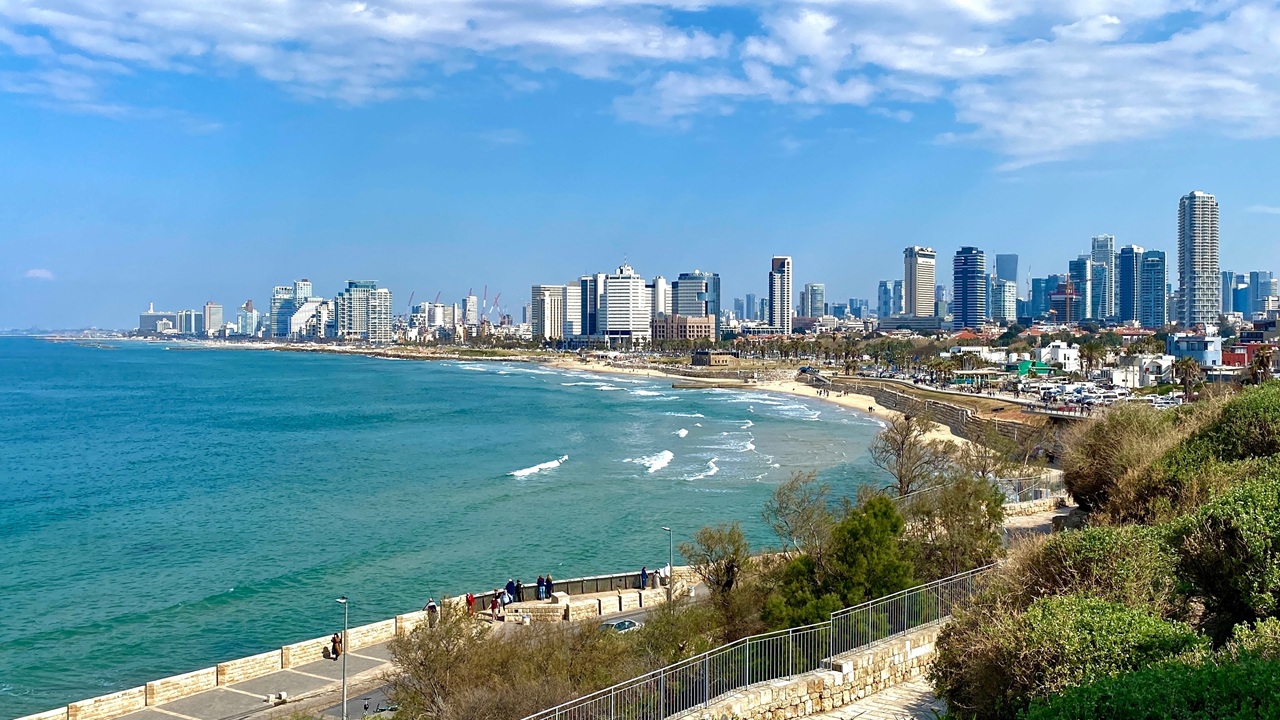
Israel’s immigration law—citizenship on arrival for Ukrainians of Jewish descent, favorable tax laws, and de facto non-extradition—makes the country a paradise for corrupt oligarchs.
As Ukraine’s war efforts falters, and pressure mounts on President Volodymyr Zelensky’s embattled administration, a strange rumor has circulated in Kyiv and beyond: the Ukrainian leader may soon bolt for Israel—perhaps with a suitcase (or several) of war-era riches.
To be clear, there is no evidence that Zelensky plans such a move. But the rumor persists for a reason. Israel has quietly become the escape hatch of choice for Ukrainian oligarchs, operators, and ex-officials who fear not just the Russians, but the accountability their own people—and American taxpayers—might one day demand.
Fringe conspiracy it may be. But it is built atop a decade-long pattern of Ukrainian elites grabbing what they can, running out the backdoor, and landing softly in Tel Aviv.
Israel Is an Attractive Destination for Many Oligarchs
Migration scholars often talk about “push factors”—the forces that drive people out of their home countries. War is a classic example, and the Ukraine War has led to an exodus of young, draft-eligible men from both Ukraine and Russia.
Israel’s role in this story sits on the opposite side of the equation. It’s a pull factor—an irresistible magnet for a certain class of wealthy, well-connected Ukrainians. The country’s legal, financial, and political environment offers key benefits for rich newcomers with murky fortunes:
- Citizenship on Arrival: Under Israel’s Law of Return, anyone with Jewish ancestry (plus spouses, converts, and adjacent categories) can receive citizenship or permanent residency with stunning speed. For ex-Soviet elites, this is not just a passport upgrade. It’s a real exit strategy.
- A Decade-Long Tax Holiday: Israel’s famous “new immigrant” tax regime, often referenced as the Milchan Law, lets wealthy arrivals shield foreign-held income and assets from taxation for up to ten years. If you’re an oligarch with questionable accounts scattered across Cyprus, Vienna, London, or Hong Kong, that’s not a benefit—it’s a lifeline.
- Fewer Sanctions, Fewer Questions: Israel is not the EU. It does not automatically mirror NATO sanctions. Israel does not reflexively freeze assets at the whisper of impropriety. For elites worried that Ukraine’s collapse might expose their own prodigious corruption, Israel represents neutral ground.
Together, these features form a gravitational pull so strong that it has reshaped the post-Soviet elite diaspora.
Fleeing to Israel: The Case of Tymur Mindich
If any one figure embodies this phenomenon, it is undoubtedly Ukrainian oligarch Tymur Mindich. He’s a longtime associate of powerful oligarch Ihor Kolomoyskyi—and incidentally a former business partner of Zelensky, a co-founder of the “Kvartal 95” television studio that made the current president famous.
According to Ukrainian investigators, and confirmed in reporting by The Guardian, Mindich allegedly masterminded a kickback scheme inside Energoatom, Ukraine’s nuclear-energy operator, siphoning off 10-15 percent of contract values. The total haul? An astonishing $100 million.
But when Ukrainian law enforcement finally descended on more than 70 properties linked to the scheme, Mindich was already gone. He had conveniently slipped out of Ukraine mere hours before Ukrainian authorities closed in and could arrest him—and gone straight to Israel. Israeli citizenship laws, paired with the permissive financial landscape, provided exactly the kind of soft landing a man in Mindich’s position would need.
Tymur Mindich is now being prosecuted in absentia. Ukraine wants him back. Israel is, at minimum, disinclined to act hastily. And the Ukrainian public—exhausted by war and furious about corruption—watches another oligarch scamper off with wartime millions.
The Israeli Connection to Ukrainian Corruption
The case of Ihor Kolomoyskyi, the titan who helped shape modern Ukraine’s political economy, is a similar case. He holds Israeli citizenship as well. In 2023, a Kyiv court arrested him and placed him under detention for fraud and money laundering. His legal fate remains unsettled.
But the symbolism is unmistakable. Ukraine’s oligarch class has long viewed Israel as a second home—and a legal refuge. Some stay put. Some flee. Some simply keep a plane fueled on the tarmac.
The connection is structural, not incidental. Between February 2022 and February 2023, as it became clear that the Ukraine War would not end quickly, approximately 13,000 Ukrainians—mostly refugees—immigrated to Israel under standard procedures. Most of these immigrants are assumed to be honest and non-corrupt. But the humanitarian wave also provided the perfect cover for the smuggling-out of illicit wealth. In a sea of legitimate arrivals, high-net-worth fugitives disappear into the crowd. For investigators hunting stolen state funds, this is a nightmare scenario.
Israel never set out to become the Riviera of Eastern European kleptocrats. Its laws were built to protect the Jewish people after the horrors of the twentieth century. Israeli laws were meant to attract global capital, too, and to strengthen the fledgling nation’s financial base. But Jerusalem’s benign intentions have not erased the real consequences of its lax immigration policies.
Today, Israel faces a painful reckoning:
- Has Israel inadvertently become a laundromat for corrupt post-Soviet fortunes?
- Is it enabling the escape of individuals who looted a US-backed ally during wartime?
- How long will Washington tolerate Israeli laws that shield men who likely stole American taxpayer-funded aid?
This is not a small diplomatic problem. It is a fuse leading straight back to Washington.
What Are Zelensky’s Options If Things Go Bad?
And so, we return to the rumor of Zelensky himself. Again, there is no evidence he is planning such a move. But after Mindich and others slipped out, taking unearned wealth with them, it is not so fantastical of a question. It is a structural concern—a question created by the very “pull factors” Israel has built into its legal DNA.
Israel must decide whether it wants to remain a sanctuary for the world’s most controversial fortunes, or whether it will finally close the loopholes that have turned Tel Aviv into a post-Soviet financial ark.
As Ukraine faces misfortune on the battlefield, as its internal corruption scandals regularly make the news, and as the public demands accountability for every dollar of Western aid and every bit of Ukrainian assets that were taken over by these oligarchs, then a sudden flight from Kyiv to Tel Aviv by someone as prominent as Zelensky would not be shocking at all.
About the Author: Brandon J. Weichert
Brandon J. Weichert is a senior national security editor at The National Interest. Recently, Weichert became the host of The National Security Hour on America Outloud News and iHeartRadio, where he discusses national security policy every Wednesday at 8pm Eastern. Weichert hosts a companion book talk series on Rumble entitled “National Security Talk.” He is also a contributor at Popular Mechanics and has consulted regularly with various government institutions and private organizations on geopolitical issues. Weichert’s writings have appeared in multiple publications, including The Washington Times, National Review, The American Spectator, MSN, and the Asia Times. His books include Winning Space: How America Remains a Superpower, Biohacked: China’s Race to Control Life, and The Shadow War: Iran’s Quest for Supremacy. His newest book, A Disaster of Our Own Making: How the West Lost Ukraine is available for purchase wherever books are sold. He can be followed via Twitter @WeTheBrandon.
Image: Shutterstock / PannaLia.