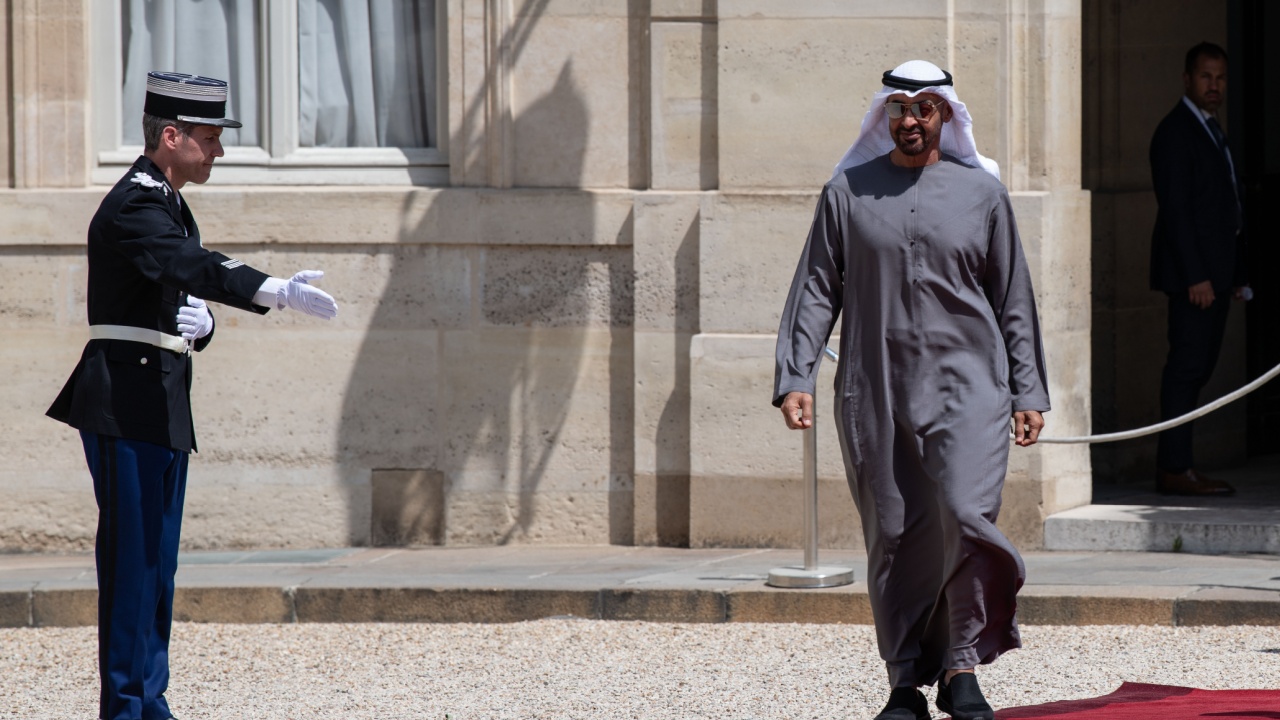
Like President Donald Trump, the president of the UAE has changed the course of the Middle East’s history for the better.
At a moment when global leadership feels increasingly hesitant, and the Middle East is trapped between ideological extremism and humanitarian catastrophe, two figures stand out for producing tangible, measurable shifts in the region’s diplomatic landscape: Donald Trump and Mohamed bin Zayed Al Nahyan. One reshaped policy from Washington; the other reshaped reality from Abu Dhabi. Both altered the course of regional history, and both now deserve serious consideration for the world’s most prestigious peace honor: the Nobel Prize.
The case for Donald Trump has already been debated internationally for his role in enabling the Abraham Accords. But the case for Mohammed bin Zayed—MBZ—is equally powerful and in many respects more urgent today. As the leader of the United Arab Emirates, he has consistently chosen stability over chaos, modernity over ideological rigidity, and human development over destructive geopolitics. In a region defined for decades by entrenched conflicts and maximalist ideologies, MBZ has charted an entirely different course, one rooted in a clear moral and strategic vision.
The UAE was the first nation to fully embrace and implement the Abraham Accords, a decision that required extraordinary courage. Signing the normalization agreement with Israel meant defying regional ideological currents, confronting the hostility of extremist networks such as the Muslim Brotherhood, and navigating pressure from Iran and its affiliated movements. The risks were real. The Houthis—an Iranian-aligned group—launched weaponized drones at Abu Dhabi during this period, underscoring the volatility of the regional environment. Yet even amid these destabilizing actions, the UAE did not reconsider its commitment to diplomacy, coexistence, and long-term stability. MBZ’s response remained measured, resilient, and focused on the broader vision for his country and the region.
This strategic steadiness is what transformed the Abraham Accords from a diplomatic experiment into a durable, functioning regional architecture. President Trump created the political framework that allowed normalization to emerge, but MBZ provided the regional legitimacy and conviction required for the process to take root. Without the UAE’s decisive leadership, the accords would not have evolved into a true restructuring of Middle Eastern dynamics. MBZ understood that the alternative—remaining locked in ideological confrontation—would condemn the region to another generation of stagnation and insecurity.
While some regional states have used their wealth to fuel ideological contests or foreign interventions, MBZ charted a fundamentally different path. Under his leadership, the UAE invested heavily in science, education, innovation, and national capacity-building. It became the first Arab country to send a probe to Mars and developed peaceful nuclear energy programs. Most notably, the UAE, after Israel, is the second-largest investor in artificial intelligence in the Middle East, committing billions of dollars through major agreements to accelerate AI development. MBZ recognized early that the twenty-first century would be defined by AI, and he sought to leverage it not for control, but for national development: modernizing infrastructure, expanding healthcare, improving food security, and diversifying the economy.
This forward-thinking agenda contrasts sharply with the ideological rigidity of the Muslim Brotherhood and similar movements. While they emphasize doctrinal confrontation and political absolutism, MBZ emphasizes knowledge, innovation, and constructive coexistence. His vision represents a new governing model for the Arab world—one predicated on competence rather than ideology, on global integration rather than isolation.
Yet perhaps the most visible expression of MBZ’s leadership is his humanitarian doctrine. For years, the UAE has been the most generous humanitarian donor in the Arab world and one of the largest globally. Whether responding to crises in Yemen, Syria, Pakistan, or across Africa, the Emirates have consistently delivered large-scale, well-coordinated relief. Nowhere, however, is this more evident than in Gaza, where the UAE has launched the most extensive and organized humanitarian operation of any country.
Through the “Gallant Knight 3” initiative, the UAE delivered more than 100,000 tons of aid worth $2.57 billion, transported by air, sea, and land. Hundreds of flights, dozens of ships, and thousands of trucks carried food, medical supplies, and critical equipment into Gaza. The UAE built community kitchens, bakeries, and six desalination plants producing two million gallons of clean water every day for over a million people. It established a fully equipped 200-bed field hospital with advanced telemedicine, deployed a hospital ship treating thousands of patients, and evacuated nearly 3,000 injured Palestinians to Emirati hospitals. Crucially, the UAE was the first country to mobilize urgent, large-scale aid for Gaza. While others debated political angles, MBZ acted immediately to save lives.
These actions reflect a consistent philosophy: peace is not only a diplomatic achievement—it is the protection of human life and dignity. MBZ’s humanitarian leadership is not episodic or symbolic; it is structural, strategic, and global in scale. It mirrors his broader belief that stability arises from development, knowledge, and compassion, not from ideological confrontation.
Mohamed bin Zayed’s leadership is defined by clarity and purpose. He believes that the future of the Arab world depends on modernization rather than militancy, on human development rather than ideological mobilization, and on coexistence rather than perpetual conflict. His governance model has already reshaped the UAE, influenced regional politics, and established new expectations for what Arab leadership in the twenty-first century can look like.
For his courage in navigating extremist threats, his indispensable role in the Abraham Accords, his transformative modernization agenda, and his unparalleled humanitarian leadership, Mohamed bin Zayed deserves the Nobel Peace Prize just as much as President Donald Trump. Both men changed the trajectory of Middle Eastern history. The world should recognize now what historians will one day write: that peace in the region has new architects—and Mohamed bin Zayed is among the most consequential of them.
About the Author: Niger Innis
Niger Innis is the national chairman of the Congress of Racial Equality (CORE), the first Black-led organization recognized by the United Nations, and is currently serving on the UN’s Economic and Social Council.
Image: Frederic Legrand – COMEO / Shutterstock.com.