I hate to disagree with my colleague, the great Roland Fryer—and doubly so when it comes to economics. Fryer’s work is consistently both stimulating and insightful, and his contributions to public policy substantially outstrip my own. I nevertheless feel obliged to comment on his recent Wall Street Journal op-ed, in which he uses sound economic reasoning to reach a conclusion I reject: that we should legalize and tax addictive drugs.
Fryer’s argument proceeds from an important and correct insight—that addicted users’ demand for their drug of choice is highly inelastic (that is, it changes very little given alterations in price or other factors). Because of this, reducing supply through enforcement mostly increases price, while leaving relatively unchanged the quantity consumed. That, in turn, makes drug traffickers richer, increasing the harms of the market. A more efficient way to achieve the goals of drug control policy, Fryer argues, is legalization and an excise tax, which would similarly reduce consumption without all the harms done by enforcement.
Finally, a reason to check your email.
Sign up for our free newsletter today.
Fryer is right that much drug policing is unhelpful. But specific approaches can and measurably do reduce drug-associated harms—in a way that is consistent with his argument. Moreover, prohibition per se—independent of intensive enforcement—remains an effective strategy for suppressing consumption and associated harms. Legalization and taxation, by contrast, appear consistently to increase it.
Fryer’s argument draws on work done by the late University of Chicago economist Gary Becker, alongside his colleague Kevin Murphy and CUNY’s Michael Grossman. In an influential 2006 paper, the trio lay out an economic account of why, in their view, much drug enforcement is not worth the cost, and why prohibition is almost always inferior to legalization-plus-taxation (Fryer’s proposed solution).
Drug enforcement and prohibition reduce the supply of drugs, in turn increasing their price and reducing the quantity consumed. Becker, Murphy, and Grossman observe that the exact effects of this shift depend on the elasticity of demand for drugs—how much a given increase in price reduces the quantity consumed, and vice-versa. The demand for drugs is, in the short run at least, inelastic, meaning that enforcement effectively increases price much more than it reduces quantity consumed.
The paradoxical implication is that more enforcement actually increases the revenue flowing into the hands of drug dealers—because revenue is price times quantity, and price goes up more than quantity goes down. Dealers spend these dollars avoiding enforcement, effectively making those expenditures a nonproductive waste. Governments, too, waste some dollars in enforcement when they try to suppress an inelastically demanded good.
Becker, Murphy, and Grossman draw two conclusions from this. One is that, to justify their costs, prohibition and enforcement must massively reduce drug-related harms. The second is that an optimized excise tax is in principle superior to enforcement, because while enforcement generates waste, taxes are a transfer, the revenue from which can be put to more productive uses.
This argument gets a lot right. The War on Drugs, though often unfairly maligned, measurably failed to reduce the total quantity of drug consumption, and it had only limited effects on some of the major externalities of drugs, like rates of hardcore addiction. A great deal of routine drug enforcement similarly entails a lot of spending for little return. Literature I reviewed in a 2024 Manhattan Institute report generally implies that the marginal arrest has an extremely small effect on consumption. This is doubly true in the era of synthetic drugs, when prices are naturally too low for enforcement to have a meaningful impact.
But none of this necessarily means that legalizing and taxing drugs will produce a preferable outcome, or that all enforcement is worthless. There are several reasons why.
First, while the additional marginal unit of enforcement (e.g., each additional arrest) is often not worth the costs, the first few moves toward prohibition—the actual act of prohibiting drugs, plus some low-level enforcement—yield relatively large reductions in consumption and associated harms while expending relatively few enforcement resources (and generating relatively little waste in the illegal market). Prohibition per se works primarily by reducing prohibited industries’ access to the rest of the free market, including capital, skilled labor, and business services. The resulting businesses are highly inefficient, and their products are scarcer than they would be if, for example, Amazon were allowed to sell meth.
In reality, such low-enforcement prohibitions are the norm, rather than the exception. The ban on sports gambling, for example, effectively suppressed the industry with almost zero arrests per year. Legalization, by contrast, has led to an explosion in consumption and associated harms, including an estimated 50 percent increase in the size of the illegal and legal markets combined.
But even if the benefits of a low-enforcement prohibition exceed the costs, Fryer and Co. might argue, that doesn’t make it preferable to an equivalent legalization and taxation scheme. Shouldn’t we just set excise taxes higher?
Again, real-world experience challenges this view. The “legalize and tax” model depends on the assumption that policymakers will set socially optimal taxes. Yet the inflation-adjusted value of alcohol and tobacco excise taxes have withered to almost nothing. That’s partly because of corporate lobbying and partly because robust “grey markets” (unauthorized distribution channels) cap the effective tax rate; for example, an estimated half of all cigarettes in New York are smuggled.
Grey-market competition has similarly vexed the rollout of legal marijuana (demand for which is highly inelastic). That’s why 45 percent of all THC is still sold outside the state-legal market despite most Americans living in legalization states. In all these cases, the socially optimal tax rate is well above what policymakers can actually impose.
Becker, Murphy, and Grossman recognize the grey market problem, but they expect policymakers will enforce against the non-compliant sellers in such a way as to make the legal sellers more competitive. Yet in the cases of both marijuana and tobacco, this simply has not happened. This is partly because enforcing against sale of an otherwise legal substance is far less politically feasible than enforcing against an illegal one, and partly because the enforcement challenge is much harder when the illicit market is not being constrained by prohibition.
For another example, consider Oregon’s experiment with drug decriminalization, which Fryer alludes to as a failure of treatment rather than legal design. Indeed, after Oregon decriminalized possession of controlled substances in 2021, drug and disorder enforcement fell; crime rose; and overdose deaths spiked.
Fryer attributes this last to a lack of treatment resources. But while Oregon did struggle to deliver treatment, more than 80 percent of those in need received it prior to passage of decriminalization. A more likely culprit is that the reduced enforcement created an opportunity for fentanyl—up until that point rare in Oregon—to spread into the market. In either case, enforcement levels did not rise to the levels necessary to suppress the now quasi-legal drug market.
Lastly, while the marginal enforcement effort probably isn’t worth it, some enforcement tactics can still be fruitful. As the eminent drug-policy scholar Mark Kleiman argued, street-level enforcement can disrupt the operation of a drug market entirely (rather than just creating an avoidance cost). That, Kleiman argued, increases the time people spend searching for drugs. The result is reduced quantity consumed without increasing revenue for dealers.
Again, this is backed up by real-world experience. Policing strategies that focus on crippling or shutting down whole markets have been shown to work in rigorous evaluations in places like Jersey City, Nashville, and High Point, North Carolina. One analysis of a crackdown-style operation in Philadelphia found that it reduced overdose deaths not only in the city but also in the surrounding region.
Police cannot and should not be the front-line response to the drug crisis. But, as I argued in the above-mentioned Manhattan Institute report, strategic policing of this sort is one of several ways that law enforcement can contribute to the fight against drugs.
Despite its unorthodox nature, there’s sound reasoning behind Fryer’s proposal. And that reasoning really does imply that a great deal of drug enforcement—especially of the hyper-aggressive War on Drugs variety—is not worth the squeeze in terms of reducing the quantity demanded. But the “legalize and tax” model hasn’t worked particularly well, either. The best solution, then, is a middle ground: a strategic enforcement approach, coupled with preserving prohibition as a matter of law, consistent with what both economics theory and the data themselves tell us.
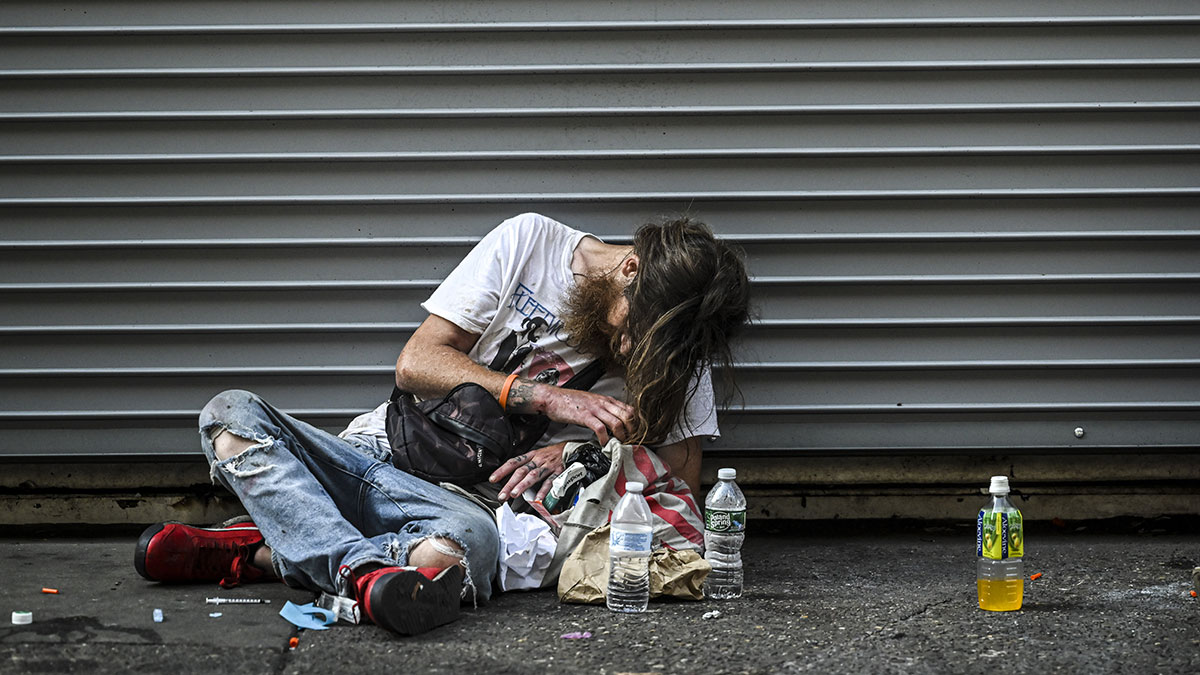
Photo by Fatih Aktas/Anadolu Agency via Getty Images
Source link