President Trump’s intentions for Venezuela remain unclear—but the deployment of the KC-135s could be a prelude to extended aerial operations over South America.
No one can quite figure out what President Donald Trump is up to when it comes to his policy toward Venezuela. On the one hand, Western hemispheric defense is in keeping with the stated goals outlined in the Trump administration’s new National Security Strategy (NSS) memo. On the other hand, the United States can ill afford a regime change war—and such a conflict goes completely against the ideas Trump campaigned on last year.
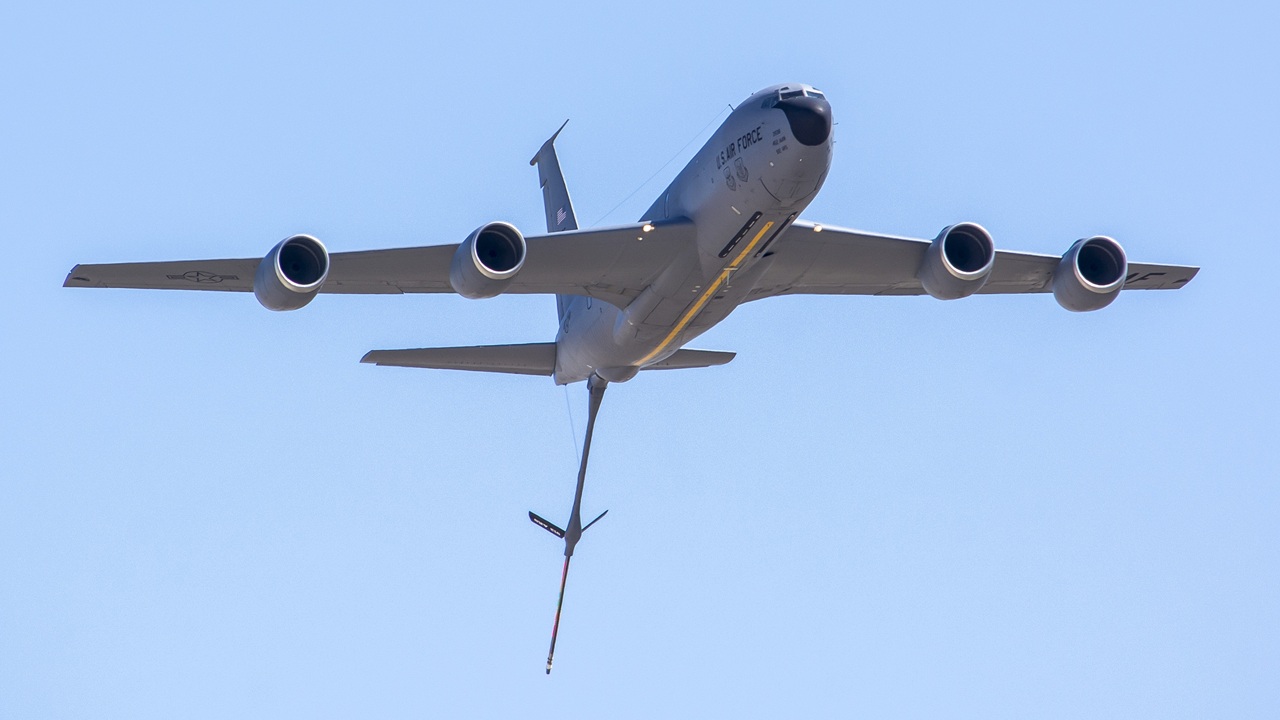
With 16,000 Marines and roughly 25 percent of the US Navy’s combat power positioned off the coast of Venezuela, the region is on edge. Now there’s more fuel for the war pyre. The Trump administration has moved United States Air Force KC-135 Stratotanker aerial refueling tankers to the Caribbean. These units are operating out of the Dominican Republic.
Washington is bolstering key air support for ongoing (and expanding) military operations in the Caribbean, notably with those linked to counter narcotic, surveillance, and regional pressure missions.
These tankers are being deployed alongside the larger military presence in the region. That expanding US military presence includes the introduction of helicopters, warplanes, electronic warfare (EW) birds, and combat search-and-rescue (SAR) planes.
Of course, such increases in force presence are not without complications.
Trump Has Escalated the Situation Near Venezuela
The Trump administration has, in recent weeks, declared Venezuela’s airspace closed. The White House has presided over the destruction of suspected drug-running boats in the Caribbean and has seized oil tankers it claimed were taking sanctioned Venezuelan oil to Cuba.
All the increased activity in the region has generated immense levels of controversies—with claims of piracy, war crimes, and now, near-misses between US-based airliners (specifically JetBlue) and American mid-air refuelers in the Caribbean.
As of mid-December 2025, the Air Force has deployed at least 10 KC-135s. These will supplement KC-46 refuelers operating in the US Virgin Islands. In essence, the Pentagon has created a major aviation refueling hub in the last six months as part of the buildup.
Essentially, the Trump administration’s mission to destabilize the Maduro regime of Venezuela is not some short-term matter. It will be protracted and expensive.
Understanding the KC-135 Stratotanker
- Year Introduced: 1957
- Number Built: 396
- Length: 136 ft 3 in (41.53 m)
- Wingspan: 130 ft 10 in (39.88 m)
- Weight: 322,500 lb (146,285 kg)
- Engines: Four CFM International CFM56 (USAF Designation F108) turbofan engines
- Top Speed: 600 mph (966 km/h)
- Range: 1,500 mi (2,419 km)
- Service Ceiling: 50,000 feet (15,240 meters)
- Loadout: 200,000 lb, or 30,000 gallons, of fuel, as well as a 37-passenger / 83,000-lb cargo deck
- Aircrew: 3 (pilot, co-pilot, and boom operator)
KC-135s are more than 60 years old. The older the plane, the higher the cost of maintenance, the longer the plane’s downtime is, too. Flying over saltwater for protracted periods could further put wear-and-tear on these older birds.
Currently, the entire KC-135 fleet costs around $3.7 billion to maintain each year. Prolonged mission sets for the KC-135s in the Caribbean Sea will only intensify the wear-and-tear, not just because of the saltwater but the humidity, too.
Besides, the KC-135s are past their prime and are being made to continue serving because the KC-46 Pegasus replacements are not fully ready. There have been major delays due to technical difficulties and other complications, causing those planes to go over budget and overtime—forcing the Air Force to rely on older refuelers that are in decline, such as the KC-135.
Since their initial delivery to the Air Force in 1957, the KC-135s have participated in just about every major combat operation this country has engaged in since—including the Vietnam War, Panama, the invasion of Grenada, the Gulf War, the air wars over the Balkans in the 1990s, Afghanistan, Iraq, and several other missions.
Is the Caribbean Mission Sustainable for the Aging KC-135s?
These birds are mission-critical for the US military to operate effectively as a global expeditionary force.
That’s why there are many concerns on the part of experts that keeping these planes continuously operating, even in airspace closer to the US, like the Caribbean, will not be good for the KC-135s.
After all, these planes are due to start retiring and they haven’t been due to the persistent failures of the KC-46 development program.
At some point, accidents will become more prevalent, and the overall power projection of America’s air units (Air Force, Navy, and Marine Corps) will be threatened.
About the Author: Brandon J. Weichert
Brandon J. Weichert is a senior national security editor at The National Interest. Recently, Weichert became the host of The National Security Hour on America Outloud News and iHeartRadio, where he discusses national security policy every Wednesday at 8pm Eastern. Weichert hosts a companion book talk series on Rumble entitled “National Security Talk.” He is also a contributor at Popular Mechanics and has consulted regularly with various government institutions and private organizations on geopolitical issues. Weichert’s writings have appeared in multiple publications, including The Washington Times, National Review, The American Spectator, MSN, and the Asia Times. His books include Winning Space: How America Remains a Superpower, Biohacked: China’s Race to Control Life, and The Shadow War: Iran’s Quest for Supremacy. His newest book, A Disaster of Our Own Making: How the West Lost Ukraine is available for purchase wherever books are sold. He can be followed via Twitter @WeTheBrandon.
Image: Shutterstock / Santiparp Wattanaporn.