As the Trump administration ramps up pressure on Cuba, members of the Democratic Socialists of America are not standing on the sidelines. Through delegations to the island, aid campaigns, and high-profile partnerships with commentators like Hasan Piker, the DSA is working to provide both political and material support for the regime in Havana.
DSA’s sustained, national-level focus on Cuba is a relatively recent development. In 2019, after passing a resolution at its national convention, the organization formally joined the National Network on Cuba. The network is an umbrella coalition of left-wing groups committed to opposing U.S. military action, turning American public opinion against the longstanding American embargo, and pressing for a fundamental shift in U.S.-Cuban relations.
Finally, a reason to check your email.
Sign up for our free newsletter today.
Soon after, the DSA International Committee (IC) began issuing condemnations of U.S. policy on Cuba. In September 2022, the IC dispatched its first official delegation to the island.
In October 2025, the DSA sent a second delegation to Cuba that included 11 members of its National Political Committee, including both co-chairs. Members met with Cuba’s Deputy Minister of Foreign Affairs, Carlos F. de Cossío. According to comedian and DSA member Kate Willet, de Cossío urged them to “educate people” about the impact of the blockade and Cuba’s designation as a state sponsor of terrorism. Willet also said that “he can’t tell us what to do exactly”—ostensibly to avoid the appearance of DSA coordination with foreign officials.
In the run-up to these trips, organizers also sought to leverage the delegations for fundraising on Cuba’s behalf. As one DSA leader noted in internal discussions, the goal was to “sell this idea to the influencers,” encouraging participants like Piker to help raise funds in addition to taking part in the delegation.
DSA’s Cuba Solidarity Working Group has worked to expand these trips, explicitly seeking to include “endorsed electeds” to “cultivate Cuba’s solidarity in up-and-coming politicians” and to build a “pro-Cuba block basically of elected officials . . . especially at the federal level.” To sustain this pipeline, the DSA established the Venceremos Fund to finance future delegations, asking donors to “support the struggle to dismantle U.S. empire.”
Earlier this year, the DSA expanded the Venceremos Fund to cover “humanitarian” purposes. Funds for this purpose, Cuba Solidarity Working Group co-chair Claire Blechman told a March meeting of the Cuba Solidarity Direct Aid Committee, would be used to purchase medical supplies that would then be transported to the island.
“It is very not legal to send money directly to Cuba,” Blechman said. “So, this is what we have to do. We have to send money to DSA, and then we have to buy stuff and then send stuff to Cuba.”
Given the tight U.S. financial and export restrictions on transfers to Cuba, the linchpin of DSA’s campaign is a partnership with Global Health Partners, a 501(c)3 tax-exempt organization whose stated mission on its 990 forms is “PUBLIC EDUCATION & HUMANITARIAN RELIEF.” Global Health Partners has a Commerce Department export license to send medical supplies to Cuba, and DSA is “piggybacking” off that license, according to Blechman.
At a February emergency meeting of the Cuba Solidarity Working Group, DSA member and GHP vice president and executive director Bob Schwartz described the arrangement.
“We [Global Health Partners] have been donating to Cuba for more than three decades. We’re probably the largest donor of meds and medical supplies,” Schwartz said. “We’ve done over $275 million worth of products to Cuba. This is something that’s very important for DSA, and it’s very important for us. So, we’d like to do this as a DSA brand, so to speak, because it also helps to build local chapters, and we’ve found that when local solidarity organizations get involved in something successful like this, they tend to stay involved in other aspects of Cuba work.”
Asked where the medical supplies would be sent, Schwartz acknowledged that they would go to the Cuban Ministry of Health, explaining that “Cuba doesn’t have a private health sector, and it would be distributed according to need.”
Cuban dissident media sharply contest the idea that health care on the island is “distributed according to need.” They allege that medicines are routinely diverted and sold, sometimes even marketed on social media. According to them, Cuba’s public health system is plagued by corruption and chronic mismanagement, with patients often forced to buy the “sutures, scalpels, saline solution, cotton” for their own surgeries.
While it expands its operations, the DSA has been explicit internally that contact with Cuban authorities must run through the International Committee. As Blechman put it at the launch of the IC’s Stop the Siege campaign on February 22, 2026: “The International Committee is the official group that interfaces with the Cuban government. So, I know some of you might have Cuban government or Cuban contacts that you want to work with, and it’s totally fine to work with civilians, with doctors, et cetera. However, please do not plan anything with the Cuban government or the party without IC’s involvement.”
Despite this caution, the DSA’s Cuba advocacy nevertheless continues to tread a fine legal line. It risks running afoul of the Foreign Agents Registration Act, among other legal pitfalls. The DSA’s relationships, and the broader network of U.S.-based Cuba advocacy organizations, merit scrutiny from the Justice and Commerce Departments.
With delegations, fundraising, and carefully coordinated advocacy, the DSA is building a platform that could influence U.S. discourse and policy toward Cuba for years to come. Policymakers would be foolish to ignore these efforts.
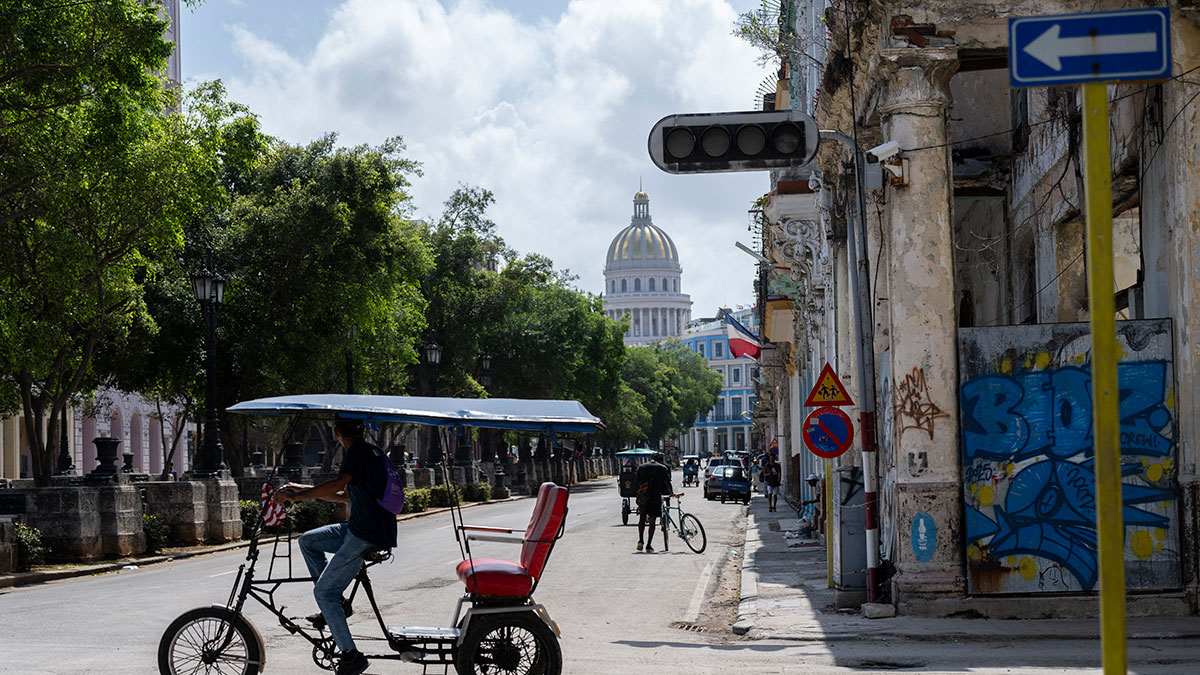
Photo by YAMIL LAGE / AFP via Getty Images
City Journal is a publication of the Manhattan Institute for Policy Research (MI), a leading free-market think tank. Are you interested in supporting the magazine? As a 501(c)(3) nonprofit, donations in support of MI and City Journal are fully tax-deductible as provided by law (EIN #13-2912529).
Source link