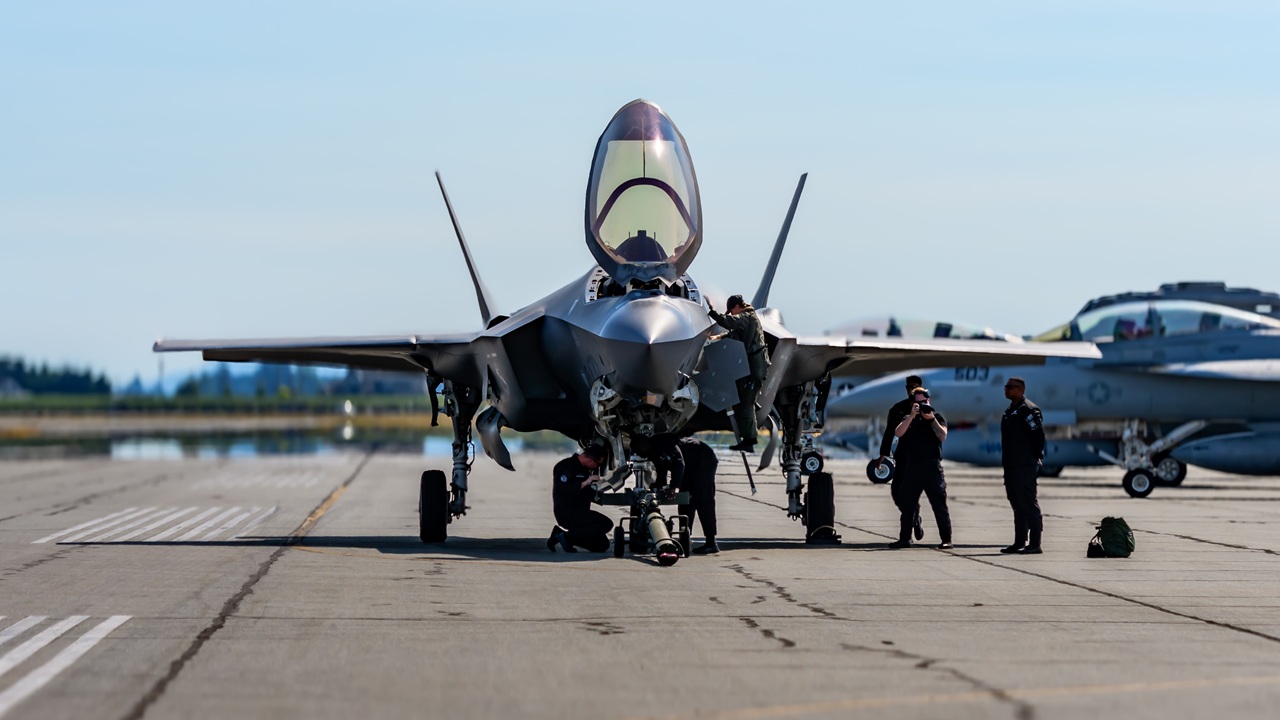
A shortfall of spare parts has contributed to terrible readiness rates among US F-35 fleets—and even led some service branches to cannibalize certain aircraft to keep others flying.
The Lockheed Martin F-35 Lightning II has been touted as the most successful fifth-generation aircraft made to date, and it is hard to see how any jet fighter of this era will ever reach the same level of adoption. More than 1,300 of the multirole stealth fighters are now in service, with orders likely to continue through the mid-2030s and likely even longer.
However, the aircraft has no shortage of detractors, with critics highlighting its high operating costs and its failure to meet the expected mission-capable rate. The latter fact has been mostly due to a lack of spare parts, a problem first identified by the Project on Government Oversight in 2020. Moreover, the Pentagon has been found to have spent billions of dollars on F-35 parts that can’t be accounted for. That has been an ongoing problem since at least 2019, according to the Government Accountability Office (GAO).
Lockheed Martin Wants to Make F-35 Spare Parts Easier to Get
Last month, Lockheed Martin announced it would invest $1 billion to stockpile spare parts for the Lightning II as part of efforts to increase mission readiness and drive cost-reduction initiatives.
“Over, I’ll say, a few prior years, there was, in our opinion, some underfunding of spare parts and repair capacity in the various defense budgets previous to this administration,” Lockheed Martin CEO Jim Taiclet said on a January 29 earnings call with analysts.
“We’ve also committed to an additional $1 billion of strategic internal investment for the F-35, with an emphasis on the aircraft sustainment system to improve mission-capable rates across the fleet. This is an absolute priority for us and one we are working closely with the Department of [Defense] on,” Taiclet added. “We’re going to double down on that to make an extra effort to improve the mission-capable rates of the aircraft and kind of make up for this unfortunate spare parts and repairs deficit that’s been created.”
The F-35’s Sustainment Costs Are Skyrocketing
The GAO warned in 2023 that the F-35 program’s life-cycle sustainment costs had jumped by nearly 30 percent to $1.58 trillion.
Even as costs have increased, the readiness levels for the multirole aircraft have declined. The United States Navy, which has some of the newest F-35 aircraft in its fleet, failed to meet its 60 percent readiness target.
The GAO had made several recommendations to address the issue, including for the Pentagon to establish military service depots to mitigate supply chain disruptions.
The announcement from Lockheed Martin is a sign that it is taking the issues seriously. Still, it comes after another report from the US Department of Defense (DoD) Inspector General warned that a lack of spares was affecting mission readiness.
Maintainers have also been facing supply chain challenges in receiving adequate parts to keep the F-35s operational. In too many cases, “F-35 squadrons are also cannibalizing parts to keep aircraft flying instead of being able to rely on receiving parts from Lockheed Martin’s supply chain,” the report stated.
Efforts to increase spares production will benefit the world’s largest aerospace and defense contractor, with the company reportedly on track to earn $2 billion from its investment.
“These systems are so critical in today’s world that we do feel that we are going to get benefit both financially and operationally on the performance of the aircraft from making this investment,” Taiclet continued. “So we’re going to do it.”
About the Author: Peter Suciu
Peter Suciu has contributed over 3,200 published pieces to more than four dozen magazines and websites over a 30-year career in journalism. He regularly writes about military hardware, firearms history, cybersecurity, politics, and international affairs. Peter is also a contributing writer for Forbes and Clearance Jobs. He is based in Michigan. You can follow him on Twitter: @PeterSuciu. You can email the author: [email protected].
Image: Shutterstock / Joe A. Kunzler.