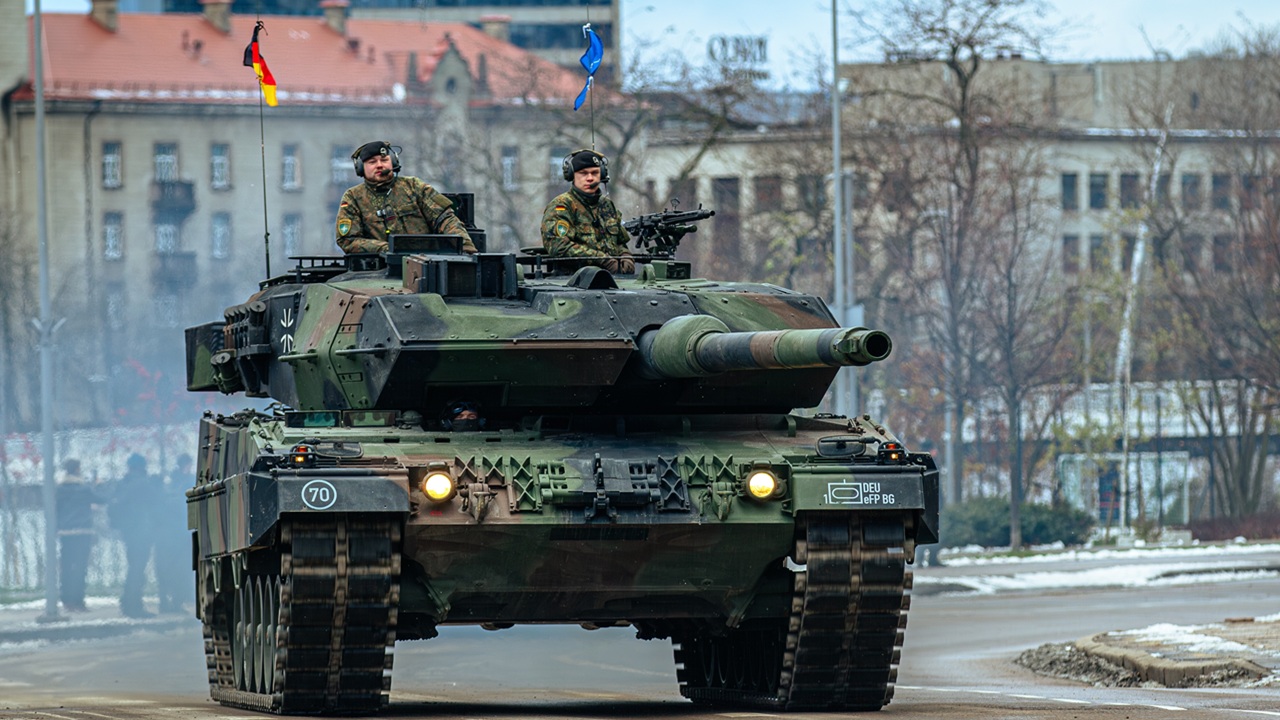
Around 5,000 German troops, along with 105 Leopard 2A8 tanks, will soon be permanently stationed along Lithuania’s southeastern border with Russian-allied Belarus.
The Bundeswehr continues its build-up of forces in the Baltics—the first permanent foreign deployment of German military personnel since the end of World War II. The recent move comes as part of a 1,200-page classified plan, “OPLAN Deu,” which was drawn up to counter a feared Russian invasion before the end of the decade.
Last month, two combat battalions arrived in Lithuania, as part of an expected buildup that could see more than 5,000 troops stationed in the largest Baltic nation by 2027. The first 250 Bundeswehr troops from the 45th Armored Brigade arrived in the Lithuanian capital, Vilnius, in the fall of 2024, marking the official start of German military operations on Lithuania’s territory.
The German forces will be stationed near the city of Rūdninkai, located around 30 km (18.6 miles) from Lithuania’s southeastern border with Belarus.
Berlin had previously rotated military personnel to Lithuania, which also borders Russia’s Kaliningrad exclave to the west. Yet the ongoing deployment marked the first time a German brigade has been formally based abroad since 1945.
Lithuania Doesn’t Want to Be Owned by Russia Again
Lithuania is both a former Soviet republic and a NATO member state, a fact that has raised concerns for Moscow. Russian President Vladimir Putin has suggested that his nation’s war of aggression in Ukraine and its build-up of forces were in response to NATO’s “eastern expansion.”
Perhaps understandably, Vilnius has a different view. Along with Estonia and Latvia, it fell under Russian rule from the late 18th to the early 19th centuries, and gained independence only after the Russian Empire collapsed in the latter stages of World War I. In 1940, all three states were again absorbed into the Kremlin’s orbit, this time under the flag of the Soviet Union—under the guise of Moscow’s “protection.” It was only after the end of the Cold War and the dissolution of the USSR in 1991 that the three nations regained their independence.
The omnipresent eastern border with Russia—and past Russian denigration of Baltic nationalism—has spurred all three Baltic states to spend significantly more on their respective militaries than the NATO average. The three nations have consistently exceeded the NATO guideline of 2 percent of their gross domestic product (GDP), with plans to further increase defense spending to 5 percent. This has included adopting modern systems such as the M104 HIMARS mobile rocket launchers, Javelin missiles, and drones.
The three nations are now jointly constructing the so-called “Baltic Defense Line,” consisting of an integrated network of fortifications along their borders with Russia and Belarus. In December, three states, along with Finland and Poland, also officially withdrew from the Ottawa Convention banning anti-personnel landmines, and are expected to restart land mine protection and usage along the Russian border.
Yet, even as the countries modernize their militaries, all three depend on NATO’s support, including regular deployments of combat aircraft for Baltic Air Policing (BAP) missions along the alliance’s eastern flank.
Germany’s Lithuanian Deployment Comes with 105 Leopard Tanks
As part of a December 2023 roadmap action plan agreed to by Berlin and Vilnius, the deployment of 105 German-operated Leopard 2A8 main battle tanks (MBTs) is planned. The stationing of German forces in Lithuania is intended to deter Moscow and to ensure that Berlin has time to respond should Russia mount an invasion.
In an address to the German Army in Lithuania in May 2025, German Chancellor Friedrich Merz stated, “Lithuania’s security is also our security. The protection of Vilnius is the protection of Berlin.”
Merz reaffirmed that commitment last month, according to Euro News.
“This brigade is not a political symbol, but a military contribution to deterrence and defence,” the chancellor added.
The German brigade at Rūdninkai will be supported by a multinational combat unit from eight allied countries, which will rotate to the region and operate from Rukla in central Lithuania.
About the Author: Peter Suciu
Peter Suciu has contributed over 3,200 published pieces to more than four dozen magazines and websites over a 30-year career in journalism. He regularly writes about military hardware, firearms history, cybersecurity, politics, and international affairs. Peter is also a contributing writer for Forbes and Clearance Jobs. He is based in Michigan. You can follow him on Twitter: @PeterSuciu. You can email the author: [email protected].
Image: Shutterstock / Arnoldas Vitkus.