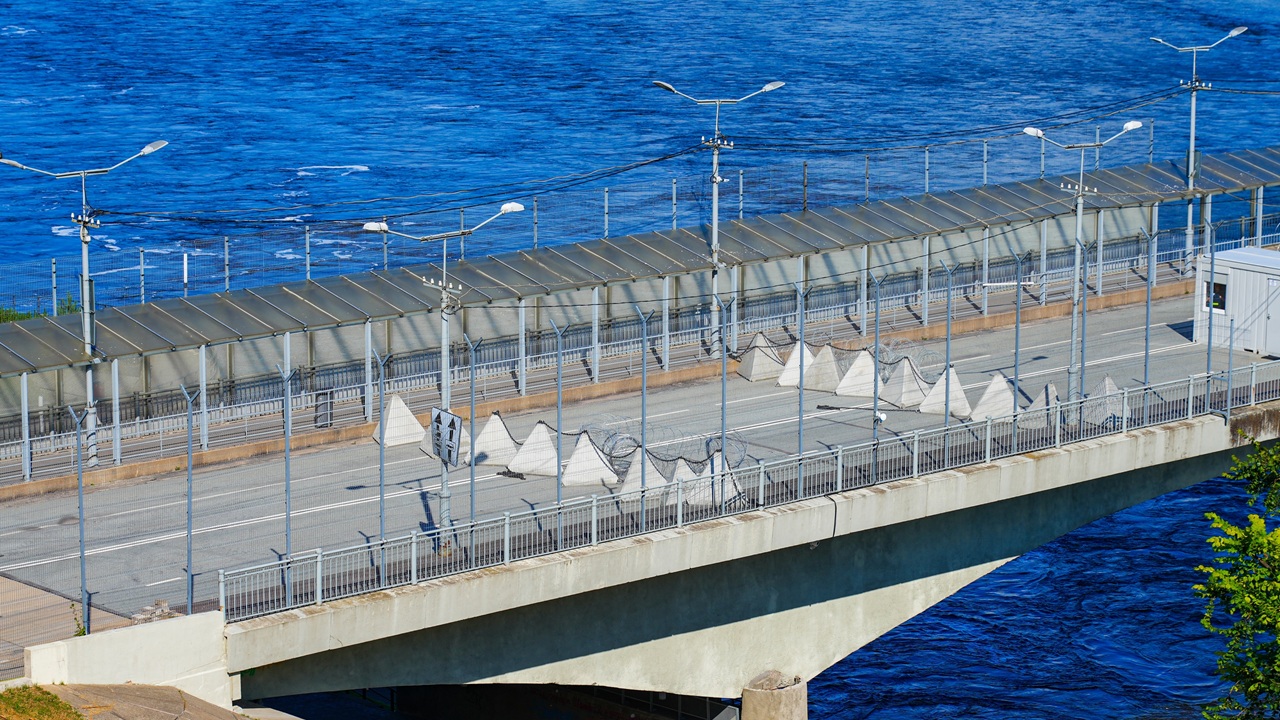
Estonia, Latvia, and Lithuania are cooperating in a joint effort to fortify their shared border with Russia—including through mines, anti-tank fortifications, and new bunker construction.
NATO member Estonia shares a roughly 340-kilometer (210-mile) border with Russia, stretching from the Gulf of Finland to the Latvian border. Although it includes Lake Peipsi, the Narva River, and even marshy wetlands that could impede an invasion, the Estonian government continues to fortify the frontier in anticipation of a future attack.
Bloomberg first reported last week that Tallinn has procured approximately 600 modular bunkers that will be installed along the frontier. The hardened structures will further fortify the ongoing efforts to install “delay-rated” fences designed to resist forced entry.
Installation of the reinforced fencing is scheduled for completion by early 2027.
The Baltic States Are Developing a Joint Defensive Line
The Estonian Center for Defense Investments (ECDI) is working with Latvia’s Ministry of Defense, with both nations seeking to install the bunkers along their respective borders with Russia. According to Estonian media, the total cost is estimated at €60 million ($70.7 million), with half allocated this year.
Installation of the first nine bunkers has begun in southeastern Estonia, with a total of 28 already delivered to pre-deployment areas.
“The experience gained gives us the confidence to move forward with the larger-scale procurement,” explained ECDI deputy director Asko Kivinuk.
However, there have been delays due to “challenges with terrain, land ownership, and production costs,” Defense News reported, citing Estonian officials.
The bunkers probably could not stop the full force of the Russian Army if it were to launch a large-scale invasion of Estonia akin to its invasion of Ukraine in February 2022. Instead of serving as an impenetrable, static line, the bunkers serve as a “glue trap” that could slow, disorient, and disrupt a Russian invasion force—buying time for preparations behind the line, and potentially for NATO forces to surge into the Baltic.
Each 35-square-meter (376.7 square foot) bunker was designed to withstand a direct hit from 152mm artillery shells. The modular design allows them to be installed quickly along the border, notably in forested terrain, where the structures would serve as “kill zones.”
In addition to the bunkers, Estonia has continued work on anti-tank ditches, part of a broader “Baltic Defense Line” that includes the delay-rated fences and other obstacles aimed at slowing a feared Russian invasion.
The Baltic Defense Line follows a NATO doctrinal change that had previously accepted trading ground in the Baltic States for a time, as reinforcements from allied nations could arrive.
Other New Construction: Landmines, Ditches, and “Dragon’s Teeth”
Further to the south, Lithuania began installing landmines and “dragon’s teeth” anti-tank barriers along the border with the Russian exclave of Kaliningrad and the frontier with Belarus, which remains a close ally of Moscow.
In addition to the modular bunkers, Estonian defenses call for a section of anti-tank ditches, followed by rows of barbed wire, dragon’s teeth, and even a strip of land where anti-vehicle and anti-personnel landmines could be laid if a military threat is perceived.
Russia has frequently accused the Baltic States of Estonia, Latvia, and Lithuania of “Russophobia” and preparing for war. NATO officials have suggested the claims are part of a broader “hybrid war” strategy that seems to destabilize NATO’s eastern flank.
Tallinn and the ECDI have made clear that they are ensuring peace by preparing for war—with keen recollection of the Soviet Union’s easy conquest of the Baltic states in the summer of 1940.
“The construction of the defence line is part of the development of Estonia’s defence capabilities, aimed at strengthening and protecting Estonia,” the ECDI explained. “We are preparing to defend ourselves. Establishing a defence line along the eastern border is not new; it has been done in the past as well.”
About the Author: Peter Suciu
Peter Suciu has contributed over 3,200 published pieces to more than four dozen magazines and websites over a 30-year career in journalism. He regularly writes about military hardware, firearms history, cybersecurity, politics, and international affairs. Peter is also a contributing writer for Forbes and Clearance Jobs. He is based in Michigan. You can follow him on Twitter: @PeterSuciu. You can email the author: [email protected].