The ongoing Gaza War has infuriated Egypt, which sees it as a flashpoint for a regional refugee crisis.
Egyptian and Israeli relations continue their precipitous decline over the fact that Cairo opposes the harsh actions undertaken by the Israeli Defense Force (IDF) in the Gaza Strip. Ever since the October 7 attacks three years ago, Israel has intensified its military operations against suspected Hamas militants embedded within the civilian infrastructure of the Gaza Strip.
The problem that Egypt is having with Israel has less to do with the untold tens of thousands of unarmed Palestinians in Gaza who have been caught up in what many consider to be Israel’s indiscriminate bombings. It has to do more with the fact that, by initiating these sweeping attacks, the Israelis are creating an untenable living situation there. And with limited amounts of humanitarian aid reaching the benighted people of Gaza, the people there are increasingly facing a terrible choice: stay and live among the constantly exploding rubble, or flee to neighboring Egypt.
This is where Cairo’s real problems with their Israeli neighbors reside. Egypt does not want to contend with massive refugee flows emanating from the IDF’s harsh measures in Gaza and being channeled into the Sinai Desert of Egypt. At its core, the argument between Egypt and Israel is the fact that Cairo doesn’t want to accept these refugees, fearing that once they did accept those refugees, the Israelis would never allow for those people to return to the Gaza Strip. Cairo is also concerned about the presence of Islamists among the refugees, which could destabilize its secular military government.
What Is an Egyptian Navy Ship Doing Near Gaza?
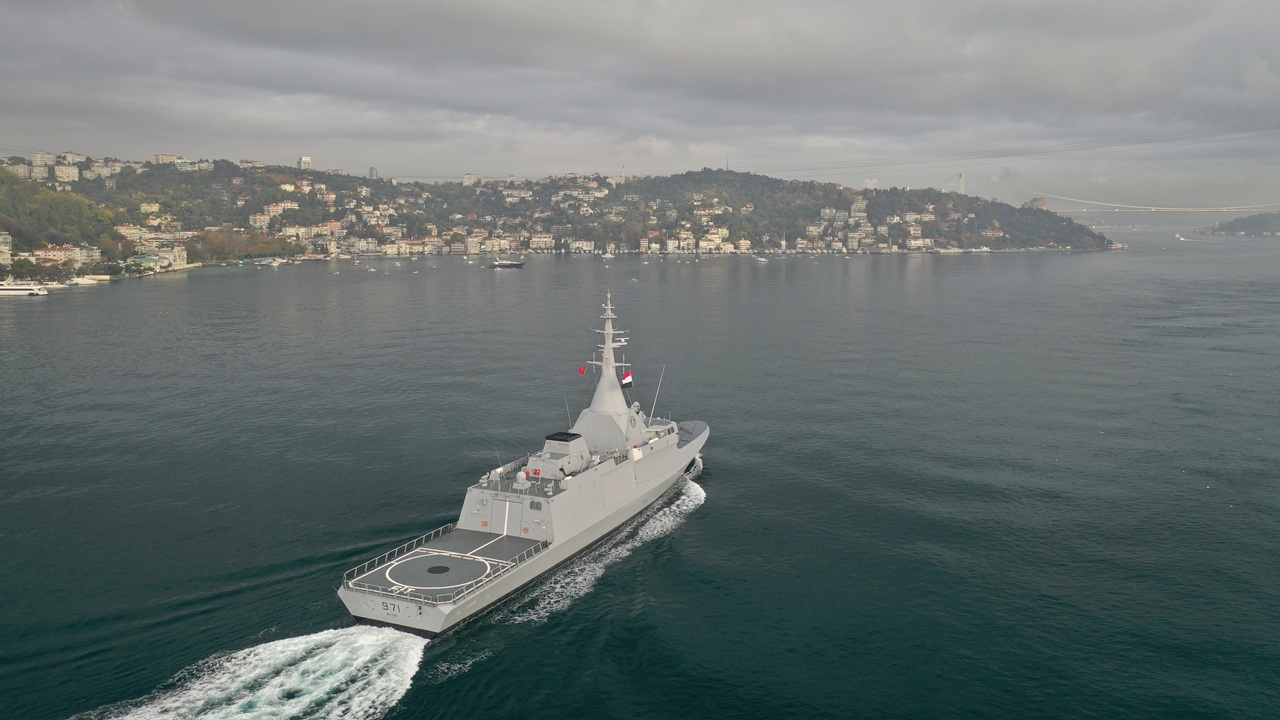
Anyway, an Egyptian warship recently entered the closed maritime zone off the coast of the Gaza Strip, according to The Jerusalem Post. It has been determined by authorities that the Egyptian warship deployed from the Sinai Peninsula (the region where Palestinian refugees from Gaza would inundate).
In reaction to this Egyptian warship entering Israeli territorial waters, Israel Navy warships were immediately deployed from Ashdod Naval Base. Those Israeli warships ordered the Egyptian ship to leave—going so far as to fire multiple warning shots at the Egyptian warship, believing the ship posed an imminent threat.
Israeli officials claim that the Egyptian has taken responsibility for the incident. Cairo, meanwhile, has issued no verification of these claims. Bear in mind that while Israel and Egypt have diplomatic relations, neither nation has an ambassador in the other’s capital representing their interests and smoothing over difficulties. So diplomacy between these two neighbors is quite cold in the otherwise fiery Mideast.
Obviously, many questions remain, notably…did this really happen? And if it did happen, did the event occur as the Israeli military is claiming?
Egypt Fears Gaza’s Fallout More Than Israel Does
The reason many in the region are skeptical is because the Israeli waters that the Egyptian warship supposedly entered had been closed off to the world since 2006. Israel’s navy had maintained a blockade there for 20 years. Egypt’s military is a competent force (for that region). Its commanders are well aware that these waters are off-limits to them. In fact, in the past when Egyptian warships have operated near these closed waters, the Egyptian Navy alerted their Israeli counterparts well before the warships were deployed.
If the event has occurred as the Israeli government describes, then it stands to reason that something significant occurred between Egypt and Israel that is not yet being reported. Or it could be that Israel is engaged in some form of covert maneuver to put the Egyptians on the defensive.
Another interesting, indeed likely, explanation is that the Egyptians put that warship in Israeli waters to send a clear message of deterrence to Jerusalem: Cairo will not tolerate territorial self-aggrandizement and perennial threats to Egypt’s sovereignty from an Israeli government that has been engaged in seemingly endless escalations against all its neighbors. By placing their warship in Israeli waters that have been blockaded for 20 years, Egypt was effectively sending a warning shot to Israel to slow down in Gaza or suffer the consequences.
Egypt Has Steadily Militarized the Sinai Since October 7
Let’s take a step back for a moment and analyze this in the wider context of deteriorating Egypt-Israeli relations. Since the October 7 attacks, Egypt has been warning Jerusalem not to engage in anything that even smacks of ethnic cleansing in Gaza, understanding fully that the refugee flows would overrun the Sinai Peninsula.
As such, Egypt has stationed massive numbers of US-made main battle tanks (MBTs) in the Sinai, along the border with Israel.
The Egyptian government has consistently resisted enormous Western diplomatic pressure, along with generous Israeli economic inducements, to absorb refugees from Gaza. What’s more, Cairo views the Israeli military operations near Rafah as a direct threat to Egypt’s national security. This has only served to heighten tensions between the two neighbors.
Egypt supports a peaceful end to the Israel-Gaza Conflict. Cairo accuses Israel of delaying deescalation in Gaza, while expanding military operations in the region. Cairo worries about the implications of having a permanent Israeli military presence so near to its border.
On the other hand, Jerusalem says that Egypt has long turned a blind eye to illicit weapons smuggling into the Gaza Strip, where the weapons end up in the hands of most appreciative Islamist fighters.
Another interesting accusation from Israel is that Egypt has been allowing large drones to fly into Gaza and deliver lethal military assistance to fighters there. Historically, Egypt has tolerated the covert Hamas tunnel networks linking the Gaza Strip with Egypt.
Another interesting point is that many Israeli leaders believe that Egypt views Palestinian armed resistance as a further deterrent against Israeli expansion.
The Gaza War Is Killing Egypt-Israel Peace
Since the initial peace deal signed in 1979, ending decades of hostilities and conflict between Israel and Egypt, Cairo has behaved cautiously in their interactions with Israel. The two sides have avoided direct military confrontations for decades. But the Gaza situation is now fully destabilizing the Israel-Egypt peace treaty, which has served as a foundational bedrock of the now-evaporating regional security order.
While this seems to have been an isolated incident in which few facts have been revealed to the public, it signals a serious breakdown between the two regional powers. It marks a decisive shift away from quiet coordination and toward conflict.
The Gaza conflict is no longer confined to just Israel. It is now an insuperable geopolitical wound the likes of which are unlikely to be healed anytime soon.
About the Author: Brandon J. Weichert
Brandon J. Weichert is a senior national security editor at The National Interest. Recently, Weichert became the host of The National Security Hour on America Outloud News and iHeartRadio, where he discusses national security policy every Wednesday at 8pm Eastern. Weichert hosts a companion book talk series on Rumble entitled “National Security Talk.” He is also a contributor at Popular Mechanics and has consulted regularly with various government institutions and private organizations on geopolitical issues. Weichert’s writings have appeared in multiple publications, including The Washington Times, National Review, The American Spectator, MSN, and the Asia Times. His books include Winning Space: How America Remains a Superpower, Biohacked: China’s Race to Control Life, and The Shadow War: Iran’s Quest for Supremacy. His newest book, A Disaster of Our Own Making: How the West Lost Ukraine is available for purchase wherever books are sold. He can be followed via Twitter @WeTheBrandon.
Image: Shutterstock / Archaeonavall.