
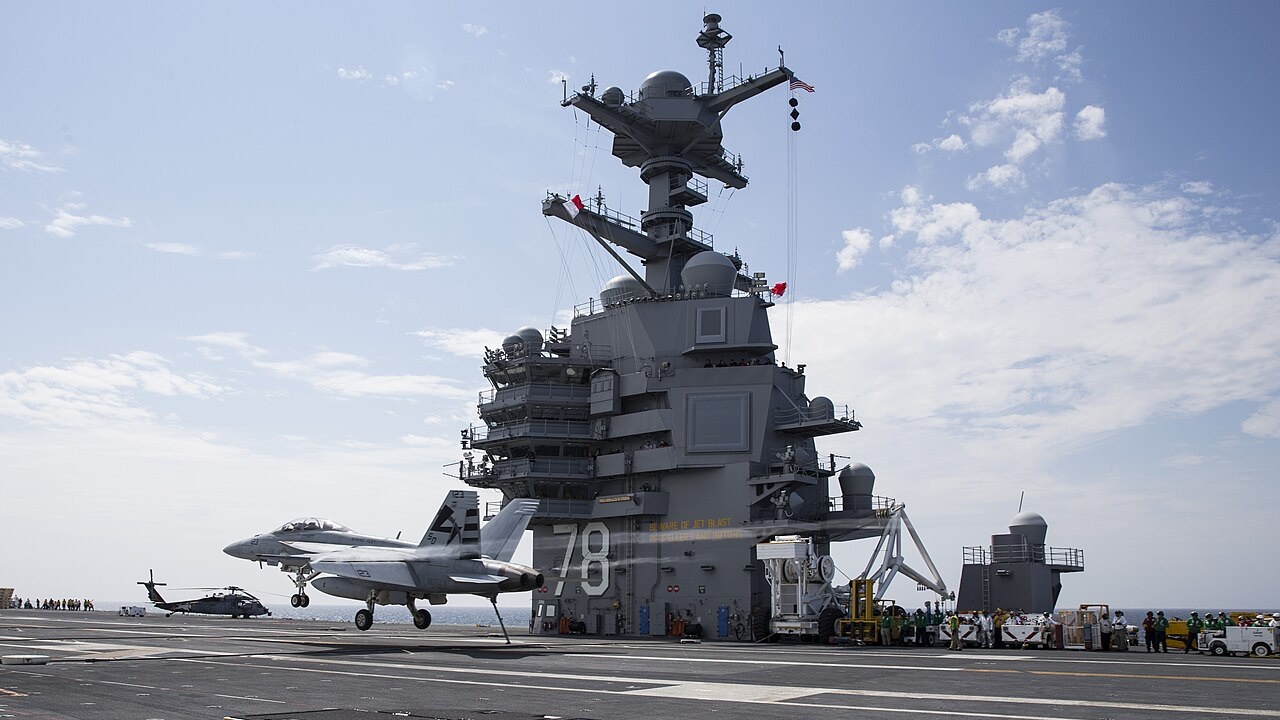
The deployment of the USS Gerald R. Ford, the most advanced aircraft carrier in the world, to the Caribbean represents a significant and unmistakable shift in the regional security landscape. The mere presence of the Ford in the waters off Venezuela carries significant military, strategic, and political implications. The Ford is not just a ship, but a mobile, self-contained power-projection ecosystem that meaningfully alters regional calculations through mere presence.
The United States Now Has the Strongest Air Force in South America
The Ford’s arrival instantly transforms the balance of power in the Caribbean. With a complete carrier air wing—including F/A-18E/F Super Hornets, EA-18G Growlers, E-2D Hawkeyes, and a full complement of ISR and refueling assets—the United States gains the ability to control airspace, conduct long-range precision strikes, and maintain persistent surveillance along the northern coast of South America.
The simple truth is that no regional air force comes close to matching the capabilities that the Ford imports to the Caribbean—meaning that from a functional military perspective, the United States now has air dominance in the region. Venezuela, the subject of the Ford’s visit to the Caribbean, fields Russian Su-30 Flanker fighter jets and an aging F-16 fleet. These aircraft will not be able to match the Super Hornets, particularly given that the Ford’s fighter wing will be backed by advanced electronic warfare aircraft and airborne early warning platforms. Even Venezuela’s Russian-supplied (and capable) air defense system would be overwhelmed with SEAD and standoff attack options.
Nor does the Ford deploy alone. Naval escorts, including Aegis destroyers, cruisers, and nuclear attack submarines, extend layers of missile defense, anti-submarine pressure, and maritime interdiction. In sum, the carrier strike group provides the US with dominant leverage in the region—the ability to destroy airfields, radar sites, naval infrastructure, or hostile aircraft in just a few hours.
The Ford’s Deployment Gives the White House Many Options
Strategically, the Ford’s deployment reinforces the longstanding US objective of maintaining regional stability and deterring adventurism. Tensions in the region have grown over the past year, in large part due to the Trump administration’s controversial airstrikes against alleged drug smugglers. By parking the Ford in the Caribbean, the US can effectively freeze escalations, as Venezuela knows any effort to escalate militarily would be foolhardy given the Ford’s decisive advantage in power.
From a political perspective, the deployment puts pressure on Nicolas Maduro’s government without forcing a direct confrontation. The Ford offers the Trump administration a tool of coercive diplomacy—demonstrating capability without crossing into actual provocation. Maduro must now factor the Ford into all calculations, which should inspire hesitancy with respect to mobilizing forces, intimidate neighbors, or interfering with maritime traffic. With the United States’ largest aircraft carrier on his doorstep, Maduro knows he is now being observed beneath one of the most sophisticated ISR networks in the world.
For the Trump administration, the deployment signals an odd paradox—in one respect honoring political promises, and in another respect disregarding them. Trump has long-promised to address the flow of both migrants and narcotics into the US through the southern border. The deployment of the Ford, ostensibly, plays at those concerns, at least optically. On the other hand, though, Trump has long alluded to a desire to extract the US from foreign entanglement. But parking the Ford off the coast of Venezuela is a method of passive confrontation with yet another foreign adversary, and could lead to further escalation if the situation does not improve.
About the Author: Harrison Kass
Harrison Kass is a senior defense and national security writer at The National Interest. Kass is an attorney and former political candidate who joined the US Air Force as a pilot trainee before being medically discharged. He focuses on military strategy, aerospace, and global security affairs. He holds a JD from the University of Oregon and a master’s in Global Journalism and International Relations from NYU.
Image: Wikimedia Commons.














.jpg)