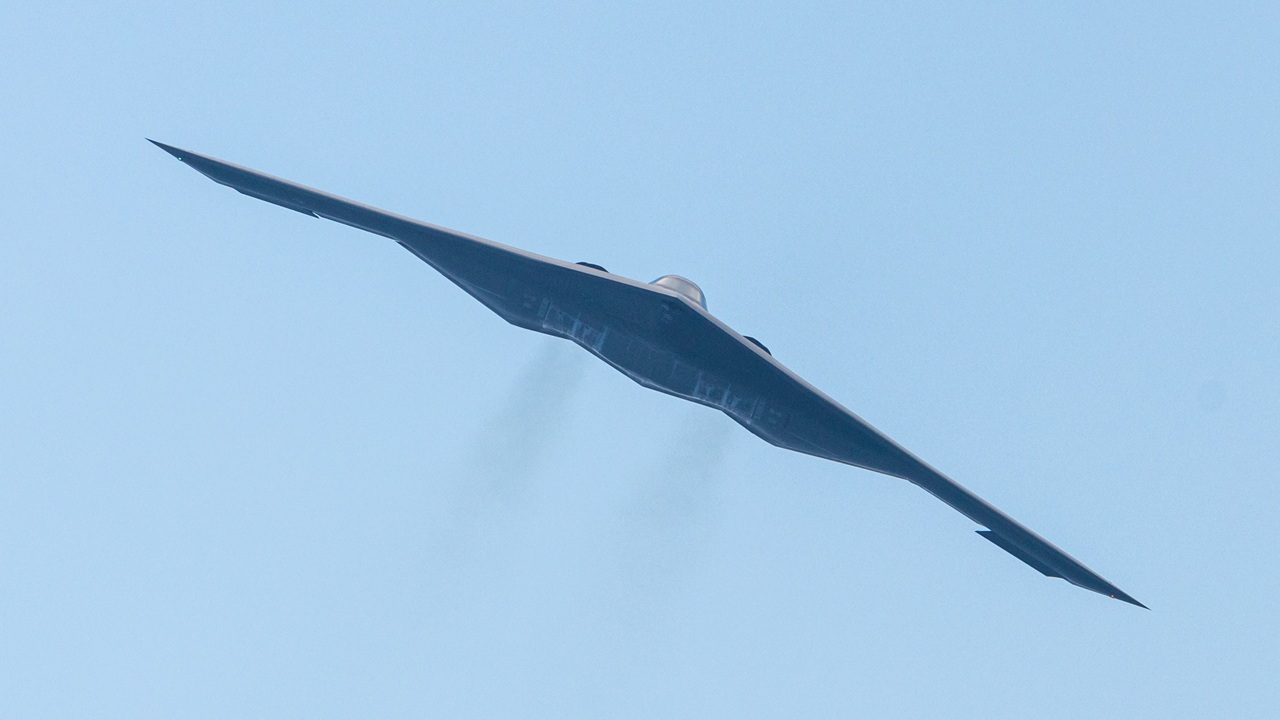
The small number of B-2s in the Air Force’s inventory—and the labor-intensive process of maintaining its stealth coating—put ongoing maintenance costs as high as $200,000 per flight hour.
The B-2 Spirit holds the record as the most expensive plane ever built, with a unit cost of roughly $2.1 billion. The stealth bomber’s astonishing price tag came in large part because of the massive investment in research and development for its stealth technology, and the fact that only 21 of the aircraft were ever built.
But the B-2’s initial cost is only one part of its enormous expense. The bomber also has an astronomical ongoing flight cost, with estimates ranging from $150,000 to $200,000 per hour. The costs stem not from fuel consumption or crew size, but from stealth maintenance, hyper-specialized infrastructure, and a tiny production run that prevented economies of scale. Sustaining such an expensive aircraft is a major factor in the Air Force decision to retire the B-2 in the near-future—ironically before the venerable B-52 Stratofortress, which the B-2 was introduced to replace.
The B-2 Spirit’s Specifications
- Year Introduced: 1997 (USAF initial operational capability)
- Number Built: 21 (19 still operational)
- Length: 69 ft (21.0 m)
- Wingspan: 172 ft (52.4 m)
- Weight (MTOW): ~336,500 lb (152,200 kg)
- Engines: Four General Electric F118-GE-100 turbofans (~17,300 lbf thrust each)
- Top Speed: ≈630–650 mph (~1,010–1,045 km/h) / ~Mach 0.95
- Range: ~6,000 nmi (6,900 mi, 11,112 km) unrefueled (intercontinental with aerial refueling; global reach)
- Service Ceiling: ~50,000 ft (15,240 m)
- Loadout: Internal weapons bays; roughly ~40,000 lb (≈18,000 kg) of ordnance — nuclear and conventional mission sets (B61/B83 certified historically), precision-guided bombs (JDAM, SDB), and select standoff munitions depending on loadout
- Aircrew: 2 (pilot and mission commander)
B-2 Arithmetic: One Hour of Flight, 50 Hours of Maintenance
The B-2 Spirit uses a generation-old form of radar-absorbent material (RAM), which is far more maintenance-dependent than more modern stealth coatings. The earlier designs require hand-applied coatings that degrade easily when exposed to rain, heat, sand, fuel, or general environmental exposure and must then be re-applied. This forces the Air Force to accommodate their B-2’s in climate-controlled (and therefore expensive) hangars with specially trained (and therefore expensive) technicians.
Because the B-2’s RAM coating is so sensitive, even small damage or imperfections can change the aircraft’s radar signature, compromising the aircraft’s survivability in the denied air spaces she was designed to penetrate. Fixing minor imperfections requires “touch labor” after nearly every flight to restore the aircraft’s stealth capabilities. Today’s stealth coatings, like those found on the F-35 and the forthcoming B-21, are more robust and less labor-intensive—emphasizing the inconvenience of the B-2’s maintenance needs. Basically, the B-2 requires about 50-60 maintenance hours for each hour flown.
Unlike an F-15 or an F/A-18, the B-2 can’t simply be parked outdoors; its RAM coating is far too sensitive. Instead, the B-2 must be stored in temperature- and humidity-controlled shelters to prevent RAM deterioration. Because these hangars are expensive and difficult to build, only a few bases have them, making B-2 deployment difficult and planning-intensive. The bases that can house the B-2—Whiteman AFB in Missouri, Andersen AFB in Guam, and Naval Support Facility Diego Garcia in the Indian Ocean—require millions in specialized construction. This limits the B-2’s strategic flexibility and increases operational costs.
Most Air Force Planes Have Economies of Scale. The B-2 Doesn’t.
Only 21 B-2s were ever built. 20 entered service, and one was later destroyed after a 2008 accident on Guam, leaving only 19 in use today. Despite this tiny fleet, the B-2 requires a large stable of mechanics, engineers, and specialists. So the labor costs per aircraft are significantly higher when compared to varieties of aircraft with fleet sizes measuring in the hundreds, where repetitive tasks can be performed efficiently.
The B-2’s nuclear missions drive costs up even further. As a platform tasked with delivering nuclear weapons, the B-2 must adhere to stringent nuclear readiness standards. This adds inspections, security, and additional training and certification—the partial costs of maintaining the air-based portion of the US nuclear triad.
The arrival of the B-21 Raider will soon force the Air Force to retire the B-2. The B-21, another flying-wing stealth bomber, applies lessons learned from the rigors of B-2 maintenance. The B-21 has modern stealth coatings and modular structures. And unlike the B-2, the B-21 is expected to enter mass production, dispersing costs across a fleet that will likely be at least five times larger than the B-2 fleet.
About the Author: Harrison Kass
Harrison Kass is a senior defense and national security writer at The National Interest. Kass is an attorney and former political candidate who joined the US Air Force as a pilot trainee before being medically discharged. He focuses on military strategy, aerospace, and global security affairs. He holds a JD from the University of Oregon and a master’s in Global Journalism and International Relations from NYU.
Image: Shutterstock / JJW Photography.