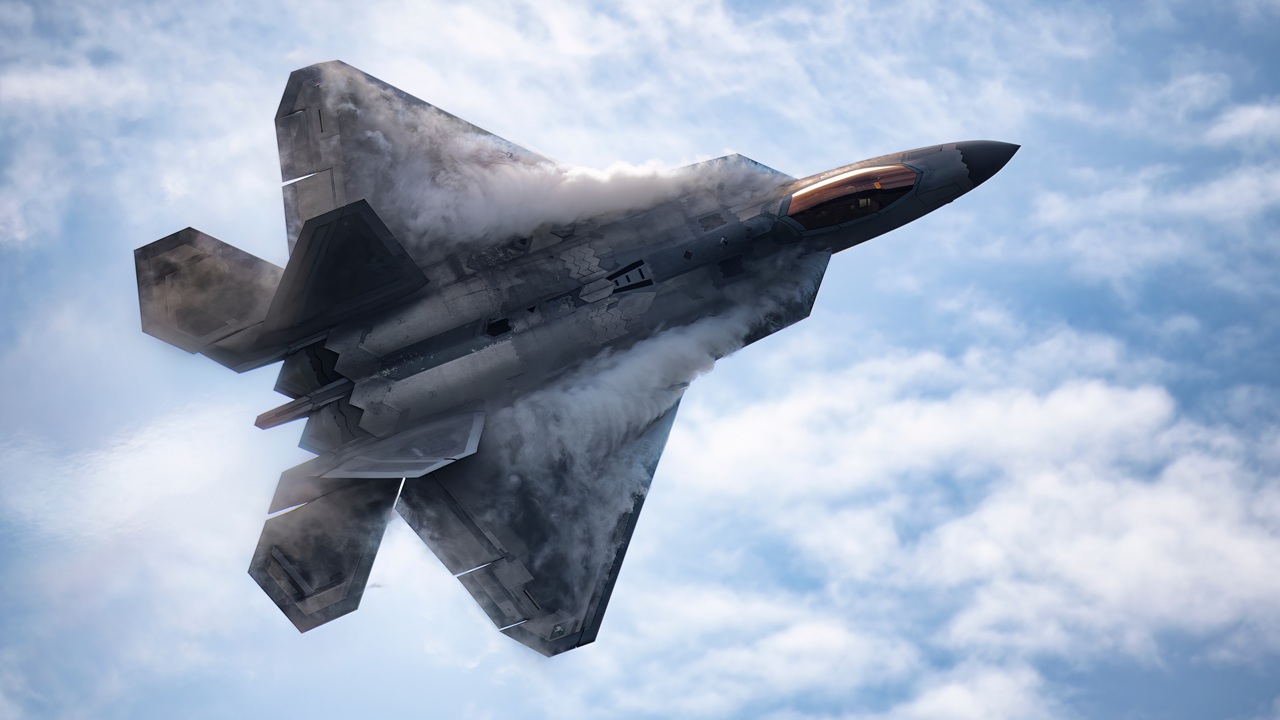
Thrust vectoring—essentially redirecting the plane’s exhaust flow—allows modern fighters to quickly change direction, giving them an edge in close combat.
Thrust vectoring nozzles are one of the most consequential technological adaptations in modern aerospace design. By allowing an aircraft to redirect engine thrust rather than rely solely on aerodynamic control surfaces for maneuvering, thrust vectoring facilitates control authority in extreme flight conditions, making modern fifth-gen fighters vastly more maneuverable than their non-thrust vectoring predecessors.
What Is Thrust Vectoring?
A thrust-vectoring nozzle physically deflects its exhaust flow to generate pitch, yaw, or roll moments. This works even when airflow over the wings is reduced or control surfaces are stalled, meaning there is a safety benefit, not just a maneuverability-for-flash benefit. Thrust vectoring typically comes in one of two common configurations: 2D, which controls pitch only, and 3D, which controls pitch, yaw, and sometimes roll. Both operate via movable nozzles flares at the engine exhaust with digital flight control integration.
Thrust vectoring offers a stark departure from the nozzle design of earlier jet fighters—which relied entirely on aerodynamic controls for maneuvering. But as aerial combat evolved, traditional engine nozzles began to lag behind the way jets were being used. Cold War aircraft pushed higher angles of attack, often engaging post-stall maneuvering. Soviet designers prioritized close-range maneuvering; Western counterparts soon followed suit, experimenting with relaxed static stability designs and digital fly-by-wire systems.
Thrust vectoring is almost exclusively a feature of fifth-generation aircraft. Operational fighters with the tech are the F-22 Raptor (which has 2D thrust vectoring for pitch), later variants of the J-20 Mighty Dragon (which are expected to integrate the tech), and the Su-57 (which features 3D vectoring as a core design feature. The only non fifth-generation aircraft in operation with thrust vectoring is the Su-30SM/Su-35 (equipped with 3D vectoring).
How Does Thrust Vectoring Help in Combat?
Thrust vectoring has useful applications in combat. First, thrust vectoring allows for control at high angles of attack; pilots can maintain control during aggressive maneuver and avoid departure from controlled flight, even when pushing the envelope. Thrust vectoring also allows for post-stall maneuvering, allowing rapid nose-pointing at lower airspeed, even enabling last-ditch missile shots in close-in dogfights. With respect to energy management, thrust vectoring helps recovery from low-energy states and improves survivability during defense maneuvers. And thrust vectoring offers a safety and handling benefit, improving takeoff, landing, and recovery from unusual attitudes.
As with any new technology, there are downsides. Thrust vectoring nozzles are heavier, mechanically complex, and more difficult to maintain. They increase the cost and reliability issues of an aircraft. Thrust vectoring effectiveness diminishes at high speeds where aerodynamic forces dominate. And because modern air combat emphasizes beyond-visual-range (BVR) engagements, aircraft reliance on extreme maneuverability is reduced.
Strategically, thrust vectoring is aligned with doctrines emphasizing close-range combat, visual dominance, and pilot authority in chaotic environments. Russian and Chinese fighters seem to highlight thrust vectoring as a way to signal kinematic superiority. But Western doctrines value stealth, sensor fusion, and missile performance. The F-22 demonstrates 2D thrust vectoring as a complement, not a centerpiece, while the F-35 was designed without thrust vectoring altogether. In the future, expect thrust vectoring to exist but in evolved form: with fewer moving parts, integration with adaptive engines, and software optimization.
About the Author: Harrison Kass
Harrison Kass is a senior defense and national security writer at The National Interest. Kass is an attorney and former political candidate who joined the US Air Force as a pilot trainee before being medically discharged. He focuses on military strategy, aerospace, and global security affairs. He holds a JD from the University of Oregon and a master’s in Global Journalism and International Relations from NYU.
Image: Shutterstock / Maciej Kopaniecki.