
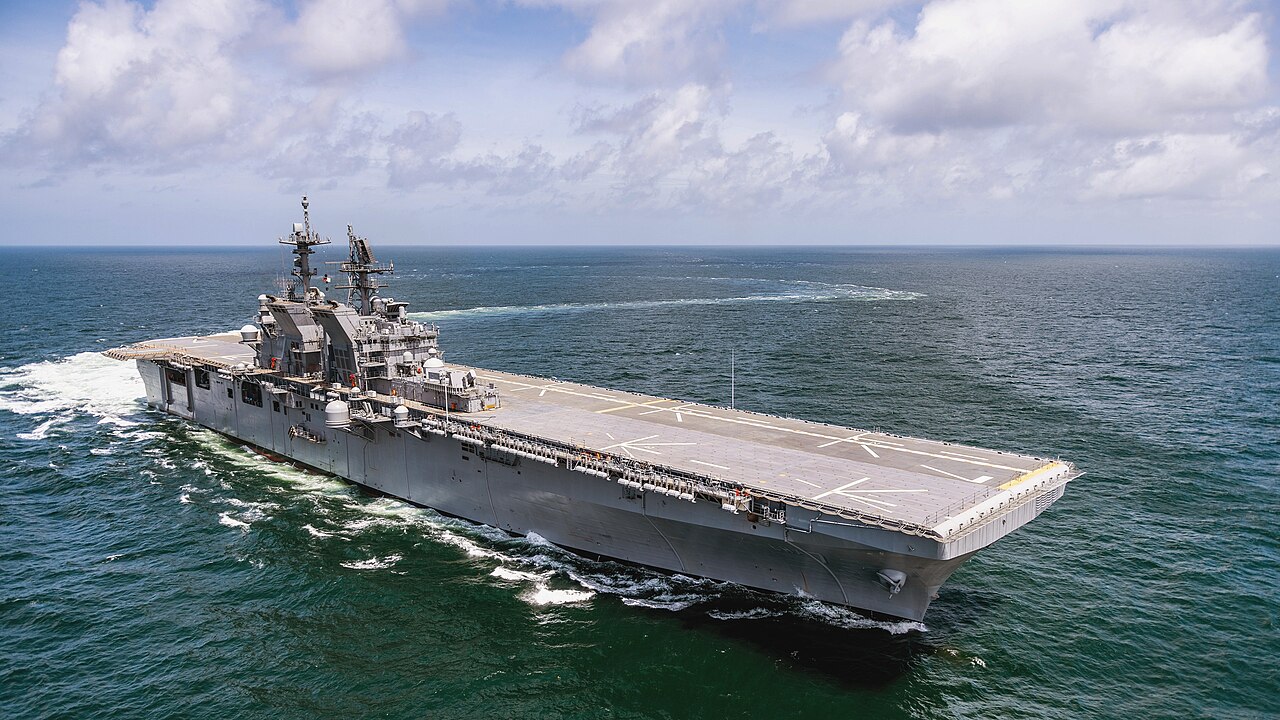
Beyond a vague commitment to “maintaining peace and security,” it is not yet clear what the Tripoli Expeditionary Strike Group’s aims in the Indo-Pacific are.
The US military deployed one of its most important units in the Indo-Pacific.
The Tripoli Expeditionary Strike Group, a combined Navy and Marine Corps task force, is operating in the 7th Fleet’s area of operations, conducting routine operations but also sending a message to China.
The Tripoli Expeditionary Strike Group
The joint Navy-Marine Corps task force is centered around the USS Tripoli, an America-class amphibious assault ship, and also includes the 31st Marine Expeditionary Unit (MEU), the USS Robert Smalls, a Ticonderoga-class guided-missile cruiser, and the USS Rafael Peralta, an Arleigh Burke-class guided-missile destroyer.
The task force has the right amount of strike and amphibious warfare capabilities to conduct offensive operations independently.
The USS Robert Smalls and USS Rafael Peralta provide the task force strike, anti-surface, anti-submarine, and air defense capabilities. Combined together, the two surface combatants have 218 vertical launch system cells that can fire Tomahawk cruise missiles, Standard Missile anti-aircraft missiles, and RUM-139 anti-submarine munitions.
The 31st MEU is the size of a regiment and has approximately 2,400 troops. Most importantly, the Marine Corps unit has the necessary organic assets to conduct offensive and defensive operations on its own.
For example, the unit’s Aviation Combat Element provides fighter, attack, and transport capabilities. It has CH-53E Super Stallion, MV-22B Osprey, UH-1Y Venom, and AH-1Z Viper transport and attack helicopters, and F-35B Lightning II stealth fighter jets. Moreover, the 31st MEU can rely on two C-130 transport planes, which are on standby at Marine Corps Air Station Futenma, in Okinawa.
“The Tripoli Expeditionary Strike Group is maintaining peace and security in the Indo-Pacific while assuring access to the seas for all nations,” Rear Admiral Tom Shultz, the commanding officer of the Tripoli Expeditionary Strike Group, said in a Navy press release.
The Marines of the 31st MEU also have their own drones.
“As the only permanently forward-deployed expeditionary strike group, our Navy and Marine Corps team’s ability to operate in the air, on land, and sea, combined with anti-air warfare, anti-submarine warfare and anti-surface warfare capabilities allows us to support any contingency in the region,” the senior Navy officer added.
The Tripoli’s Mission: Deterrence and Training
Sending the Tripoli Expeditionary Strike Group in the 7th Fleet’s area of operations is meant to both deter China and reassure US allies and partners in the region.
“The 31st MEU is flexible and responsive. We’re forward deployed and have longstanding, habitual relationships with Amphibious Squadron 11, the Japan Ground Self-Defense Force’s Amphibious Rapid Deployment Brigade and Special Operations Command Pacific,” Marine Corps Colonel Chris Niedziocha, the commanding officer of the 31st MEU, stated. “Those relationships, coupled with the unit’s high operational tempo ensure the MEU is always ready to respond to crises and campaign with our allies or fight tonight.”
Moreover, routine deployments such as this one give commanders and troops the skills and experience to perform if the need arises. The exceptional performance of several US military air, cyber, intelligence, and ground units during the operation to capture Venezuelan President Nicolas Maduro was the result of years and years of realistic exercises, as well as combat experience.
About the Author: Stavros Atlamazoglou
Stavros Atlamazoglou is a seasoned defense journalist specializing in special operations and a Hellenic Army veteran (national service with the 575th Marine Battalion and Army HQ). He holds a BA from the Johns Hopkins University and an MA from the Johns Hopkins’ School of Advanced International Studies (SAIS). His work has been featured in Business Insider, Sandboxx, and SOFREP.
Image: Wikimedia Commons.















_underway_in_the_Gulf_of_Mexico_during_builder%E2%80%99s_trials,_15_July_2019_(190715-N-N0101-150).jpg)