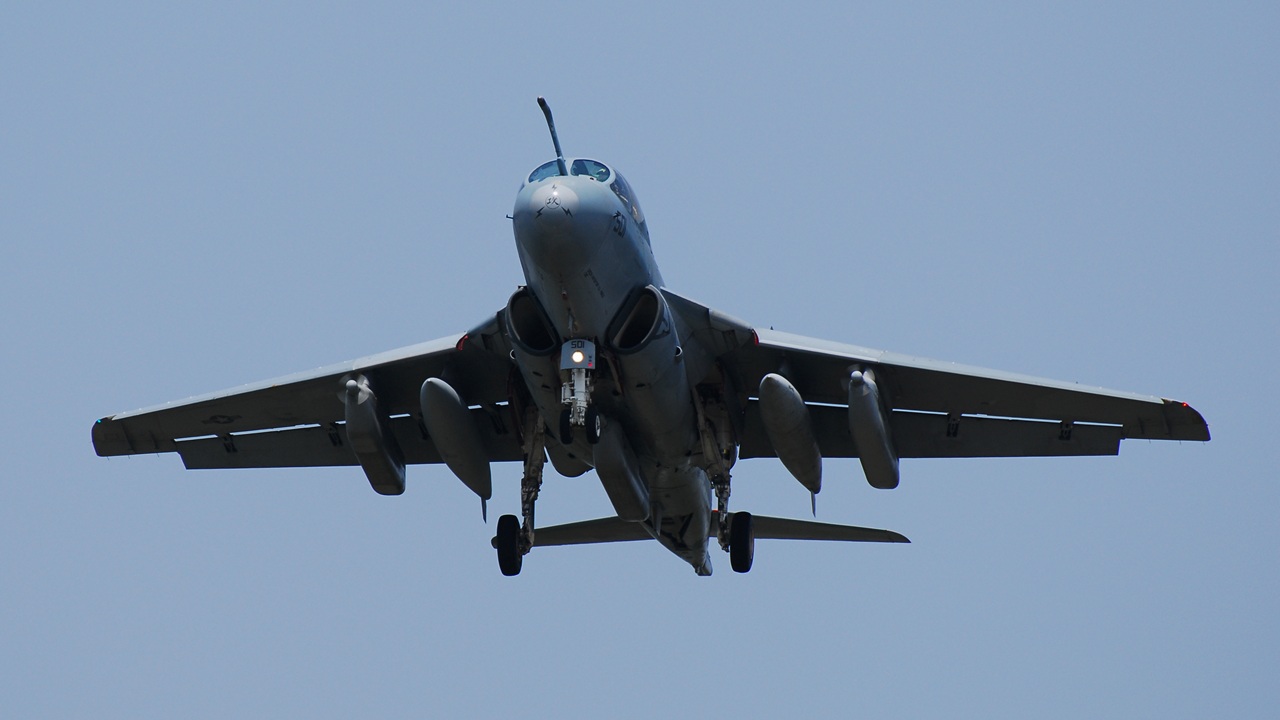
The EA-6B Prowler was not retired because of obsolescence, but because the advanced age of its airframes had significantly increased maintenance costs.
For more than four decades, the EA-6B Prowler served as the backbone of the US Navy’s airborne electronic attack. Developed by Grumman and introduced in 1971, the Prowler was a specialized derivative of the A-6 Intruder, modified extensively to carry powerful jamming systems, electronic surveillance gear, and a crew dedicated to managing the electromagnetic battle space. Over its long service life, the Prowler evolved into a versatile and consequential platform that conducted air operations from Vietnam through Iraq and Afghanistan and Libya.
The EA-6B Prowler’s Specifications
- Year Introduced: 1971
- Number Built: 170
- Length: 59 ft (18 m)
- Wingspan: 53 ft (16.15 m)
- Weight (MTOW): ~61,000 lb (27,670 kg)
- Engines: Two Pratt & Whitney J52-P408 turbojets (10,400 lbf thrust each)
- Top Speed: ~650 mph (1,050 km/h)
- Range: ~2,327 mi (3,745 km) depending on mission dependent
- Service Ceiling: ~37,000 ft (11,500 m)
- Loadout: Five hardpoints; 18,000 lb (8,164 kg) payload capacity; sophisticated electronic warfare suite
- Aircrew: 4 (pilot and three ECMOs)
Why Was the Prowler So Useful to the Navy?
Technically, the Prowler was a robust and complex machine. The airframe was a stretched version of the A-6, with a lengthened fuselage to accommodate the four-person cockpit. The Prowler was not a fast aircraft, but was far faster than its presumed targets on land and sea—and earned high marks for stability, endurance, and payload capacity, allowing for extended loiter times and extended missions. The crew of four featured one pilot and three electronic countermeasures officers (ECMOs), reflecting the needs of the platform’s mission profile, namely, coordinating, analyzing, and executing intricate jamming and electronic attack tasks.
Perhaps the Prowler’s signature feature was the AN/ALQ-99 Tactical Jamming System, a suite of pods that enabled the aircraft to disrupt radar systems, degrade communications, and blind enemy air defenses over wide areas. The Prowler could also employ AGM-88 HARM anti-radiation missiles, giving the jet the ability not only to jam enemy radars, but to actively destroy them.
The technical capabilities of the Prowler made the platform indispensable to US forces. In the skies over Vietnam, the Prowler proved itself, escorting strike packages and shielding aircraft from North Vietnamese SAMs and radar-directed AAA. In the Gulf War, Prowlers were central in neutralizing Iraq’s integrated air-defense system, enabling the coalition’s devastating air campaign to operate with near impunity. And in Kosovo, Afghanistan, and Iraq, the Prowler provided jamming support, communications disruption, and electronic overwatch—all vital functions during complex joint operations.
The Prowler’s Retirement Is Surprisingly Recent
The Prowler’s retirement was only fully completed in 2019—and was not the result of obsolescence, but instead platform age and the emergence of more modern systems. The Prowler airframe, for example, dated back to the 1960s and by the 21st century was requiring increasingly intensive maintenance support. More importantly, perhaps, the Navy introduced the EA-18G Growler, a two-seat Super Hornet derivative with enhanced electronic warfare capabilities relative to the Prowler.
The strategic implications of the Prowler’s service, and retirement, were significant. For decades, the Prowler gave the United States a decisive advantage in the electromagnetic space, with capabilities ahead of its time that few nations could match. This allowed US forces to operate in high-threat environments with relatively reduced risk.
The retirement of the Prowler represents a trend away from concentrated electromagnetic capabilities into a dispersed, networked electronic attack. Instead of a single four-person aircraft carrying the bulk of the electromagnetic capabilities, the US is shifting towards platforms where electronic attack is integrated across multiple nodes—stealth fighters, cyber capabilities, unmanned systems, and surface assets.
About the Author: Harrison Kass
Harrison Kass is a senior defense and national security writer at The National Interest. Kass is an attorney and former political candidate who joined the US Air Force as a pilot trainee before being medically discharged. He focuses on military strategy, aerospace, and global security affairs. He holds a JD from the University of Oregon and a master’s in Global Journalism and International Relations from NYU.
Image: Shutterstock / viper-zero.