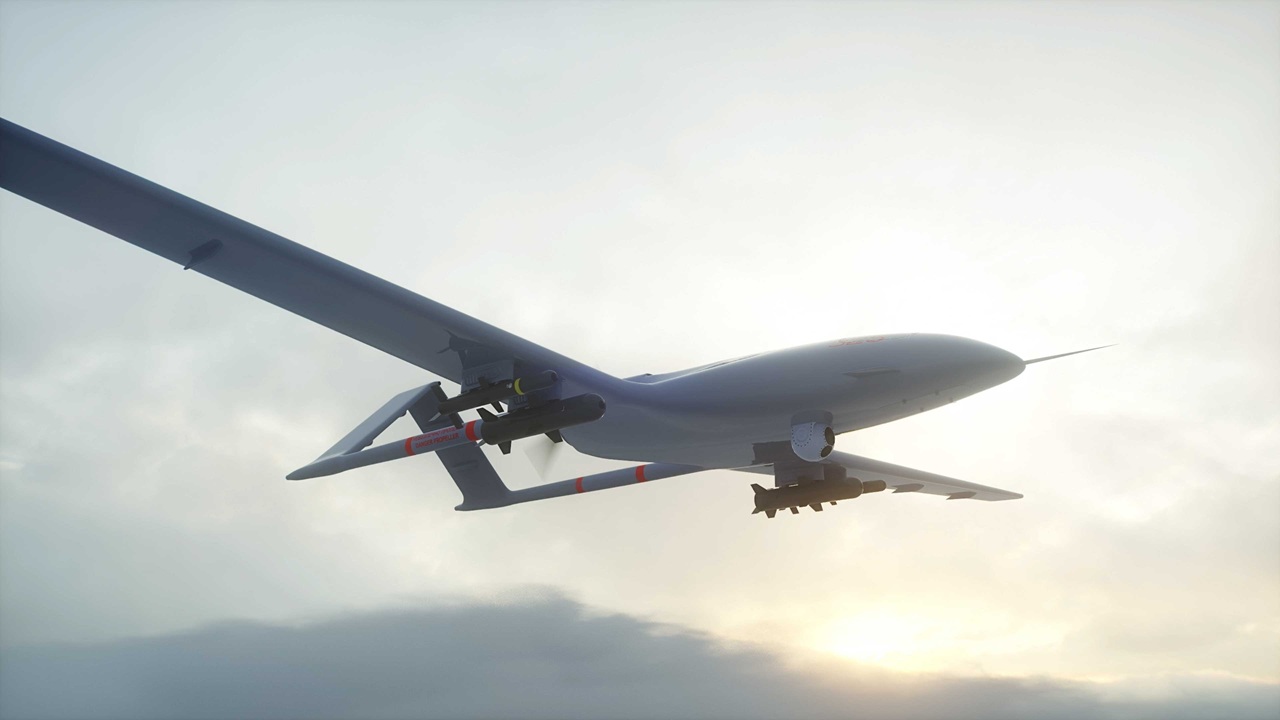
Egypt is building a drone armada in response to what it views as aggressive actions from neighboring Israel—and it has sought China’s help to do it.
The Middle East has fully slipped through the fingers of the United States, falling into the hands of America’s adversaries. Unsurprisingly, Washington is completely unaware of these developments. So is Jerusalem, which is usually quite astute to even the slightest geopolitical shifts in its home region.
The Sands Are Shifting Against Israel
Ever since the Israeli airstrikes against suspected Hamas targets in Doha, Qatar, the Arab world has rightly been on guard. Seeking to reconfigure the security situation more to their liking, while being keenly aware of the fact that the Americans will not have their strategic backs, the Arabs are quietly seeking new arrangements.
First, the Turks are moving slowly-but-surely into the region. Second, in reaction to the unstable behavior of the current Israeli government, the Saudis are starting to play diplomatic footsie with their regional rivals in Iran. Third, the Egyptians have been calling for the creation of a rapid reaction force for the Arab world… not to contain Iran, as American policymakers have hoped for years, but to deter the Israelis.
For now, that plot is on hold, as Cairo and Riyadh quarrel over which of them would be the seniormost military partner in any such joint-Arab military alliance.
Egypt Looks East for Military Assistance
So Egypt has turned to the Chinese (and the Russians). In recent months, Egypt has quietly invited Chinese military interests into their country. The two countries’ militaries conducted joint wargames earlier this year in Egypt.
Now, there is news that the Chinese state-owned arms conglomerate Norinco is launching joint production facilities in Egypt for armed drones. Specifically, Egypt is working with China on indigenizing China’s ASN-209 armed drone, under the imprimatur of the “Hamza-2.” Roughly 85 percent of the local Egyptian production will be conducted by that country’s Arab Organization for Industrialization (AOI), allowing for Egypt to master the production of these vehicles with Chinese inputs. This deal allows for China to expand its reach into the Middle East, creating a new market for Norinco.
Egypt Is Building Advanced Drones to Deter Israel
Although the Hamza-2 drone’s exact specifications remain unknown, it is thought to be a medium-altitude intelligence, surveillance, and reconnaissance (ISR) strike drone. It has a twin-boom design and employs a simple piston engine, giving it extended range (roughly 1,500 km / 932 mi) and endurance. The drone’s top speed is estimated at 200 kilometers per hour (124 mph).
This unmanned craft is designed for surveillance and precision strikes. It is a significant upgrade for Egypt’s armed forces.
What’s more, this decision to cooperate with China in developing armed drones for itself is part of a larger Egyptian military buildup. And it’s all clearly aimed at Egypt’s Israeli neighbors to the east, whom Cairo believes have gone too far both in the war against Hamas in Gaza and in the way that they have treated their Arab neighbors.
Ever since Israel invaded Gaza in the aftermath of the October 7 terrorist attacks, Jerusalem has endeavored to force the bulk of the Arab population of Gaza out of their homes and into Egypt’s Sinai Desert to the south.
The goal is clear: create a revolution in military affairs for Egypt so that it can better deter what it views as unwanted Israeli aggression directed against it. Of course, the Israelis would counter that they are merely defending themselves against an increasingly hostile set of neighbors.
Regardless of who is right or wrong, the fact remains that Egypt is looking to China to help kickstart its revolution in military affairs—and that revolution is about deterring one country alone, Israel.
About the Author: Brandon J. Weichert
Brandon J. Weichert is a senior national security editor at The National Interest. Recently, Weichert became the host of The National Security Hour on America Outloud News and iHeartRadio, where he discusses national security policy every Wednesday at 8pm Eastern. Weichert hosts a companion book talk series on Rumble entitled “National Security Talk.” He is also a contributor at Popular Mechanics and has consulted regularly with various government institutions and private organizations on geopolitical issues. Weichert’s writings have appeared in multiple publications, including The Washington Times, National Review, The American Spectator, MSN, and the Asia Times. His books include Winning Space: How America Remains a Superpower, Biohacked: China’s Race to Control Life, and The Shadow War: Iran’s Quest for Supremacy. His newest book, A Disaster of Our Own Making: How the West Lost Ukraine is available for purchase wherever books are sold. He can be followed via Twitter @WeTheBrandon.
Image: Shutterstock / Pavel Chagochkin.