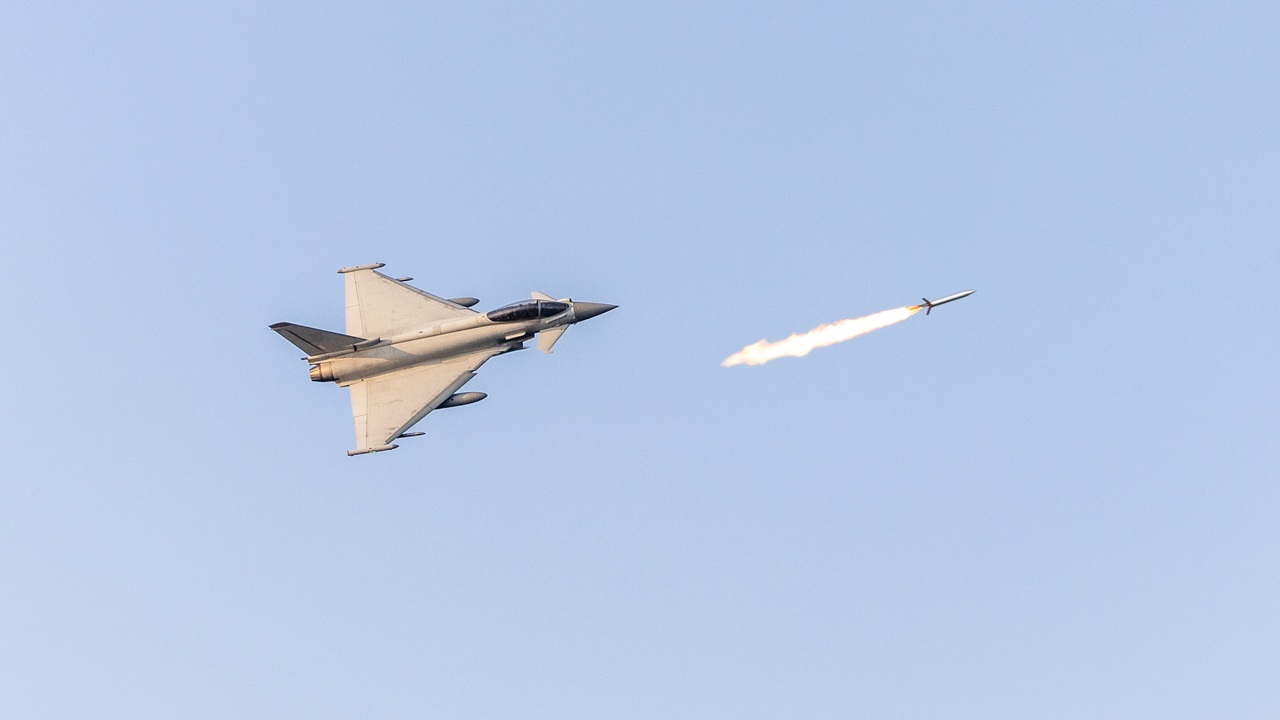
“Stand-off” range is the range an aircraft must remain away from its target to avoid putting itself in danger—a vital consideration in modern air combat.
In air warfare terminology, “stand-off” distance refers to attacking from outside an adversary’s effective engagement range. As air defense systems become increasingly sophisticated, stand-off capability is becoming increasingly important—a vital factor in survivability, efficiency, and strategic control. Indeed, stand-off has become central to air combat.
A “stand-off” engagement is any that takes place at a range where the attacker is not directly threatened. This can apply to aircraft, missiles, or electronic warfare and requires accurate targeting, with reliable sensors, and long-range weapons. In other words, stand-off is a term defined by a relationship rather than a fixed distance. And as defenses improve, stand-off ranges must necessarily grow—because “stand-off” is defined by the defender’s reach, not the attacker’s preference.
What Does “Stand-Off” Technology Really Mean?
In the first decades of air combat, “stand-off” ranges simply did not exist. Early air combat was based on visual range and machine guns. In World War II, bomber aircraft relied on escorts to keep them safe from enemy fighters, lacking any form of stand-off capability against air defenses. Things changed during the Cold War, with the emergence of SAMs, which forced stand-off as a necessity for survival. Cruise missiles and precision guidance emerged, expanding viable engagement distances. But it wasn’t until the late 1980s and 1990s that precision stand-off became routine.
Modern technology enables stand-off. Long-range precision weapons like cruise missiles and air-to-air missiles are especially important. Advanced sensors, like AESA radar and ISR platforms, allow planes to engage from greater distances. Networking is becoming increasingly important, through data links and sensor fusion. Modern aircraft also take advantage of targeting support, through satellites and drones, and electronic warfare, through jamming and deception. In effect, stand-off is systems enabled; no single aircraft performs stand-off independently.
Not all aircraft are equipped with stand-off capability. The US Air Force’s bombers—the B-52, B-1B, and B-2—can all launch stand-off weapons from safe airspace. Some fighters, like the F-15EX and F-35, are so equipped, allowing them to act as missile trucks or sensor nodes. But other aircraft have more limited ranges, necessitating a degree of danger in their own operations.
Why Standoff Weapons Are So Useful
Stand-off is chosen when defenses are dense and attrition is unacceptable. Stand-off preserves platforms for repeated use while saving lives. It reduces risk to high-value assets and allows for fewer sorties and greater persistence. Stand-off shifts the focus from pilots yanking and banking to planning and coordination. Stand-off weapons have the ability to overwhelm defenses through volume and saturation—but sacrifices immediate feedback and flexibility. These are natural tradeoffs for proximity.
Strategically, stand-off supports power projection without escalation, enabling strikes without basing access, too. Deterrence can be shaped, through showing adversaries that they are vulnerable, even from a distance. But stand-off does encourage arms races, in pursuit of longer-range weapons and better defense systems. Stand-off favors industrial capacity and networking, rewarding states that can integrate systems at scale.
In the future, stand-off distances will continue to increase. Hypersonic weapons will compress timelines. Drones will extend reach further. Counter-stand-off, like longer-range SAMs and space-based sensors will improve but stand-off will not disappear. It will become more automated and more contested as the battle shifts from air space to networks. Expect stand-off weapons to continue playing a central role—reshaping modern air combat, which will increasingly be fought beyond visual range and beyond national borders. In the future, as now, stand-off won’t be optional, but a default condition of modern air power.
About the Author: Harrison Kass
Harrison Kass is a senior defense and national security writer at The National Interest. Kass is an attorney and former political candidate who joined the US Air Force as a pilot trainee before being medically discharged. He focuses on military strategy, aerospace, and global security affairs. He holds a JD from the University of Oregon and a master’s in Global Journalism and International Relations from NYU.
Image: Shutterstock / triple_v.