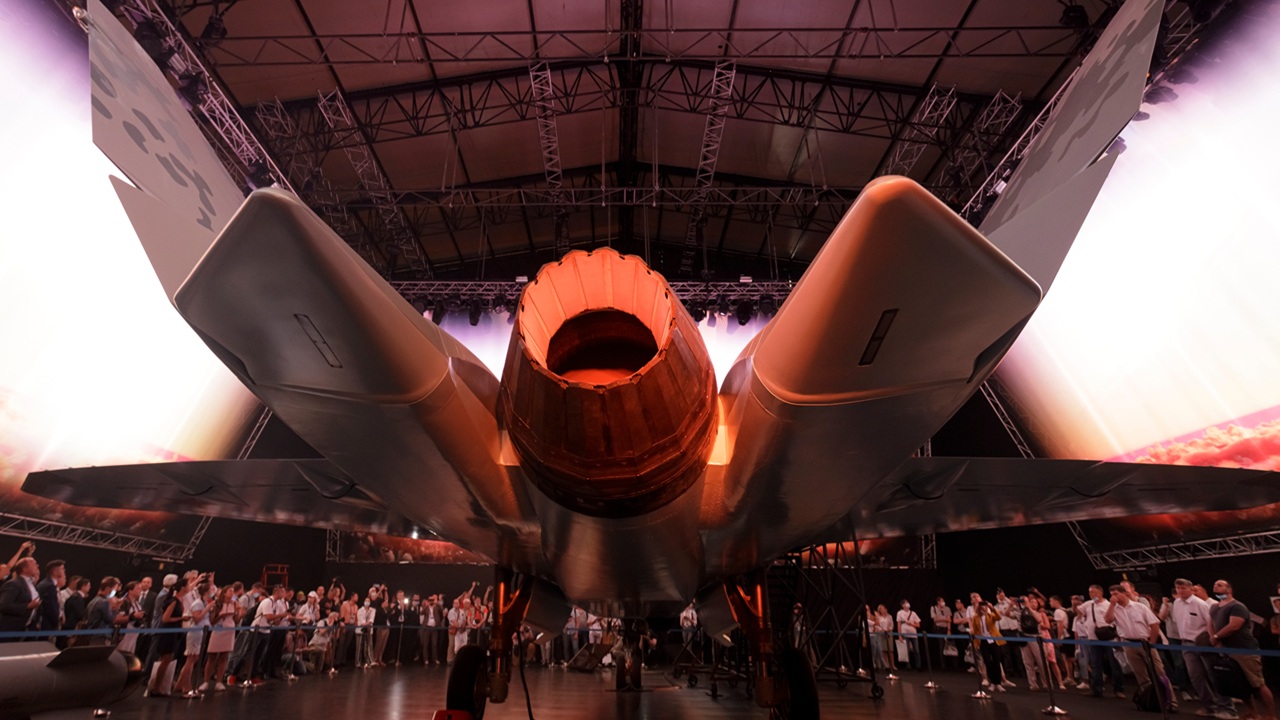
Russia’s war economy is fully devoted to the struggle in Ukraine—giving the Kremlin few resources for long-term projects like a sixth-gen fighter jet.
The race for the sixth-generation warplane is afoot. China and the United States lead the pack. The Europeans are striving to maintain pace with the two major superpowers in Beijing and Washington. Interestingly, left out of this discussion is the third major power in the quasi-tripolar world system: the Russian Federation. How could this be?
The Sixth-Generation Race is Real—but Where’s Russia?
Right now, it seems like the Russians have prioritized developing technologies and capabilities that will ensure their War in Ukraine ends in a victory. So, Moscow has ordered their wartime production to prioritize mass production of main battle tanks, long-range missiles, hypersonic weapons like the Oreshnik, and drone swarms, to name just some of the technologies Russia is focused on to win the Ukraine War.
Moscow hasn’t even prioritized their fifth-generation warplane, the Su-57 “Felon”—though many Western analysts assert that the Su-57 is not a true fifth-generation warplane. Now, the Russians appear to be scrambling to expand production of the Su-57 as Moscow dreams of the Su-57 competing for exports against the US-made F-35 Lightning II fifth-generation multirole warplane.
Russia’s Wartime Economy Has a Different Priority List
Because the Russians are seen as “losing out” in the fifth-generation warplane race, Moscow seems interested in “catching up” to the Chinese and the Americans. In the last few years, news has propagated about the mythical MiG-41 (PAK-DP) and the stealthy PAK-DA being part of a new cluster of warplane and bomber models that Russia’s iconic aerospace firms are designing.
Along with the MiG-41 is an even lesser-known system being designed called the T-60 “Golur.” Right now, much of the information on the T-60 is circumstantial and found mainly on social media OSINT-type accounts. For now, let’s look at the MiG-41 (PAK-DP), which is much more well known and understood—and likely much closer to reality than any of the other proposed Russian sixth-generation birds.
Enter the (Mythical?) MiG-41
The MiG-41 (PAK-DP) is classified as a “sixth-generation” interceptor that is intended to replace the aging MiG-31 Foxhound in the Russian Aerospace Forces. As with many of Russia’s sixth-generation warplane development initiatives, confirmable details are scattered around the internet and among aerospace and defense experts.
But Global Security reports that the MiG-41 has hypersonic speed capabilities—with top speeds around Mach 4.0-4.3, and even some claiming that the plane will be able to push up to Mach 5. If true—and there are major reasons to doubt this—that would place the proposed MiG-41 far ahead of the existing US fifth-generation warplanes, the F-22 Raptor and the F-35, in terms of speed.
Russian media makes the bird sound more like it’s a starfighter from Star Wars or Battlestar Galactica and less like a real warplane. The design reportedly aims to push the MiG-41’s operational ceiling to above the average warplane ceilings, possibly by tens of kilometers, theoretically pushing the MiG-41 to near-space altitudes.
This would mean that the MiG-41 could theoretically intercept high-speed, high-altitude threats (such as possibly incoming ballistic missiles or shoot down satellites).
This, by the way, is a similar capability to what the Chinese sixth-generation warplane will purportedly possess. While it is unlikely that the Russians and Chinese are cooperating on a sixth-generation warplane—at least not yet—the fact that the described capabilities of their respective sixth-generation warplanes are so similar should give any serious defense planner in Washington pause.
Directed Energy, Anti-Satellite Weapons, and Lots of Strategic Signaling
Writing last year in these pages, Harrison Kass highlighted how some defense analysts have speculated that the MiG-41 might carry long-range ballistic missiles, anti-satellite weapons (mentioned above), and even directed-energy weapons (DEWs), positioning the MiG-41 as both an air-and-space-threat defender.
As with the Americans and Chinese, the Russians have been interested in developing and mass-producing DEWs for years. Indeed, whether the Americans can make their DEWs work properly remains a significant question, but the Chinese seem to be making headway in this domain…why assume the Russians, who beat the world to working hypersonic weapons, haven’t made significant advances in this domain?
Even though the Russians have not prioritized the building of advanced warplanes en masse, such as the Su-57, the capabilities outlined above for the MiG-41 do align with Russia’s overall air defense doctrine. Russia needs speedy, high-flying interceptor birds to cover the massive expanse of northern airspace and it needs such interceptors to counter future high-speed threats that would pose a risk to the Russian homeland.
Still, Russia is facing industrial challenges, as it is basically all-hands-on-deck to develop the systems that are needed to win in Ukraine. Those systems are not sixth-generation warplanes.
They’re not even fifth-generation birds. They’re T-72 MBTs, drone swarms, beyond-visual-range attack systems, hypersonic missiles, and the like. Thus far, no prototype of the MiG-41 exists, meaning this is all just theoretical.
The Shadowy T-60 “Golur” and Russia’s Sixth-Generation Ambitions
As for the T-60 “Golur,” according to unconfirmed sources, the T-60 “Golur” will feature an entirely new propulsion system that will deliver increased thrust while reducing fuel consumption.
These two features of the new, unspecified engine for the purported T-60 “Golur” will increase the operational range and combat endurance of this alleged warplane.
As part of the supposed T-60 program, the Russians are working to enhance the performance, flexibility, and autonomy to operate in future, high-threat environments—including those with advanced air defense (AD) systems, electronic warfare (EW) capabilities, and even artificial intelligence (AI) capacities.
Capability Claims vs. Production Power
For now, Russia’s sixth-generation warplanes exist primarily as concepts, renderings, and strategic messaging. They are not metal on the flight line. Moscow is proving in Ukraine that it still knows how to wage industrial-scale warfare. That kind of industrial-scale, attritional warfare, though, favors quantity and durability above all else.
Exquisite aerospace marvels are simply luxuries that the Russians can neither afford nor require for winning the Ukraine War.
The MiG-41 and the even more theoretical T-60 “Golur” may one day emerge as a true “system of systems” in Russia, but until Russia demonstrates the ability to mass-produce advanced stealth aircraft at scale, its “sixth-generation” ambitions remain aspirational.
In the new era of great-power competition, and contrary to what American and Europeans believe, dreams do not deter adversaries. Factories do. To Russia’s credit, its defense industrial base is far more proficient at mass producing simpler weapons and platforms at scale than the West is. That’s what will win the day in Ukraine, not a handful of high-tech platforms.
About the Author: Brandon J. Weichert
Brandon J. Weichert is a senior national security editor at The National Interest. Weichert is the host of The National Security Hour on iHeartRadio, where he discusses national security policy every Wednesday at 8pm Eastern. He hosts a companion show on Rumble entitled “National Security Talk.” Weichert consults regularly with various government institutions and private organizations on geopolitical issues. His writings have appeared in numerous publications, among them Popular Mechanics, National Review, MSN, and The American Spectator. And his books include Winning Space: How America Remains a Superpower, Biohacked: China’s Race to Control Life, and The Shadow War: Iran’s Quest for Supremacy. Weichert’s newest book, A Disaster of Our Own Making: How the West Lost Ukraine, is available for purchase wherever books are sold. He can be followed via Twitter/X @WeTheBrandon.
Image: Shutterstock / Vectorkel.