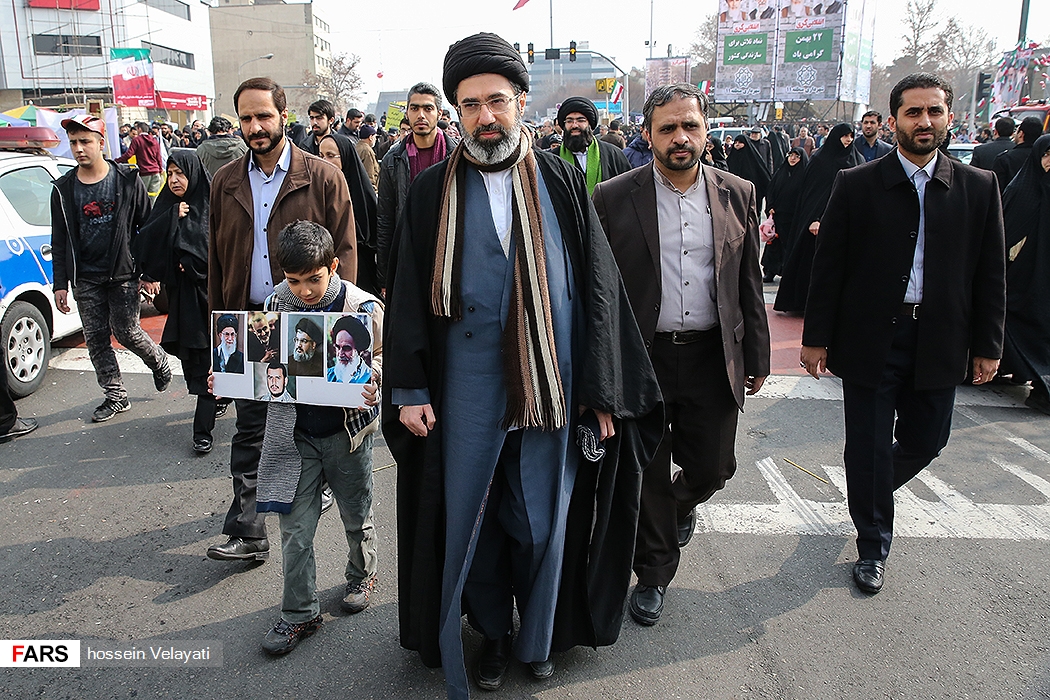
If chosen to succeed his father as Iran’s supreme leader, Mojtaba Khamenei will seal the Islamic Revolutionary Guard Corps’ dominance over the Islamic Republic.
With its head gone, the Islamic Republic now lurches forward like a zombie in search of a new one. The son of former supreme leader Ali Khamenei, Mojtaba, appears to be next in line, a powerful behind-the-scenes figure long tied to the regime’s hardline military apparatus driving Iran’s confrontation with the United States.
If the regime chooses Mojtaba Khamenei (hereafter referred to as Khamenei) over other clerics associated with the so-called “reformist” camp—often elevated to project openness to negotiations with the West and appease domestic pressure, such as former president Hassan Rouhani—it signals that Tehran is opting for escalation over compromise during wartime.
It would also demonstrate that the Islamic Revolutionary Guard Corps (IRGC), the regime’s primary ideological and military power broker, has prevailed in shaping Iran’s domestic and foreign policy in the post-Khamenei era.
Such a choice would contradict the very revolutionary fervor that fueled the 1979 Islamic Revolution against the hereditary monarchy it overthrew. Yet moments of crisis tend to override revolutionary ideals.
The joint US-Israeli campaign has destroyed much of the regime’s military and repression apparatus, leaving the IRGC, as the leading military force, directing the war effort. The Guards have shown that they can operate without a supreme leader, but this arrangement is less than ideal. An ayatollah at the top would not only lead internal politics but also grant religious legitimacy, ensuring that the regime does not appear as a military dictatorship. For that, the IRGC must navigate the complex internal politics of the Islamic Republic.
The criteria for becoming supreme leader as codified by the Islamic Republic’s constitution are deliberately vague, requiring only “Islamic jurisprudential scholarship,” along with “justice and piety” and “political and social insight, prudence, courage, and administrative ability.” The Assembly of Experts must then select the leader.
While this body is technically elected, anyone running for it must first be vetted by the Guardian Council, whose members were largely appointed by the previous supreme leader, producing a distorted system of checks and balances that employs democratic features for authoritarian ends. In effect, if the Assembly and the IRGC coalesce around Khamenei, the institutional framework can readily install him as the supreme leader.
In practice, becoming the supreme leader is not simply a constitutional exercise. The role carries the expectation of leadership across the Shia world and stewardship over Tehran’s so-called Axis of Resistance against the United States and Israel. Domestically, it requires balancing the Islamic Republic’s rival institutions while maintaining the IRGC’s support. Khamenei is the closest the regime has to meeting those criteria.
Born in 1969, Mojtaba, the second-oldest son in the Khamenei family, served during the Iran-Iraq War and studied theology but never attained the clerical rank of ayatollah. He has never held public office and has remained largely out of the spotlight. That said, he assumed responsibilities on behalf of the supreme leader, carrying out sensitive political and security tasks behind the scenes before his father’s death.
As Iran’s political establishment watched reformists secure back-to-back presidential victories in 1997 and universities emerge as centers of activism, Mojtaba Khamenei began appearing in internal regime discussions, asking hardline figures to assess the situation on campuses ahead of the unrest that culminated in the 1999 student protests. He later played a key role in backing the hardliner Mahmoud Ahmadinejad’s rise to the presidency, including his disputed 2009 reelection against a reformist challenger that helped spark the Green Movement protests.
Khamenei’s political ambitions soon translated into his entrenchment within the regime’s repressive machinery. He led the crackdown against the 2009 protests, mobilizing Basij militias and other security forces against demonstrators. The campaign left dozens dead and thousands jailed, marking the Islamic Republic’s first large-scale suppression of a major anti-regime wave and teaching Khamenei that brute force could secure political gains.
Those close ties to the IRGC and the Basij extend beyond domestic repression. The US Treasury Department sanctioned him in 2019 under Executive Order 13876, which targets members of the Supreme Leader’s inner circle. The designation specifically cited his close connections to the IRGC’s Quds Force, the branch responsible for executing Tehran’s extraterritorial operations, including attacks that killed hundreds of Americans.
Beyond politics and security, he also oversees a clandestine overseas investment network stretching from Tehran to Dubai and Europe, channeling funds from Iranian oil sales through shell companies and intermediaries. The network includes more than a dozen luxury properties in London worth over $138 million, including a $46 million mansion, as well as upscale hotels in Frankfurt and Mallorca and a villa in Dubai. Operating through an extensive kleptocratic network of front companies and offshore accounts across the UK, Switzerland, Liechtenstein, and the UAE, the system has moved billions of dollars into Western markets despite sanctions.
Mojtaba Khamenei embodies his father’s legacy and all of the Islamic Republic’s defining pathologies: theocratic rule, human rights abuses, destabilizing foreign policy ambitions, and kleptocracy. Should he assume the role of supreme leader, his growing dependence on the IRGC would further cement the unholy alliance between clerical authority and military power, tightening repression at home while escalating confrontation with the United States.
About the Author: Janatan Sayeh
Janatan Sayeh is the Iran analyst at the Foundation for Defense of Democracies, focused on Iranian domestic affairs and the Islamic Republic’s regional malign influence. Previously, he held various research roles at the International Republican Institute, Washington Institute for Near East Policy, and the American Enterprise Institute. Born and raised in Tehran, he studied Hebrew and Arabic at the Hebrew University of Jerusalem and received his BA in political science from the University of California, Berkeley.