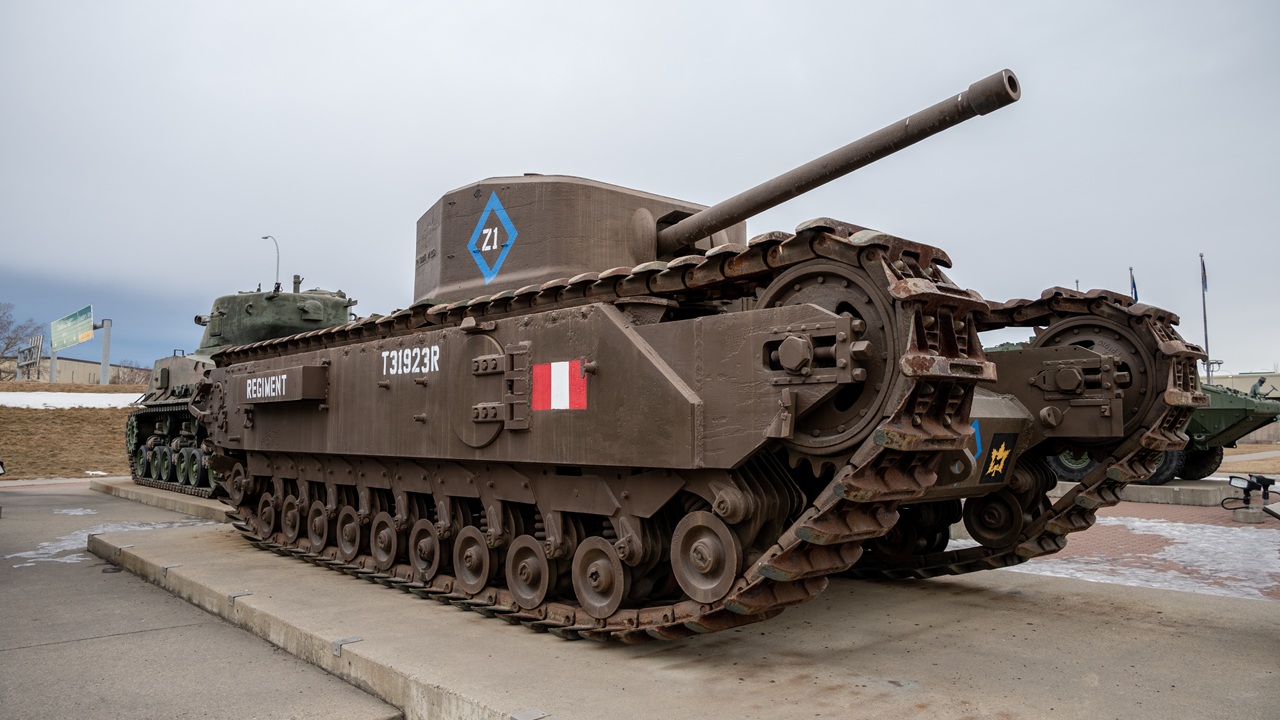
Many believe that the Churchill tank, widely used by the United Kingdom during World War II, was named for then-prime minister Winston Churchill. It was not—but there is a connection.
There is an old riddle/joke, often associated with Groucho Marx from his radio and later TV show, You Bet Your Life, that asked: “Who is buried in Grant’s tomb?” The unexpected answer is: no one! While it is true that President Ulysses S. Grant and his wife Julia Grant are both entombed there, they aren’t technically buried, as they are enshrined aboveground.
A riddle for military history buffs, along the same lines, might be: Who is the A22 Churchill tank named for? Obviously, it is named for “Churchill.” At this point, most would assume that the tank is named for the most famous Churchill of all—Sir Winston Churchill, the prime minister of the United Kingdom during World War II.
There are, in fact, dozens of online articles that state explicitly that the infantry tank was named for the UK’s wartime leader. Unfortunately, they are wrong.
Winston Churchill Helped (?) Invent the Tank
Although Churchill is remembered for his fiery speeches, his trademark homburg hat and cigar, and his lengthy service as a politician and a military officer, he was much more. In addition to being one of the greatest statesmen of the 20th century, Churchill was a Nobel Prize-winning author, a painter, and even a bricklayer. He was also a military visionary—for good and bad, often devising military operations that were overly complex or risky, requiring every detail to go as planned.
During World War I, Churchill also had a hand—albeit a somewhat unproductive one—in developing the world’s first tanks. He had established the Landships Committee, formed in 1915 to develop an armored vehicle capable of breaking the stalemate of trench warfare. The committee, initially composed of naval officers, politicians, and engineers, envisioned a massive vehicle of upwards of 1,000 tons that would have dwarfed even Nazi Germany’s absurd Maus super-heavy tank. Such a vehicle—a true “landship”—was beyond practical or realistic, and could have existed only in the world of science fiction.
After Churchill resigned from the committee and the British Army took charge, the program took on more realistic dimensions. The actual first tank—dubbed “Little Willie” as a joke mocking Germany’s Kaiser Wilhelm II—was far smaller than the massive landships originally envisioned, and it was initially unarmed. It took more than a year for the concept to be refined into Britain’s eventual Mk. I tank.
In an effort to hide what the military was up to, the vehicles were called “tanks” to suggest they were containers for transporting fresh water to the front. In December 1915, the codeword “tank” was officially adopted, and the Landships Committee officially became the Tank Supply Committee.
So, even as Churchill played almost no role from that point on, it might still be reasonable to think that the A22 tank was named to honor Winston, and the role he had in the tank’s origins. But, again, that’s not the case.
What to Know About the A22 Churchill Tank
- Year Introduced: 1941
- Number Built: ~5,640
- Length: 24 ft 5 in (7.44 m)
- Total weight, battle ready: 39.1 tons (38.5 long tons)
- Suspensions: Coiled springs
- Engine: Bedford 12-cylinder, 4-stroke, water-cooled petrol engine (~325 hp)
- Armament: Main cannon (2-pounder on Mk 1); coaxial 7.92 Besa machine gun; 3 inch howitzer
- Top Speed: 13.5–16.4 mph (21.7–26.4 km/h)
- Range: 75–130 miles (120–210 km)
- Crew: 5 (commander, gunner, loader/radio operator, driver, co-driver/hull gunner)
Officially designated the “Tank, Infantry, Mk IV (A22) Churchill,” the Churchill tank served with the British military from 1941 to 1952. Work began on the A22 in the summer of 1940 after a previous design was abruptly cancelled. Designed by Vauxhall, a prototype was built in just seven months, and 14 production models were completed by June 1941.
As initially built, the Churchill tank was considered well-armored for its day, with particularly thick front plates. It underwent several upgrades during the war, with variants featuring thicker armor and a heavier main gun. As originally produced, the Mk. 1 Churchill housed two main guns: a 40 mm (two-pound) gun in its turret and a hull-mounted three-inch six-pound howitzer to support infantry in an assault.
It was soon determined that the two guns were impractical, as the hull-mounted weapon required the entire tank to be turned to aim at a target. The 40 mm gun was also seen as inadequate against German armor. The hull-mounted howitzer was replaced by a bow-mounted Besa general-purpose machine gun, chambered for 7.92mm ammunition, allowing captured German ammunition to be used. With the introduction of the Mk III model, the six-pounder gun was mounted in the turret. A total of 5,460 Churchill tanks of all variants were produced during the war.
The tank saw its first action during the Dieppe Raid in August 1942. It was hardly an impressive display, however, as all the tanks either sank after leaving the landing craft or were captured on the beaches. Still, the Churchill tanks saw subsequent combat in the final stages of the North Africa campaign, the invasion of Italy, and the liberation of northwest Europe.
The A22 Churchill’s thick armor proved effective in combat, but the tanks were hampered by being outgunned by German armor. Winston Churchill reportedly joked to Field Marshal Jan Smuts about the A22, “That is the tank they named after me when they found out it was no damn good!”
Whether Smuts knew the tank wasn’t actually named for Winston is unclear, but over the years, at least a few authors believed it was named for the famous British PM.
The Churchill Tank Is Named After a Different Churchill
In hindsight, it is easy to see that the A22 couldn’t have been named for Winston Churchill, as he had spent much of the 1930s in the political wilderness. It was only on September 3, 1939, the day the British Empire declared war on Nazi Germany, that Prime Minister Neville Chamberlain appointed him First Lord of the Admiralty, a post he had held at the start of World War I. Churchill was seen as the right man for the job, both among the civilian government and within the Navy. After learning of the news, the Board of Admiralty reportedly sent a simple but encouraging signal to the fleet: “Winston is back!”
Churchill then became prime minister in May 1940, leading the UK through its proverbial darkest hour.
Yet, the British military had only just begun development of the A22 in June 1940—and had no reason in 1941 to name the tank for Winston Churchill, even as his steady hand guided the UK through the Battle of Britain and the Blitz.
The tank was actually named for John Churchill, the 1st Duke of Marlborough, one of England’s greatest generals, who led the English/British and allied armies to several noteworthy victories over King Louis XIV of France.
Winston, a direct descendant of the Duke of Marlborough (as was the late Princess Diana), wrote a multi-volume biography of his ancestor. Titled Marlborough: His Life and Times, it detailed the career of John Churchill, one of England’s greatest military commanders and statesmen. Winston’s father, Lord Randolph Churchill, was the second son of John-Spencer Churchill, with the Dukedom passing to Winston’s uncle and later cousins.
It likely made sense that the British Army should name its latest tank after the Duke of Marlborough, who was also an ancestor of the current PM.
The British Army’s Cromwell tank, which supplanted the Churchill in the final years of World War II, is sometimes subject to similar misapprehensions. Most would assume it was named for Lord Protector Oliver Cromwell, but some assume it was for his distant relative Thomas Cromwell, the chief minister to King Henry VIII, or for Ralph Cromwell, who served as Treasurer of England under Henry VI. In this case, Oliver is the correct answer—but then again, apart from know-it-all Anglophiles, who even heard of Ralph Cromwell?
About the Author: Peter Suciu
Peter Suciu has contributed over 3,200 published pieces to more than four dozen magazines and websites over a 30-year career in journalism. He regularly writes about military hardware, firearms history, cybersecurity, politics, and international affairs. Peter is also a contributing writer for Forbes and Clearance Jobs. He is based in Michigan. You can follow him on Twitter: @PeterSuciu. You can email the author: [email protected].
Image: Shutterstock / Jeff Whyte.