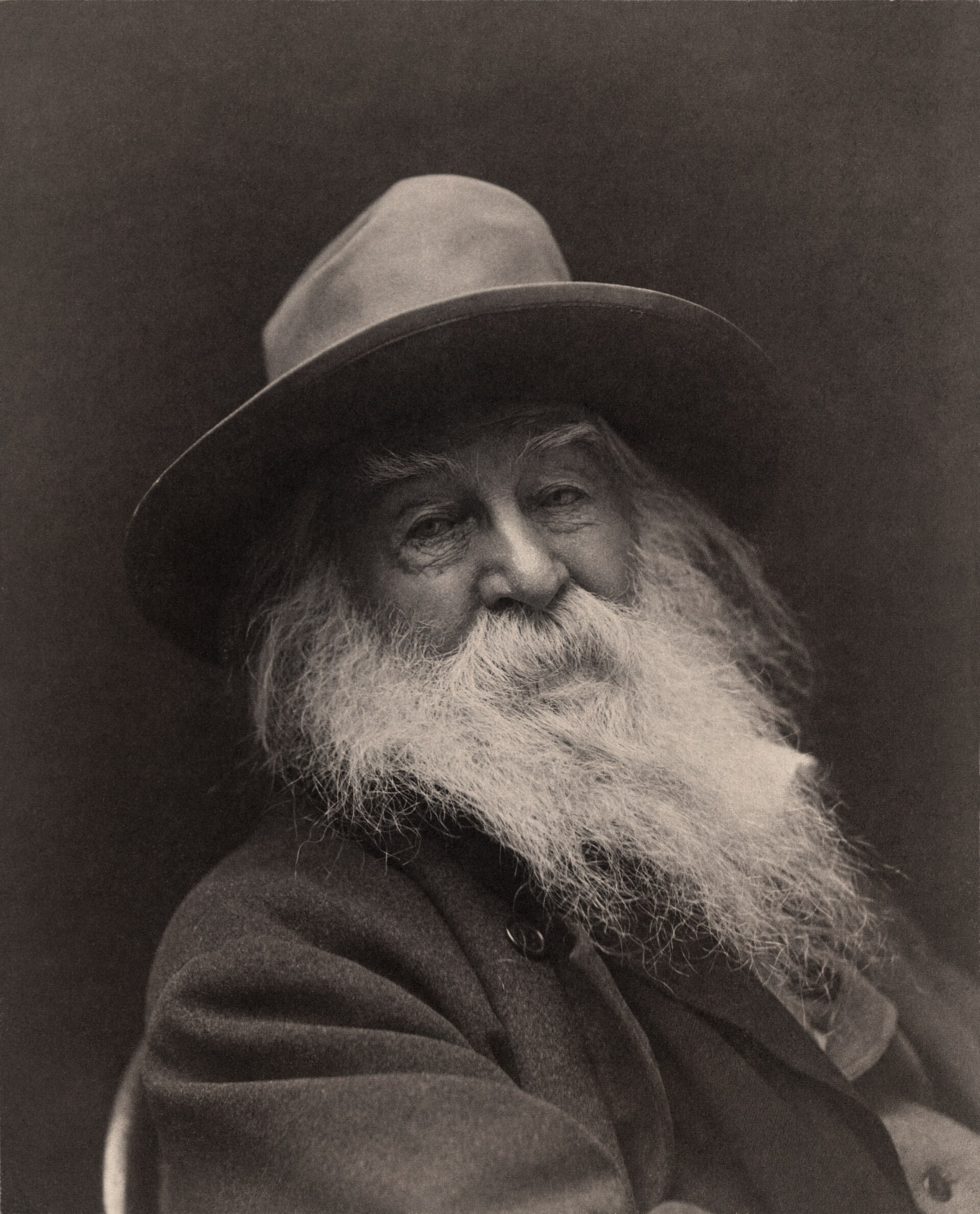
A few years ago, during an interview for an editorial position at an American magazine, the editor asked me (a foreigner) if I had read Walt Whitman. I had read some American poets, but no, not Whitman, at least not substantially. The editor looked disappointed. Some months later, I learned why the question was pertinent. Whitman is “the” American poet, the one whose words people use to let themselves off the hook (“Do I contradict myself? . . . I am large, I contain multitudes”), while patting themselves on the back for mere feeling. He is the go-to for the kind of sentimental democracy that has become fashionable in the United States.
The current political instability may also explain the recent publication of a new collection of his prose writings, Walt Whitman: On Democracy. Issued by the Library of America and introduced by David Bromwich, an illuminating critic of Whitman’s poetry, the texts include the book Democratic Vistas (1871), one essay on secession from The Complete Prose Works (1892), and shorter excerpts from Specimen Days (1882)—a wild concoction of a book that the author put together from jottings, letters, and a few published pieces.
In his unpublished pamphlet “The Eighteenth Presidency!” (1856), Whitman rails against political parties and their nominees. Presidents Millard Fillmore and James Buchanan, whom he dubs “two dead corpses,” are particularly savaged. One might ask why this essay—reminiscent in many ways of Whitman’s early invective journalism—has been unearthed. Perhaps to make the bard seem knowing and urgent? “The people, credulous, generous, deferential, allow the American government to be managed in many respects as is only proper under the personnel of a king and hereditary lords,” writes Whitman. “If this were to go on, we ought to change the title of the President, and issue patents of nobility.” (Assuming that this edition is meant to be relevant to contemporary politics, one might observe that the nobleman type does not quite fit President Trump, who may well stand in for the mechanic leaving his workbench to go serve in Washington—a sight Whitman longed to see.)
With the exception of that essay, the other pieces here were written during or after the Civil War, by which time Whitman had lost his faith not only in political parties, but also in religion, political institutions, and Shakespeare (a metonymy for Old World literature) as reliable inoculations against the corrosion of freedom. At the same time, he had more faith in his country and in his fellow Americans, especially its young men, whom he tended to as a nurse during the war. From that devotion he drew his conception of a robust, idealistic democracy.
Whitman lays out his ambitious political program in Democratic Vistas. American democracy, he claims, will only be justified by the future—and not through the concessions it makes, but through accommodations made for it in every part of society. Political democracy must evolve and become “the absolute faith.” Presenting this radically irreverent vision, he writes: “I say that democracy can never prove itself beyond cavil, until it founds and luxuriously grows its own forms of art, poems, schools, theology, displacing all that exists, or that has been produced anywhere in the past, under opposite influences.”
All that reeks of the old, superstitious world must go, must be superseded. Most importantly, Whitman preaches that a new American literature able to reflect the United States and instill the idea of ultimate freedom must emerge. Literary texts should do the work once done by religion and infuse into the hearts of the people a pure, natural, and uninhibited moral sense.
Like Thomas Carlyle (to whose essay “Shooting Niagara—And After?” Democratic Vistas was partly a response), Whitman suspected that democratic societies are susceptible to corruption from excessive love of money. But for the poet, the thing to dread about industrial America is the production of “generations of humanity like uniform iron castings.” The new pseudo-mystical literature would have to provide the “perfect characters” (superior selves) needed to break that uniform mold and keep the wheel of progress rolling, and encourage the people’s latent individualism.
Whitman did not alter the idea of individualism (of the “I” as the final arbiter) that he borrowed from J. S. Mill in any significant way. Both men put their hope for the security of free society in the eccentricity of its citizens. For both, the risk in democracy is not that individual liberty can go too far, but that citizens are not entirely safe from a conservative tendency. The original individual is to be the cure. Neither gave much thought to the possibility that the self might become the idol of the multitude, that the love of new things without deference to age-old truths might threaten the very base of democratic society. “I contain multitudes,” in one slant of light a statement of great sensitivity, may from another be the cry of a deranged man, intent on the destruction of himself and everything valuable to the community.
If the challenge for nineteenth-century British and American thinkers was finding a way to reconcile a popular democracy to a necessary hierarchy of values, Whitman did not meet it. Whitman’s musings should be taken more as curiosities rather than serious reflections on the defining questions of his (and our) day.
Bromwich writes in his introduction, “Whitman invites us to test his observations against our own, with no expectation of assent; but about the worth of democracy, properly understood, we should assume what he assumes.” If only the bard had understood more than he assumed.