NEWYou can now listen to Fox News articles!
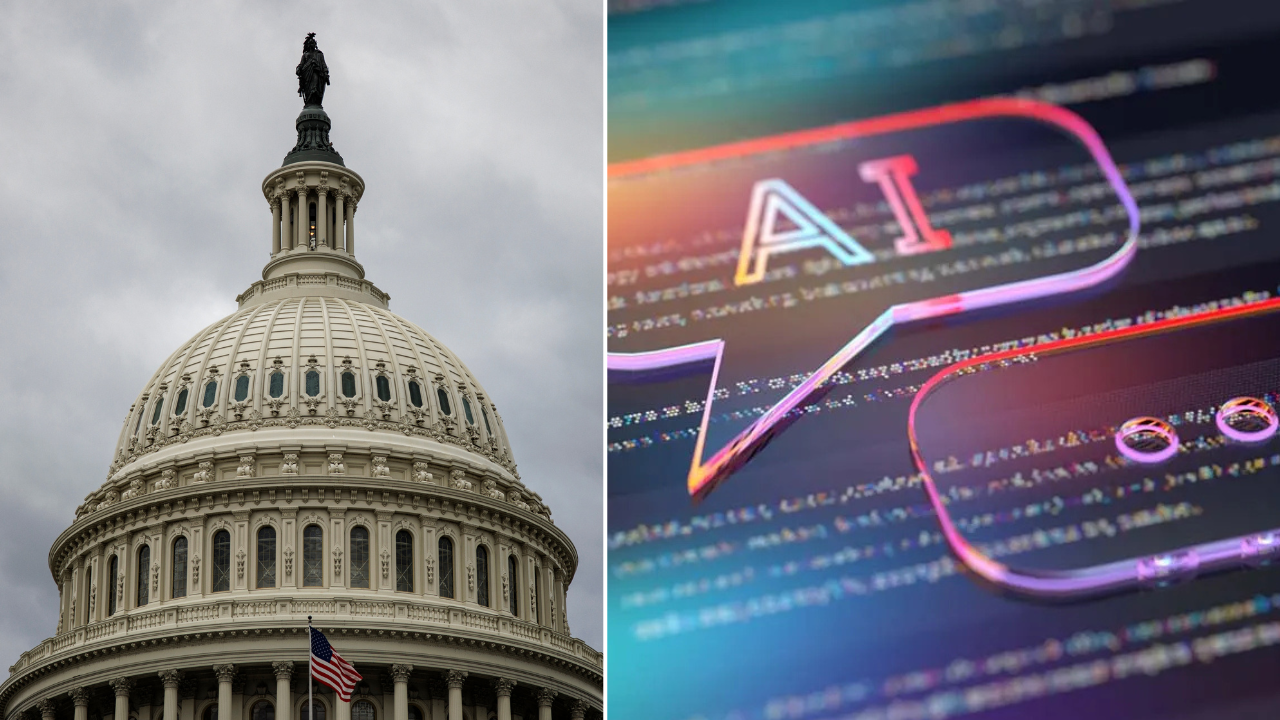
EXCLUSIVE: The White House on Friday unveiled its first national policy framework for artificial intelligence — a legislative outline to establish a “consistent” national standard for AI development across the nation that prevents censorship and protects free speech and children, Fox News Digital has learned.
Fox News Digital exclusively obtained the legislative framework that the White House will share with congressional leadership Friday as the White House pushes Congress to advance and codify its “commonsense” proposals into law “this year.”
“This year. As fast as we can,” White House Office of Science and Technology Policy Director Michael Kratsios told Fox News Digital in an exclusive interview Thursday evening. “Congress has a lot of priorities they’re trying to make happen, but we believe this can receive bipartisan support.”
White House sources told Fox News Digital that the framework was designed to reduce regulatory uncertainty, sustain U.S. dominance in the AI space, prevent censorship and protect free speech.
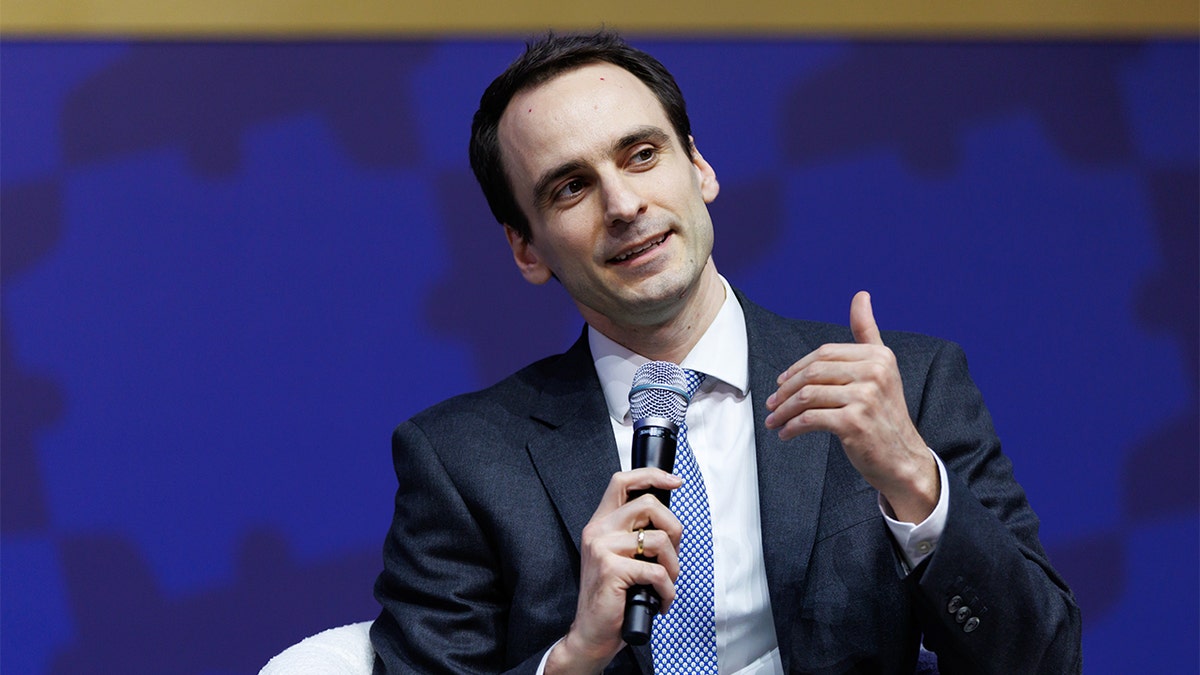
U.S. science and technology official Michael Kratsios addresses attendees at the APEC CEO Summit in Gyeongju, South Korea, on Oct. 29, 2025. (SeongJoon Cho/Bloomberg via Getty Images)
“We need one national policy — not a 50-state patchwork of laws,” Kratsios told Fox News Digital in an exclusive interview Thursday evening. “This legislative proposal delivers on that.”
“In December, President Trump signed an Executive Order tasking us with the development of a national framework for AI, what he called ‘One Rulebook,’” White House AI and crypto czar David Sacks told Fox News Digital. “This was in response to a growing patchwork of 50 different state regulatory regimes that threaten to stifle innovation and jeopardize America’s lead in the AI race.”
The White House is urging Congress to “preempt state AI laws that impose undue burdens to ensure a minimally burdensome national standard consistent with these recommendations, not fifty discordant ones,” according to the official framework obtained by Fox News Digital.
“This national standard should respect key principles of federalism and not preempt the traditional police powers retained by the states to enforce laws of general applicability against AI developers and users, including particular laws to protect children, prevent fraud, and protect consumers,” the framework states, adding it should also not preempt “state zoning laws, including state authorities, to determine the placement of AI infrastructure.”
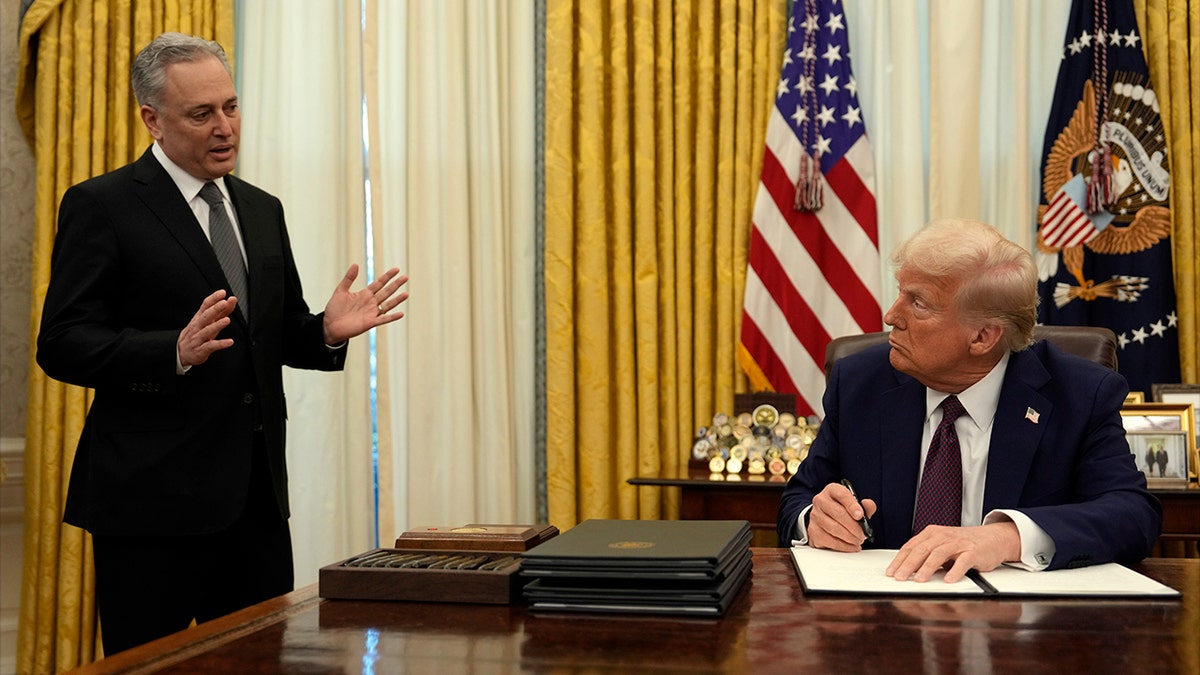
President Donald Trump listens to White House adviser David Sacks as he signs an executive order regarding cryptocurrency in the Oval Office of the White House, Thursday, Jan. 23, 2025, in Washington. (AP Photo/Ben Curtis)
The framework said that “preemption must ensure that state laws do not govern areas better suited to the Federal Government or act contrary to the United States’ national strategy to achieve global AI dominance.”
The White House stresses that states “should not be permitted to regulate AI development, because it is an inherently interstate phenomenon with key foreign policy and national security implications.”
“States should not unduly burden Americans’ use of AI for activity that would be lawful if performed without AI,” the framework says. “States should not be permitted to penalize AI developers for a third party’s unlawful conduct involving their models.”
Beyond the regulatory structure, the framework also focuses on protections for children.
The White House is urging Congress to build on and codify actions taken throughout the Trump administration to protect children from AI harms and empower parents with robust tools to manage their children’s privacy settings, screen time, content exposure and account controls.
Sacks told Fox News Digital that the framework helps parents to “safeguard their children from online harm, shield communities from higher electric bills, protect our First Amendment rights from AI censorship, and ensure that all Americans benefit from this transformative technology.”
The legislative proposal includes establishing commercially reasonable, privacy protective, age-assurance requirements — like parental attestation — for AI platforms and services likely to be accessed by minors.
TRUMP’S SCIENCE AND TECH MAN LAYS OUT WHITE HOUSE’S GLOBAL AI STRATEGY
In addition, the White House is calling for legislation requiring AI platforms to implement features that reduce the risk of sexual exploitation and self-harm to minors.
“We are calling on Congress to ensure parents are empowered to shape and protect their children’s digital upbringing,” Kratsios told Fox News Digital.
The United States Capitol building is seen in Washington D.C., United States on Dec. 2, 2024. (Celal Gunes/Anadolu via Getty Images)
Kratsios pointed to first lady Melania Trump’s efforts surrounding the passage and signing of the “Take it Down Act” last year. That legislation punishes internet abuse involving nonconsensual, explicit imagery and garnered strong bipartisan support.
The framework also addresses energy costs tied to AI infrastructure.
Meanwhile, the White House is pushing Congress to codify its Ratepayer Protection Pledge into law. The pledge ensures that tech giants protect Americans from higher electricity bills tied to data center power demand. It also requires companies to “build, bring, or buy new generation resources and cover the cost of all power delivery infrastructure upgrades required for data centers.”
The pledge came amid concern that the creation of new data centers will cause mounting energy prices for everyday Americans.
The pledge works to protect Americans against spiking electricity bills. It also has companies vowing against passing expenses to American households and commits companies to hiring and training talent from within communities where they build and operate data centers — a move that could create thousands of jobs.
“We’re calling on Congress to codify this Ratepayer Protection Pledge,” Kratsios said.
Meanwhile, the White House is also calling on Congress to augment existing law enforcement efforts to combat AI-enabled impersonation scams and fraud that target vulnerable populations, such as seniors.
President Donald Trump has made AI a key initiative, but to keep beating China, we need voluntary standards. (Getty/iStock)
The framework also addresses national security concerns tied to advanced AI systems.
As for national security, the White House is urging Congress to ensure the appropriate federal agencies have sufficient technical capacity to understand frontier AI model capabilities and any associated national security considerations. The White House is also calling on Congress to establish plans to mitigate potential national security concerns.
Another key area is intellectual property and creator protections.
Another section of the White House’s legislative framework urges Congress to draft language to protect American creators, publishers and innovators from AI-generated outputs that infringe their protected content. This recommendation specifically asks Congress to respect those intellectual property rights, without undermining lawful innovation and free expression.
“Although the Administration believes that training of AI models on copyrighted material does not violate copyright laws, it acknowledges arguments to the contrary exist and therefore supports allowing the Courts to resolve this issue,” the White House framework states. “Similarly, Congress should not take any actions that would impact the judiciary’s resolution of whether training on copyrighted material constitutes fair use.”
CHINA’S AI INNOVATION IS ‘ACCELERATING’ BUT US REMAINS DOMINANT, WHITE HOUSE SAYS
As for imitation, the framework urges Congress to consider a “federal framework protecting individuals from the unauthorized distribution or commercial use of AI-generated digital replicas of their voice, likeness, or other identifiable attributes, while providing clear exceptions for parody, satire, news reporting, and other expressive works protected by the First Amendment.”
“Congress should prevent persons from abusing such a framework to stifle free speech online,” the proposal states, while urging Congress to continue to “carefully monitor” the development of copyright precedents and enforcement.
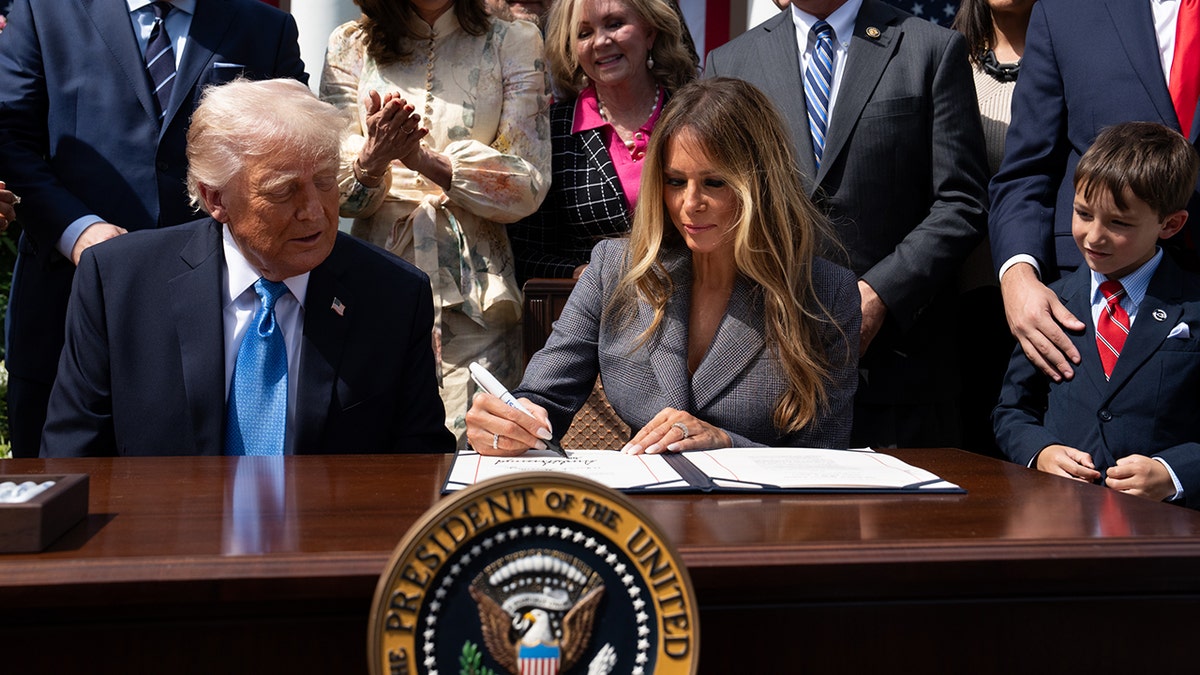
Melania Trump participates in the bill signing ceremony of the Take it Down Act on May 19. Mrs. Trump was a champion of the bill pushing to criminalize sharing intimate images without consent. (Official White House Photo by Andrea Hanks)
The White House is also urging Congress to defend free speech and First Amendment protections, while preventing AI systems from being used to “silence or censor lawful political expression or dissent.”
“Congress should prevent the United States government from coercing technology providers, including AI providers, to ban, compel, or alter content based on partisan or ideological agendas,” the framework states, adding that Congress should provide an effective means for Americans to “seek redress from the Federal Government for agency efforts to censor expression on AI platforms or dictate the information provided by an AI platform.”
Kratsios told Fox News Digital that the United States is “still ahead” in the global AI race and is “doing everything we possibly can to maintain and grow that lead.”
The White House is also calling on Congress to provide AI resources to small businesses, such as grants, tax incentives and technical assistance programs to support wider deployment of AI tools across American industry.
Fox News Digital sat for an exclusive interview with Kratsios last year as director of the White House Office of Science & Technology. He reflected on his first year on the job during the interview Thursday.
TRUMP SIGNS ‘TAKE IT DOWN ACT,’ HAILS COOPERATIVE EFFORT: ‘BIPARTISANSHIP IS STILL POSSIBLE’
“The first pillar of our work was around AI innovation, and part of that was to make sure we have a regulatory framework in the United States that provides certainty to our innovators,” Kratsios said. “This legislative framework is a big deliverable and if Congress is able to pass this into law this year it would be a big step forward for the country.”
Sacks told Fox News Digital that the White House team plans to work with Congress to “turn the principles we are announcing today into legislation.”
Kratsios and Sacks have been working with lawmakers over the past few weeks on the effort, including meetings with House and Senate leadership.
CLICK HERE TO GET THE FOX NEWS APP
“We spoke with the House Majority and Senate Majority leadership, and we think they’ll be excited,” Kratsios said.
In December, President Trump issued an executive order to ensure the National Policy Framework for Artificial Intelligence.
The new framework, according to White House officials, “delivers on the executive order while also expanding workforce and education opportunities to ensure American workers benefit from AI-driven growth.”