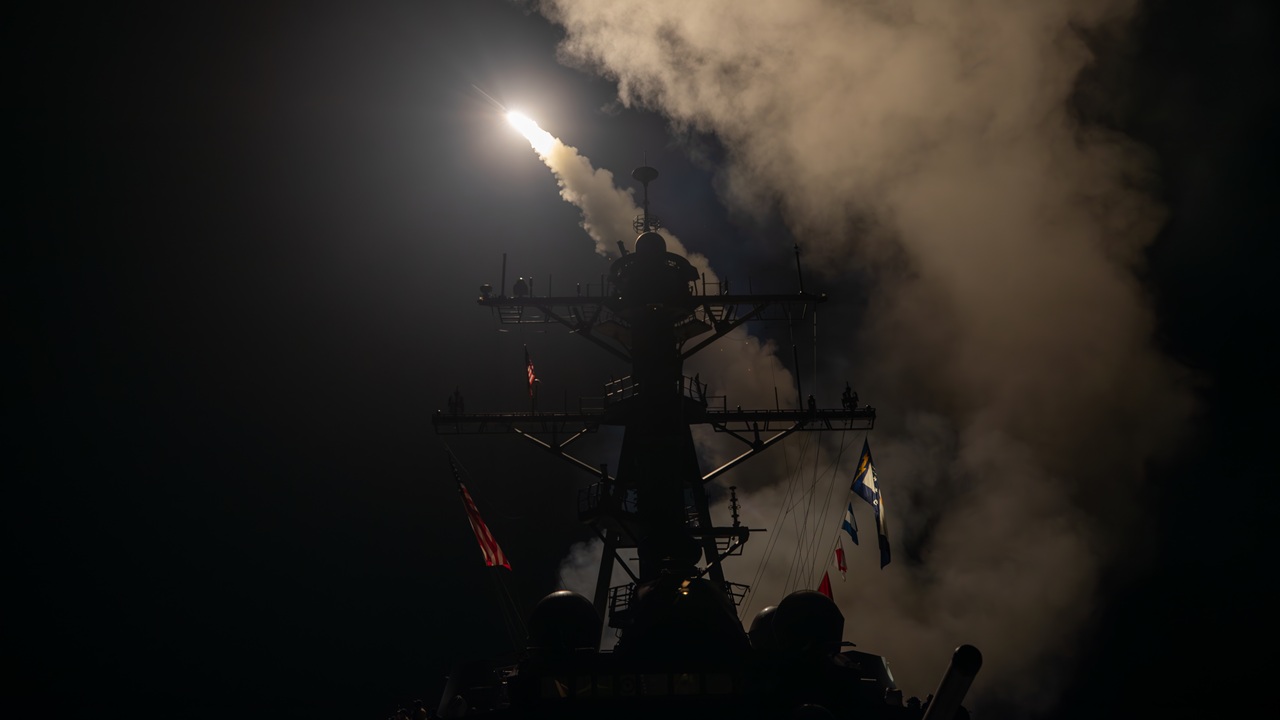
The United States, Israel, and Iran all possess “standoff weapons”—and have used them against each other for years.
When Operation Epic Fury began on February 28, Iran’s Integrated Air Defense System (IADS) was intact and prohibitive, forcing the United States to open access to Iranian airspace from afar.
To penetrate Iran’s IADS—which consisted of radar networks, surface-to-air missile batteries, and hardened command centers—without risking large numbers of their own aircraft, the United States and Israel relied heavily on long-range standoff weapons. These weapons allow forces to strike targets from hundreds of miles away, keeping ships and aircraft outside the reach of enemy defenses.
What Are “Standoff Weapons”?
Modern air campaigns rarely begin with aircraft flying directly over defended territory. Instead, forces rely on standoff munitions that can travel long distances independently. These weapons perform several important tasks: destroying radar systems; hitting air defense batteries; disabling command-and-control nodes; striking missile launch sites and airfields.
Once air defenses are sufficiently degraded, aircraft can enter enemy airspace and strike more accurately at shorter distances with far less risk.
Why Do Standoff Weapons Matter?
Standoff weapons are a common feature of modern warfare, and Iran is no stranger to them. During the Iran-Iraq War from 1980 to 1988, Iran and Iraq were unable to gain sustained air superiority over each other’s territory. For this reason, they largely targeted enemy cities with missile attacks rather than aircraft. During the “War of the Cities,” the two nations lobbed hundreds of ballistic missiles—particularly the SS-1 “Scud” missile—at major cities on the other side of the border, killing tens of thousands of civilians on both sides.
Iran has carried that form of warfare over to the present. Following the October 7 terrorist attack against Israel, Israel and Iran have repeatedly clashed in open war—first during a series of 2024 missile launches, then the 12-Day War in June 2025, and most recently during Operation Epic Fury. As its antiquated air force is unable to challenge Israel’s sophisticated air defenses, Iran has resorted to striking at Israel with standoff weapons—in this case missiles that can be fired from a safe distance, travel hundreds of miles over the Arab nations separating the two countries, and cause destruction in Israeli cities. Iran has tried to overwhelm Israeli air defenses with these missiles, so far without success. But unlike the United States, Iran has no clear follow-up move; it is merely causing random destruction within Israel, not attempting to degrade its air defense network in preparation for conventional airstrikes with its air force.
Which Standoff Weapons Has America Used Against Iran?
The United States and Israel used a number of standoff platforms against Iran in the opening salvos of Operation Epic Fury—many of them missiles.
- One of the most widely used weapons last week was the Tomahawk cruise missile. The Tomahawk has been in America’s inventory for decades, and is prized for its reliability and versatility. Typically launched from US Navy destroyers and submarines, Tomahawks can travel hundreds of miles at low altitude using terrain-following navigation to avoid radar detection. During Epic Fury, Tomahawks were used to strike Iranian naval facilities, command centers, and radar and missile sites.
- The AGM-158 Joint Air-to-Surface Standoff Missile (JASSM) has been deployed from US bombers, like the B-1B Lancer, during Epic Fury. Designed specifically for penetrating heavily defended targets, the JASSM has a stealth design, long range, and precision guidance. These missiles allow bombers to strike critical targets while remaining outside dense air defense zones.
- The United States also unveiled the Precision Strike Missile (PrSM), which made its combat debut during Epic Fury. Fired from M142 HIMARS launchers, the missile is intended to replace the older ATACMS system, which was limited by restrictions under the Intermediate-Range Nuclear Forces (INF) treaty. The United States is no longer bound by the INF Treaty, and the PrSM offers significantly greater range over its predecessor, giving it greater standoff capability. The PrSM was used to target missile launch sites, air defense batteries, and command nodes. Because the PrSM travels at extremely high speeds, it is difficult for Iranian air defenses to intercept.
Not all standoff weapons are missiles. Another common standoff weapon are glide bombs, such as the AGM-154 Joint Standoff Weapon (JSOW). These bombs have no engine or propulsion; they are released via aircraft hundreds of miles from their targets and glide downward towards them. The United States does not appear to have used glide bombs against Iran so far, but it has used them against other targets in the Middle East in recent years; the AGM-154 notably saw service against the Houthis during Operation Rough Rider in early 2025.
America has also turned to low-cost drones as a cheap and effective standoff weapon—ironically mirroring Iran, which has made the drones a mainstay of its military action abroad. Notably, the US debuted the Low-Cost Unmanned Combat Attack System (LUCAS) drone last week. During Operation Epic Fury, LUCAS was used to saturate air defense systems while targeting missile launchers and naval vessels. LUCAS’s low cost allows for large numbers to be deployed simultaneously.
America Has Now Shifted to Conventional Munitions
Once Iranian air defenses were suppressed, the nature of the campaign pivoted from standoff to more conventional bombing. With air superiority established, aircraft could safely enter Iranian airspace—at which point the US began using precision bombs, guided bombs, and GPS and laser-guided munitions. These weapons are cheaper and more efficient than long-range standoff missiles, like the Tomahawk, each unit of which takes 24 months to produce. But getting to the point where these conventional systems can be used required a successful phase of standoff weapons, which paved the way essentially, converting Iranian airspace from denied to permissive, and allowing US and Israeli aircraft to enter with reduced risk.
About the Author: Harrison Kass
Harrison Kass is a senior defense and national security writer at The National Interest. Kass is an attorney and former political candidate who joined the US Air Force as a pilot trainee before being medically discharged. He focuses on military strategy, aerospace, and global security affairs. He holds a JD from the University of Oregon and a master’s in Global Journalism and International Relations from NYU.