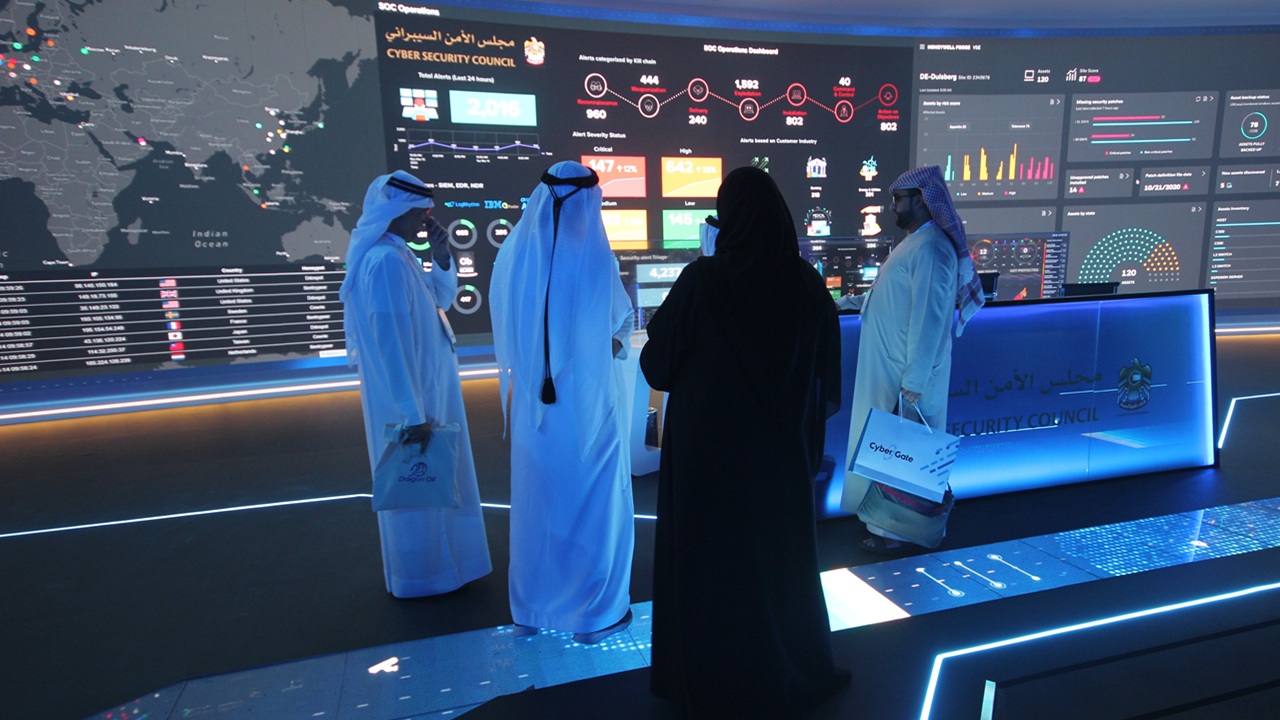
In modern warfare, data centers have joined energy supplies to become prime military targets, with server rooms now as vulnerable to missile strikes as oil refineries.
Late afternoon on Sunday March 1, an Iranian Shahed-136 “kamikaze” drone struck an Amazon Web Services (AWS) data center in the United Arab Emirates, setting off a fire and forcing a shutdown of the power supply. A second facility was hit shortly after. A third, in Bahrain, sustained damage when a drone struck nearby. By the next morning, headlines around the world highlighted a new dilemma: data centers have become a legitimate theatre of modern conflict, and the Gulf finds itself at its center.
The strikes on the UAE and Bahrain were not accidental. Iran’s Islamic Revolutionary Guard Corps (IRGC) stated the facilities were targeted for their role in supporting enemy military and intelligence operations. The claim reflects a broader reality that has been taking shape for years: as leading technology companies deepen their ties with defence establishments, the infrastructure powering commercial AI has become inseparable from the infrastructure powering modern warfare. While companies like OpenAI have signed agreements with the Department of Defense, others like Anthropic have pushed back on the wartime use of AI, raising questions about the boundaries between democratic values and AI deployment in the battlefield. The cloud, once conceived as a civilian utility, has become a contested domain.
Data Centers Are a Target Unlike Any Other
Hyperscalers including Amazon Web Services, Google Cloud, Microsoft Azure, and Meta are the companies fueling most of the world’s increasing demand for data centers, which are among the most capital-intensive structures ever built. A single hyperscale facility can take years to construct, billions of dollars to finance—and mere moments to disable.
The cost of rebuilding is only part of the problem. The more immediate damage is operational. Banking systems, logistics platforms, healthcare networks, and retail infrastructure all run on the same physical servers that a drone can reach in seconds. When those servers go dark, the consequences cascade across every sector that depends on them.
What makes data centers uniquely vulnerable is the concentration of their value. Unlike an oil pipeline or a refinery, which can sustain partial damage and continue operating at reduced capacity, a data center is effectively binary; either it is running or it is not, with no in-between. This makes data centers extraordinarily attractive targets for an adversary seeking maximum disruption at minimum cost. Today, a $20,000 drone can easily disable a facility worth hundreds of millions of dollars.
Data Centers’ Dual-Use Dilemma
The IRGC’s justification for the strikes points to a dynamic that has been building for years but is only now being confronted directly. Modern militaries no longer operate on dedicated, isolated infrastructure. Instead, they run on the same commercial cloud platforms that power civilian economies. AI tools, intelligence storage, logistics planning, and battlefield analytics increasingly depend on the same hyperscale facilities that process financial transactions and power everyday services.
This creates a fundamental ambiguity that neither international law nor the technology industry has fully resolved. When a data center simultaneously supports civilian applications and military operations, it occupies a grey zone that makes it both an asset worth protecting and an objective worth striking. Iran’s decision to target commercial facilities reflects a strategic calculation that this ambiguity, in the context of active conflict, resolves in favour of the strike.
Nor is Iran unique in its targeting of data centers as a military objective. Reports from on the ground inside Iran indicate that US and Israeli strikes on Tehran destroyed at least two data centers, one reportedly linked to the IRGC’s cyber and intelligence operations. Both sides have now demonstrated a mutual recognition that digital infrastructure is a legitimate military objective, and that precedent will not be forgotten by other state actors watching closely.
Gulf States Have an Iran Proximity Problem
For the Gulf, the data center attacks pose a challenge that is more reputational than structural. The region has spent the last decade making a credible case to the world’s leading technology companies that it is the natural home for the next generation of digital infrastructure. That case rested on three pillars: capital, connectivity, and stability. The first two remain intact, but the third is now under extreme scrutiny.
The Gulf’s AI ambitions are significant. With roughly 230 data centers across the Middle East and major investment commitments from the world’s largest technology companies, the region was on a credible path toward becoming a serious global hub. That trajectory now requires a more difficult conversation. Hyperscalers make infrastructure decisions on decade-long timelines, modeling risk carefully and conservatively. A conflict that demonstrates the physical vulnerability of Gulf facilities does not need to destroy the investment case entirely. It simply needs to raise the costs associated with risk—and right now, those costs are rising.
Data Center Attacks Are a Pattern, Not Isolated Incidents
The data center strikes did not occur in isolation. For Gulf states, the concentration of global energy infrastructure along a narrow coastline has long been an economic advantage, enabling scale, efficiency, and market dominance. That same concentration now amplifies risk. Iranian attacks on Saudi Arabia’s Ras Tanura oil complex, Qatar’s Ras Laffan LNG hub, and the closure of the Strait of Hormuz have introduced volatility that markets price immediately and investors internalise over time.
The strikes on data centers follow the same strategic logic: identify the pillars of an adversary’s economic identity and apply pressure to both simultaneously. Energy and data are the twin foundations of the Gulf’s economic future, one inherited, one built. Both have now been shown to be within reach.
A state seeking to inflict maximum economic disruption does not strike military installations alone. It targets the infrastructure that makes normal life possible, the systems that underpin investor confidence, and the assets that a rival spent years and billions constructing. The Gulf’s post-oil diversification story is precisely the kind of target that rewards disruption.
Data centers were designed and secured against a threat model that prioritised cybersecurity, power outages, and natural disasters. State-level aerial attacks were not part of that calculus. What this conflict has made clear is that data centers will increasingly serve as instruments of financial and economic power on one hand, and as targets and tools of military action on the other, and that the line between the two will only become harder to draw.
About The Author: Wasay Mir
Wasay Mir is a geopolitical risk analyst covering the Middle East and South Asia, focusing on economic and energy policy, regional security, and emerging technologies. He holds fellowships at the Pulitzer Center and Johns Hopkins SAIS, and his work has appeared in Al Jazeera, Gulf News, The National Interest, and Gulf International Forum. He is currently based between Washington, DC, and Doha. Connect with Wasay on Linkedin and find him at www.wasaymir.com.