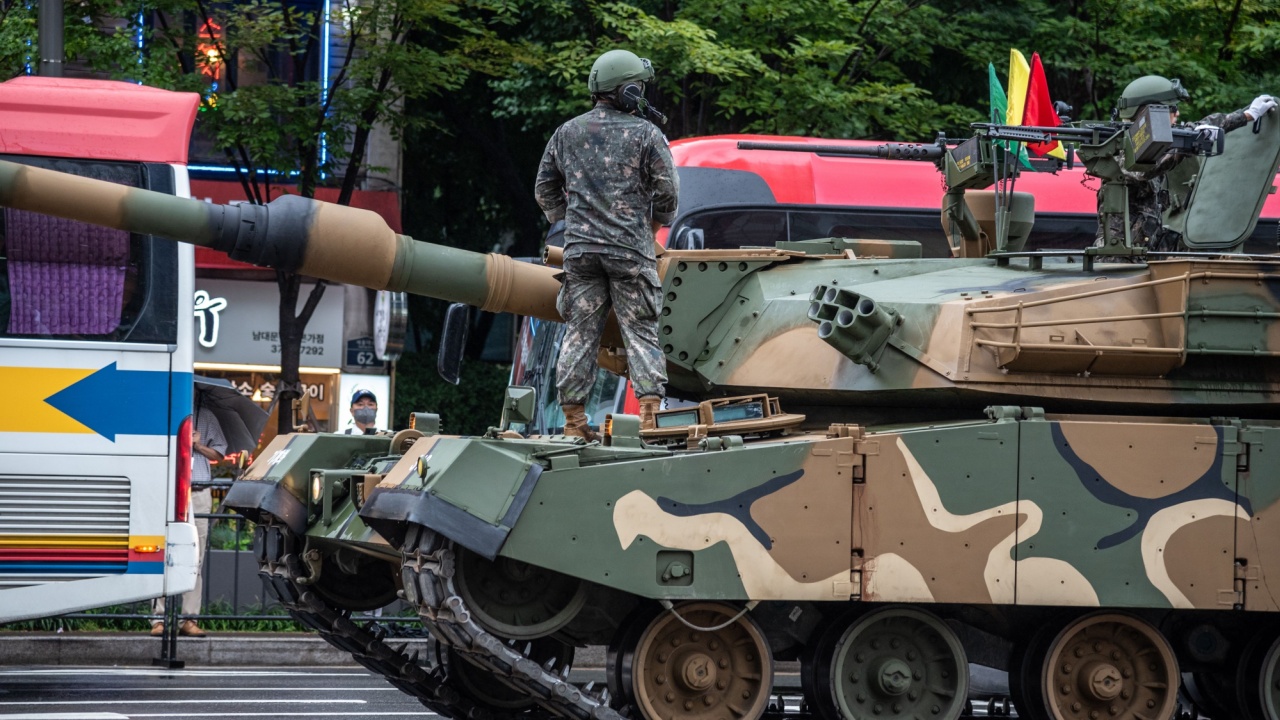
Donald Trump’s administration has made it clear that it expects more military burden-sharing from South Korea.
The much-awaited release of the Donald Trump administration’s National Defense Strategy (NDS) signals some interesting changes underway on the Korean Peninsula. The Department of Defense document signals a shift toward a more asymmetric alliance, in which South Korea assumes greater responsibility for the defense of the peninsula. At the same time, the United States narrows its regional military role within a broader strategy of selective engagement.
The most recent NDS follows the National Security Strategy (NSS) released in December and the State Department’s Agency Strategic Plan (ASP). Taken together, these documents provide more clarity about the Trump administration’s approach to national security.
First, the NDS underscores a clear theme of American primacy and “peace through strength,” which were also highlighted in the previous documents. This implies continual investment in the US warfighting capability “to fight and win the nation’s necessary wars.”
Second, the United States’ geostrategic interests are being reprioritized. The NDS places the highest priority on securing the homeland and the Western Hemisphere, with less emphasis placed on Europe and Transatlantic relations, which have been a hallmark of US grand strategy since the end of World War II. The Indo-Pacific is still mentioned as an important region, but only in the context of deterring potential Chinese aggression.
Finally, the third important theme in the NDS is revitalizing the domestic defense industrial base, which primarily concerns the Department of Defense but was also identified as an important objective in both the NSS and the ASP.
All three dimensions of the NDS, coming on the heels of recent events in Venezuela and Greenland, provide some important implications for South Korea.
The Shifting US Role in the Korean Peninsula
First, American primacy and the geostrategic reordering of US interests suggest that US intervention in regions outside the Western Hemisphere will be limited. This is quite explicit in various parts of the document. Still, as it relates to South Korea, the statement is direct: “South Korea is capable of taking primary responsibility for deterring North Korea with critical but more limited US support.” The NDS also states that “this shift in the balance of responsibility is consistent with America’s interest in updating US force posture on the Korean Peninsula.” While it is yet unclear what this new force posture will look like, the main takeaway is that the new US strategy requires significant change from the status quo on the Korean Peninsula.
Already, there are telling signs from South Korea that signal this transition is already in motion. During the 57th Security Consultative Meeting (SCM) in Seoul in November 2025, South Korea committed to increasing its defense spending to 3.5 percent of GDP and assuming a leading role in the defense of the Korean Peninsula. An important aspect of this announcement was the agreement to proceed with the transfer of wartime operational control (OPCON).
OPCON refers to the authority to command and direct military forces during wartime operations on the Korean Peninsula, a role currently exercised by a US-led Combined Forces Command (CFC). The CFC is commanded by a US four-star general, who also serves as the commander of US Forces Korea (USFK), and OPCON transfer would shift wartime command authority to a South Korean-led command while preserving the combined US–ROK military structure and the US commitment to defend South Korea.
Increasing South Korea’s Domestic Defense Industrial Capacity
Another dimension of equal significance is the stated desire to revamp domestic defense industrial capacity. According to the latest SIPRI arms revenue data, South Korea’s four largest defense industrial companies (ie, Hanwha Group, LIG Nex1, Korean Aerospace Industries, and Hyundai Rotem) accounted for over $14 billion of revenue in 2024. That is only the second in the region, behind China, which stands at over $88 billion. South Korea became the 10th-largest arms exporter in the world in 2023 and aims to be the fourth-largest by 2030.
One way to achieve this goal is not only to expand South Korea’s domestic defense industrial capacity but also to adopt a localization strategy by becoming a “trusted sovereign capability partner” for the importing nation. The Hanwha Group, for instance, has already made numerous commitments totaling above $6 billion to establish various defense industrial facilities in the United States, ranging from artillery to naval ships. Expanding the type and scale of defense industrial cooperation is one way to remake the alliance.
The US-China Factor
Finally, the NDS also signals an interesting approach to China that could have important implications for Seoul’s relations with Beijing. As hinted by some Korea observers, bilateral relations between South Korea and China appear to be mediated by US-China relations given that the last South Korean presidential visit by President Moon Jae-in to Beijing in December 2019 was about the same time that relations between China and the United States was on a rebound with the announcement of a tentative Phase One Trade deal, which was subsequently signed in January 2020.
There was no follow-up summit after December 2019 until a recent US-China deal announcement on the sidelines of APEC in Gyeongju. For now, the NDS states that the United States will seek “strategic stability” with China but “reinforce deterrence by denial” along the First Island Chain. South Korea’s diplomatic relations with Beijing and the implications for security in the western maritime domain of the peninsula may be conditioned by how relations between Washington and Beijing develop.
The new US strategic guidance for the Pentagon answers many questions that arose after the NSS was released in December. The implication for South Korea is that the US posture on the Korean Peninsula will likely undergo significant change, starting with a steady push towards OPCON transfer. South Korea, like other allies, will be asked to shoulder more of the burden in defending its own backyard while the United States maintains its primary focus on securing the homeland and the Western Hemisphere, as well as strengthening deterrence by denial in the Indo-Pacific.
The 70-year-old US-ROK alliance has reached a critical juncture. While the alliance has maintained peace and stability on the peninsula since the signing of the armistice in 1953, it will now be asked to adapt and evolve with the changing times. How South Korea navigates this transition—strategically, operationally, industrially, and diplomatically—will shape not only the future of the alliance, but also the security architecture of Northeast Asia.
About the Author: J. James Kim
J. James Kim is the director of the Korea Program at the Stimson Center. He also serves as a lecturer in the Executive Master’s of Public Policy and Administration Program at Columbia University. Previously, he was the director of public opinion at the Korea Economic Institute, senior research fellow, and director of the Center for Regional Studies and the Center for Public Opinion Research at the Asan Institute for Policy Studies in Seoul, South Korea, where he also directed the institute’s Washington, DC office. Dr. Kim earned a BS and MS in Industrial and Labor Relations from Cornell University and a PhD in Political Science from Columbia University.
Image: Mirko Kuzmanovic / Shutterstock.com.