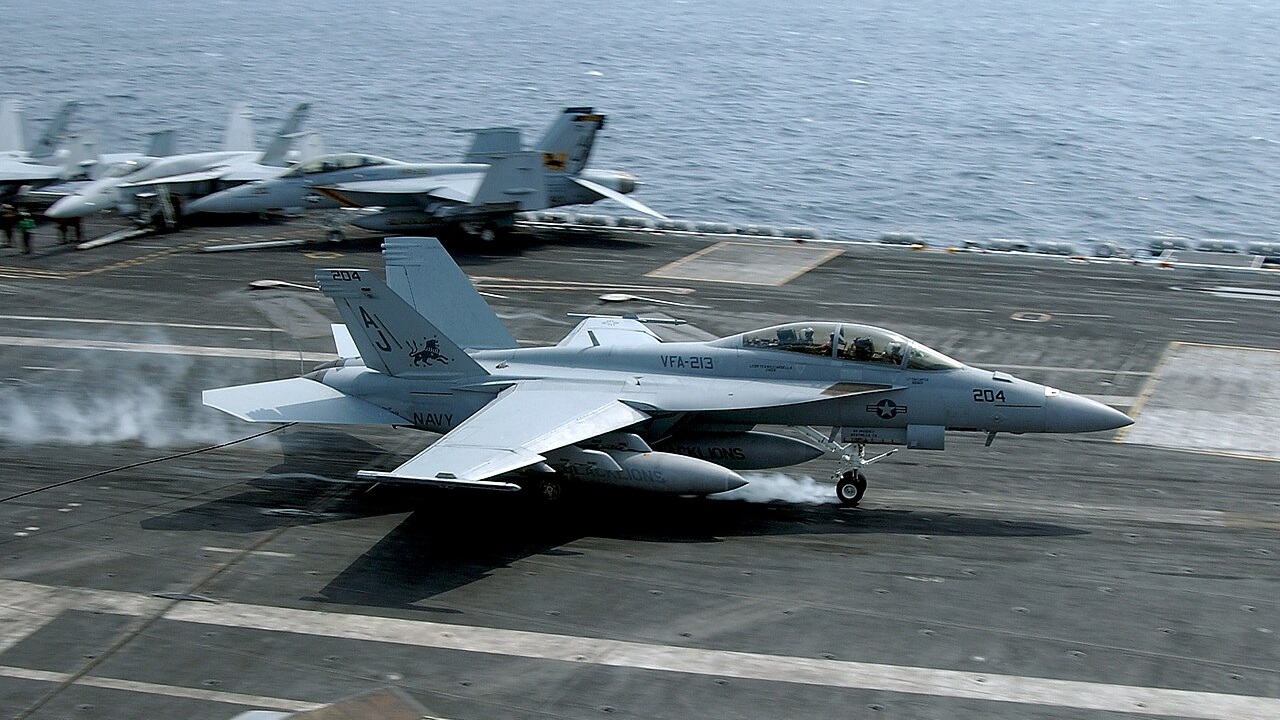
As the US Navy transitioned away from specialized fighter aircraft, it systematically overhauled the F/A-18 to serve in multiple roles—creating the new Super Hornet.
The transition from the original F/A-18A/B/C/D Hornet to the F/A-18E/F Super Hornet constituted a deeply consequential evolution in aviation technology. Although both aircraft are ostensibly the same, the Super Hornet is essentially a new aircraft—bigger, better, stronger, a direct correction of the limitations that had begun to hamper the original Hornet as early as the 1990s.
F/A-18 Hornet vs. Super Hornet: A Hornet-to-Hornet Comparison
| Aircraft | F/A-18A/B/C/D Hornet | F/A-18E/F Super Hornet |
| Year Introduced | 1983 | 1999 |
| Number Built | 1,480+ (all variants) | 600+ (including exports) |
| Length | 56 ft (17.1 m) | 60.3 ft (18.5 m) |
| Wingspan | 40 ft (12.3 m) | 44.9 ft (13.6 m) |
| Weight (MTOW) | ~51,900 lb (23,500 kg) | ~66,000 lb (29,900 kg) |
| Engines | Two GE F404-GE-402 afterburning turbofans (~17,700 lbf total thrust) | Two GE F414-GE-400 afterburning turbofans (~44,000 lbf total thrust) |
| Top Speed | ~1,190 mph (1,915 km/h) / Mach 1.8 | ~1,190 mph (1,915 km/h) / Mach 1.8 |
| Combat Radius | ~400 nmi (460 mi, 740 km) | ~500 nmi (575 mi, 926 km) |
| Service Ceiling | 50,000 ft (15,200 m) | 50,000 ft (15,200 m) |
| Loadout | ~13,700 lb (6,214 kg) payload capacity; incudes AIM-9, AIM-7, AIM-120, unguided/laser-guided bombs, AGM-65, HARMs | ~17,750 lb () payload capacity; includes AIM-9X, AIM-120D, JSOW, JDAM, Harpoon, HARM, future LRASM integration |
| Aircrew | 1–2, depending on variant | 1–2, depending on variant |
The F/A-18 Hornet’s History
The original F/A-18 Hornet entered service in the early 1980s. Designed as a lightweight and affordable multirole fighter, the F/A-18 derived from the YF-17 platform (which lost the Air Force’s LWF bid to the YF-16 before earning the attention of the Navy). The F/A-18 was valued for its versatility, the ability to perform both fleet defense and strike missions, excelling with respect to reliability, agility, and ease of maintenance.
By the late 1980s, however, problems with the original Hornet had already started to appear. Namely, the aircraft lacked range—a critical weakness in maritime operations where distances are vast and tanking resources limited. The Hornet also had limited internal fuel capacity, modest payload, and a relatively small radar aperture. And with the Navy phasing out role-specific aircraft, i.e. the A-6 Intruder, F-14 Tomcat, A-7 Corsair, the Navy needed a single platform that could assume multiple roles, filling the vacuum for retiring discreet fighter/attack aircraft.
Following a string of upgrades, the Super Hornet entered service in 1999, offering the Navy a solution to the multirole vacuum, and the shortcomings of the original Hornet.
How the Super Hornet Improved on the Original
Although the aircraft looked quite similar to legacy models, the new Super Hornet was 20 percent larger, with a 25 percent increase in wing area and a significantly expanded fuselage that could hold 33 percent more internal fuel—thereby significantly extending its range. The Super Hornet’s new combat radius was more than 100 miles wider, allowing for greater time on station for strike and air superiority missions. The larger wings also allowed for an increased payload capacity and improved high-angle-of-attack handling.
The new airframe was also upgraded to prioritize survivability with a reduced radar cross section; more powerful engines, a reinforced structure and landing gear, and greater internal space for avionics growth. Meanwhile, its radar, originally the APG-73, was replaced with the AESA APG-79—giving the Super Hornet a massive leap in target detection, tracking, jamming resistance, and sensor fusion.
The Super Hornet also addressed the maintenance issues that had plagued the original Hornet. While easy to maintain, the Hornet had a shorter lifespan owing to the smaller airframe. And, incorporating lessons learned from the original, the Super Hornet was made with 40 percent fewer parts, easier access panels, and structural improvements intended to reduce man-hours per flight. In the spirit of versatility, the Super Hornet became a modular platform, allowing for specialized variants like the EA-18G Growler, which replaced the EA-6B Prowler as the Navy’s electronic attack aircraft.
In short, the Super Hornet preserved the original Hornet’s strengths while addressing its weaknesses. With increased range, payload, and survivability, the Super Hornet gave the Navy a durable and adaptable multirole fighter for the age of role consolidation.
More than two decades later, the Super Hornet remains a pillar of naval air power—but its end is in sight. Lacking stealth features, the Super Hornet is ill-suited for great power competition, particularly against China’s layered A2/AD defense networks in the Indo-Pacific. The Navy is already working on a replacement, the F/A-XX, expected sometime in the 2030s.
About the Author: Harrison Kass
Harrison Kass is a senior defense and national security writer at The National Interest. Kass is an attorney and former political candidate who joined the US Air Force as a pilot trainee before being medically discharged. He focuses on military strategy, aerospace, and global security affairs. He holds a JD from the University of Oregon and a master’s in Global Journalism and International Relations from NYU.
Image: Wikimedia Commons.