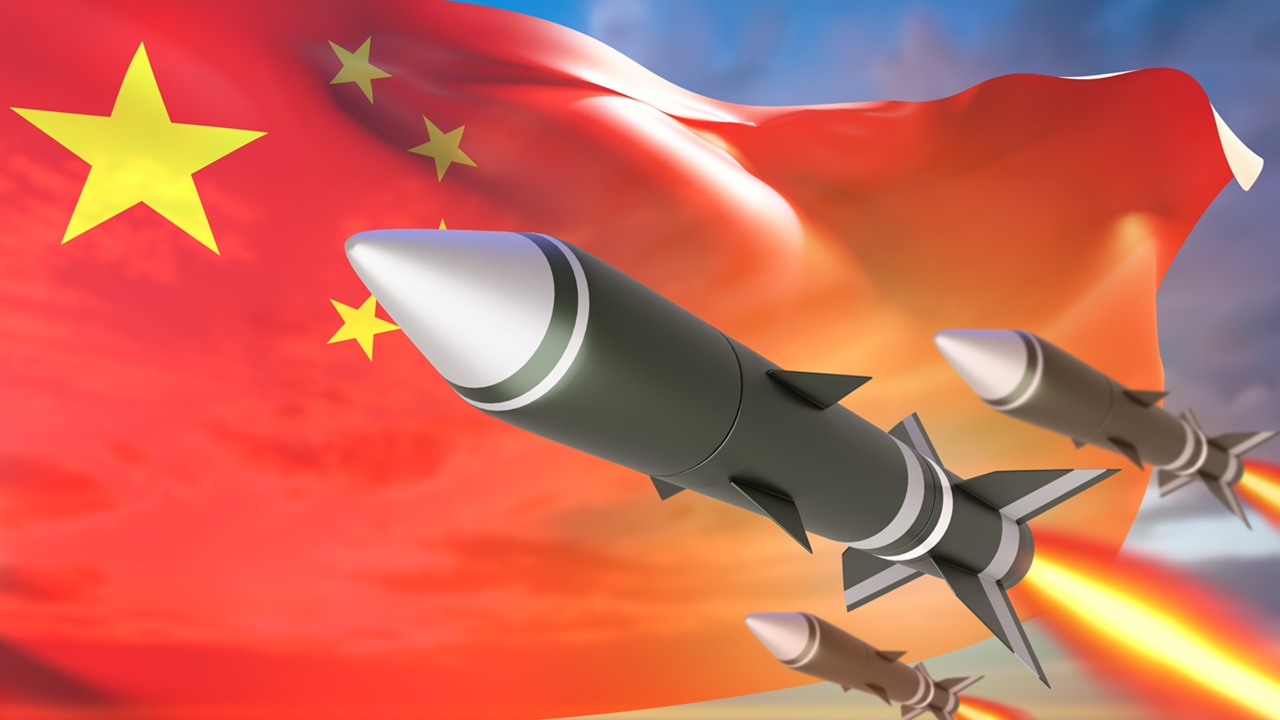
China has combined many different military systems into a dense defense network near its shores, creating a nearly impenetrable barrier for the US military.
China’s Anti-Access/Area-Denial (A2/AD) network is one of the most sophisticated and comprehensive military architectures in the world.
The network’s purpose is simple, yet carries profound implications for the global order: it is designed to make US military operations near China’s borders dangerous, expensive, and ineffective. The network does not rely on a single system, but on a multi-layered web of systems, across domains, which integrates long-range missiles, radars, aircraft, submarines, satellites, cyber tools, and electronic warfare platforms into one of the most capable defensive shields on earth.
At the core of the A2/AD network are long-range ballistic and cruise missiles, which give China striking ability. Systems like the DF-21D “carrier killer” and DF-26 “Guam killer” are designed to threaten large US warships—notably including aircraft carriers—at ranges previously thought unreachable. The effect is to push back US forces, making power projection into the Indo-Pacific more difficult and shifting the regional power balance towards China’s favor. Complementing the long-range missiles are mid-range cruise missiles including the YJ-12 and YJ-18, capable of high-speed terminal maneuvers and saturation attacks. Finally, China’s land-attack cruise missile, the CJ-10, extends its denial zone even further.
The missile systems rely upon data from a network of over-the-horizon (OTH) radars that can accurately monitor maritime activity thousands of kilometers away. Paired with China’s growing constellation of ISR satellites—including electro-optical, synthetic aperture radar, and electronic intelligence platforms—these systems provide wide-area detection, tracking, and fire-control-quality information. This web of satellites and radars is essential to making China’s long-range missiles effective.
Another layer of the A2/AD web is China’s integrated air-defense system. Long-range SAMs, including the domestically-built HQ-9B and Russian-imported S-400, create a dense missile shield along the coastline, backed by short- and medium-range interceptors that protect key sectors. This air defense system makes US aircraft operations inside China airspace extremely difficult without stealth or electronic warfare assets.
In the air, China employs a mix of stealth and non-stealth fighter jets, typically armed with long-range PL-15 air-to-air missiles, to enhance the A2/AD perimeter. The J-20 Mighty Dragon is the centerpiece of this effort, serving as a long-range interceptor optimized for targeting high-value US enablers like AWACS and tankers. Backed by workhorse fighters like the J-16, the PLAAF can push US aircraft farther from the Chinese border.
In the South and East China Seas and the Pacific Ocean, the A2/AD system is reinforced through sea vessels. Type 055 cruisers and Type 052D destroyers carry long-range surface-to-air and anti-ship missiles while Yuan-class diesel-electric submarines and Shang-class nuclear attack submarines threaten US vessels from beneath the surface. Coastal defense batteries equipped with YJ-12B and YJ-62 missiles create additional layers of anti-ship capability along Chinese littoral regions.
Last, cyber and electronic warfare elements are integrated into the network. China fields extensive cyber warfare units, capable of attacking networks, logistics systems, and communications. Long-range jammers, airborne EQ aircraft like the J-16D, maritime EQ platforms, and GPS spoofing systems are designed to blind adversary sensors, disrupt targeting, and degrade US command-and-control.
Taken together, these pieces form a hardened and redundant network, a multi-domain kill web that makes US intervention costly, thereby granting China credible deterrence, and ultimately muting US power projection in the Indo-Pacific.
About the Author: Harrison Kass
Harrison Kass is a senior defense and national security writer at The National Interest. Kass is an attorney and former political candidate who joined the US Air Force as a pilot trainee before being medically discharged. He focuses on military strategy, aerospace, and global security affairs. He holds a JD from the University of Oregon and a master’s in Global Journalism and International Relations from NYU.
Image: Shutterstock / FOTOGRIN.