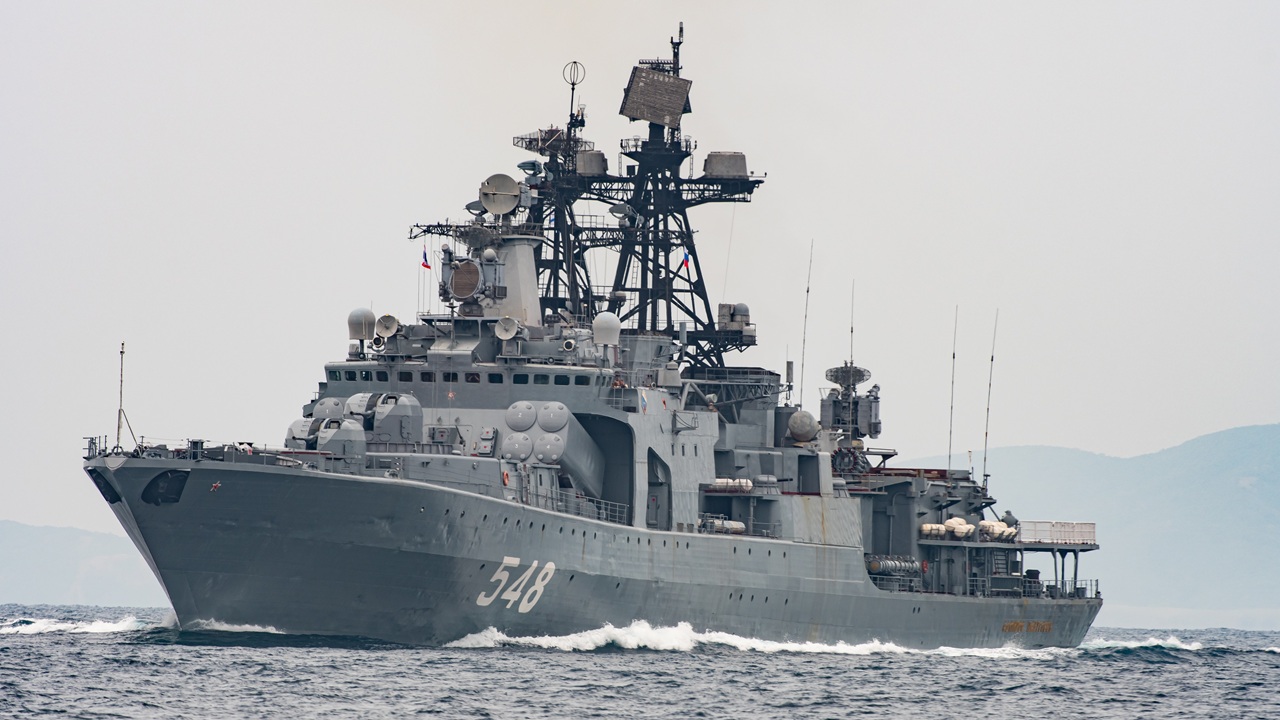
Russia’s Marshal Shaposhnikov Udaloy-class destroyer stopped in Vietnam on its way back to Vladivostok, the home base of Russia’s Pacific Fleet.
A Russian Navy frigate made a scheduled port visit to Vietnam—the first such visit by a Russian warship to the Asian country this year. However, given the ongoing conflict between the United States and Iran, it is unclear where the modernized Udaloy-class anti-submarine guided-missile frigate might head next.
“The Pacific Fleet frigate Marshal Shaposhnikov made a business call at the port of Cam Ranh in the Socialist Republic of Vietnam as part of a long-distance voyage. Representatives of the Russian Embassy in Vietnam and the Vietnamese Naval Base Command met the Russian sailors on arrival,” the Russian Ministry of Defense announced.
The Project 1155 Fregat (Russian for “Frigate”) Udaloy-class warship departed from the Russian Navy’s Pacific Fleet homeport of Vladivostok on October 1, 2025, and recently “represented the Russian Navy” at the Indian Navy’s MILAN 2026 multinational naval exercises in the Indian Ocean, Russian state news agency TASS reported.
The Iranian Navy frigate IRIS Dena, which was sunk by a US Navy submarine earlier this week, had also taken part in those naval exercises.
About Russia’s Udaloy-Class Destroyer
- Year Introduced: 1977
- Number Built: 13 (8 remaining in service)
- Length: 163 m (535 ft)
- Beam: 19.3 m (63 ft)
- Displacement: 6,930 tons (standard) and 7,570 tons (full load)
- Propulsion: COGAG (Combined Gas and Gas) system with four gas turbines producing 120,000 hp
- Top Speed: Up to 35 knots (64.8 km/h)
- Range: 10,500 nautical miles at 14 knots
- Armaments:
- Anti-ship/Anti-submarine missiles: 8 x SS-N-14 Silex missiles
- Surface-to-air missiles: 64 x SA-N-9 Gauntlet missiles in 8 x 8-round vertical launching system (VLS) cells
- Guns: Two 100mm/L70 dual-purpose naval guns
- CIWS: 4 x 30mm AK-630 guns
- Torpedo tubes: 2 x 21-inch (533 mm) quad-fire torpedo tubes
- Anti-submarine rockets: 2 x RBU-6000 rocket launchers
- Crew: Approximately 300
The Udaloy-class destroyers were developed in the latter stages of the Cold War as anti-submarine warfare (ASW) vessels. Eight of the frigates remain in active service—though none of them are stationed in the Black Sea, and they are therefore locked out of the ongoing Ukraine War.
Other Russian Warships Are Also on the Move
TASS also reported that multiple other Pacific Fleet vessels have been deployed. That included the Project 636.3 (Improved Kilo-class) diesel-electric submarine Petropavlovsk-Kamchatsky, the Project 20380 Steregushchiy-class corvette Gromky, and the Project 23470 seagoing tug Andrey Stepanov.
The flotilla “set course for the Korea Strait to conduct long-range missions in the Asia-Pacific region,” according to the state news agency. In addition, “a detachment of ships, consisting of the corvettes Sovershenny and Rezky, is also currently operating in Asia-Pacific waters, supporting the tanker Pechenga.”
The Russian Navy’s Pacific Fleet remains the second-most capable force of its five major naval fleets, after only the Northern Fleet. It has been a key component of the Kremlin’s aggressive modernization, and current analysis suggests it operates approximately 260 total units, including coastal vessels with around 65 surface combatants. However, it also maintains around two dozen nuclear and conventional submarines.
The flagship of the Pacific Fleet is the Slava-class guided-missile Varyag (formerly the Chervona Ukrainia or Red Ukraine).
The Pacific Fleet was first established in 1731 as a branch of the Imperial Russian Navy, known as the Okhotsk Military Flotilla. Rebuilding the Pacific Fleet has been a priority for Russia in recent years, even as it has continued to face many of the same maritime challenges that plagued the Soviet Union during the Cold War.
The key port facility at Vladivostok frequently freezes over in the winter, and conducting year-round naval operations requires the use of large icebreakers. Yet the ice cover does provide a certain tactical advantage for the submarines of the Pacific Fleet, as they can depart and return to the naval base undetected.
The warming conditions in the Arctic have extended the period of ice-free conditions. In addition, while the Pacific Fleet headquarters is at the closed city of Forkino in Primorsky Krai, near Vladivostok, operations are also carried out from Petropavlovsk-Kamchatsky.
About the Author: Peter Suciu
Peter Suciu has contributed to dozens of newspapers, magazines, and websites over a 30-year career in journalism. He regularly writes about military hardware, firearms history, cybersecurity, politics, and international affairs. Peter is also a contributing writer for Forbes and Clearance Jobs. He is based in Michigan. You can follow him on Twitter: @PeterSuciu. You can email the author: [email protected].