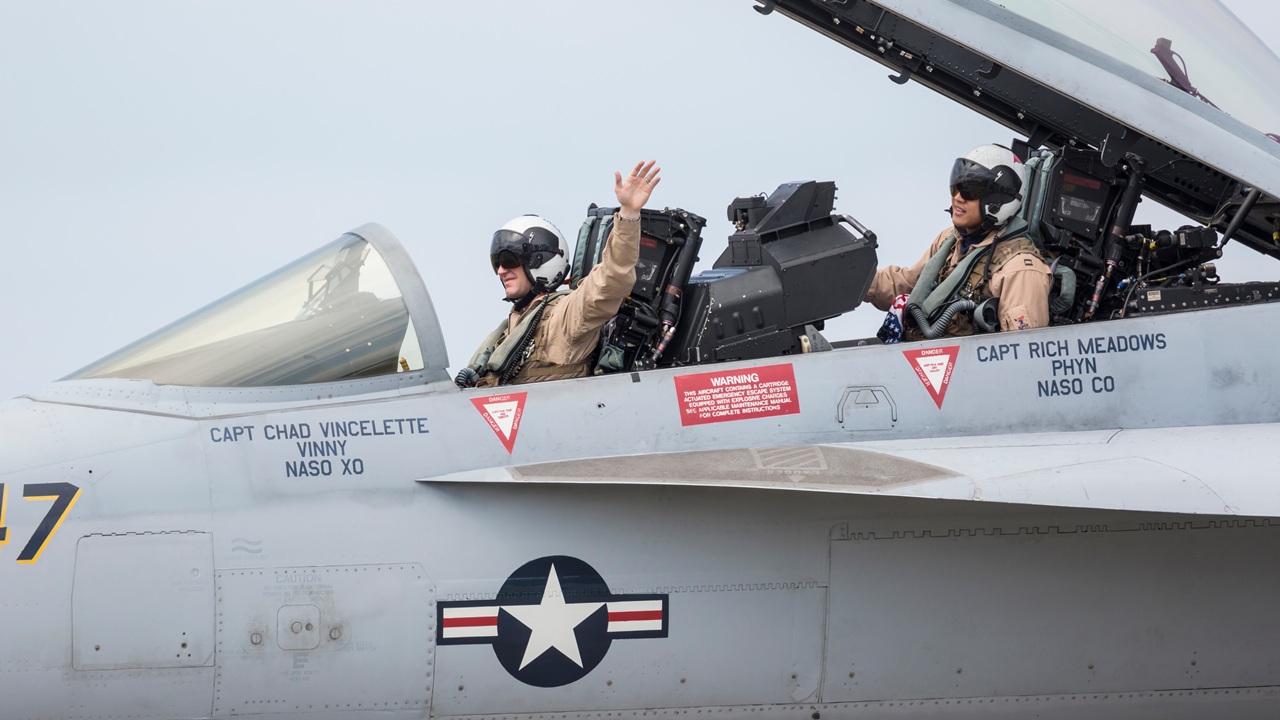
A modern fighter jet’s weapons systems officer is responsible for monitoring sensor data, operating weapons, and conducting electronic warfare.
In Top Gun, Anthony Edward’s lovable character Goose is portrayed as a sort of sidekick to Tom Cruise’s Maverick—secondary to the pilot in importance. In reality, the backseater is an equally essential member of any fighter jet’s crew. Modern aircraft—including the F-14, F-15E, and F/A-18F—all rely on a second crew member. But the backseater is not a passenger, or a “beta” to the pilot; they are deeply responsible for mission outcomes, with control over weapons, sensors, navigation, communication, electronic warfare, and mission management.
Why Do Some Fighter Jets Have Two Seats?
The early jet fighters were rudimentary relative to today’s models, lacking integrated sensors, requiring a second set of hands for managing the radar, navigation, radios, and weapons. This became a problem starting in the mid-1960s, when radar systems were big and analog and manpower-intensive. A pilot could not fly the aircraft and operate the increasingly complex avionics simultaneously.
Accodingly, aircraft like the F-4 and F-14 were designed around a division of labor—a pilot up front to control the aircraft, and a Radar Intercept Officer (RIO) or Weapons Systems Officer (WSO) in the back to control the aircraft’s systems. Even today, despite advancements in pilot-aircraft integration, many advanced aircraft retain a backseater because missions have grown more complex, requiring double the cognitive bandwidth.
While the Pilot Flies the Plane, the Backseater Fights
The backseater has a variety of responsibilities, all integral to mission success. The most important among these is sensor management. The backseater is responsible for operating radar modes, tracking multiple aircraft, managing infrared and optical sensors, and generally scanning for threats and organizing the battle space picture. When weapons are needed, the backseater selects, targets, and guides the weapon. Often he or she controls laser designation for strikes, or programs GPS weapons. In other words, it is the backseater that often performs the fighter jet’s most lethal functions.
As warfare gradually migrates to the cyber-electronic spectrum, the backseater will only grow in importance; his or her mission has expanded to detecting and identifying enemy radars, jamming threats, and managing countermeasures such as chaff, flares, and towed decoys. Basically, the fighter jet’s entire EW function falls to the backseater.
Navigation also falls to the backseater, who monitors flight path, timing, and fuel planning, coordinates air-to-air refueling, and ensures complex strike packages stay synchronized. The backseater also runs point on communications, handling the multi-band radios, coordinating with AWACS, tankers, and joint units, and managing link systems like the Link-16. Basically, the backseater is responsible for tactical management, maintaining big picture awareness while the pilot focuses on the task of flying the actual aircraft.
In Air Warfare, Two Heads Are Better than One
Ultimately, the backseater allows for division of labor in high-stress combat. This allows the pilot to focus on flying, maneuvering, energy management, etc. The backseater serves instead as the battlefield brain of the aircraft. This increases survivability because one person is always scanning the threat picture. This also enables long-duration missions—increasingly important as the US pivots towards the expansive Indo-Pacific—where one crew member can rest or rotate tasks.
There are, of course, drawbacks to having a second person in the cockpit. The airframe is heavier when it must accommodate two people, while fuel and payload capacity is diminished. The aircraft is also more expensive to maintain. And two-seat cockpits complicate stealth shaping, a downside in air conflict between peer nations.
Adding a backseater also increases the training burden, requiring twice the manpower and twice the training pipeline. And of course, adding the backseater requires that two people work together as one—sometimes easier said than done. But still, for many platforms, the tradeoffs are worth the benefits; a backseater is still seen as essential, increasingly important as missions grow more complex.
About the Author: Harrison Kass
Harrison Kass is a senior defense and national security writer at The National Interest. Kass is an attorney and former political candidate who joined the US Air Force as a pilot trainee before being medically discharged. He focuses on military strategy, aerospace, and global security affairs. He holds a JD from the University of Oregon and a master’s in Global Journalism and International Relations from NYU.
Image: Shutterstock / BlueBarronPhoto.